
Here, his daughter, JO SINGH, shares some of the images and an interview she did with Jerry before he passed away this year.
The idea of putting together an exhibition of my dad’s photography began a few years ago after numerous responses I was receiving in local Facebook groups. He was extremely humbled and often surprised at the feedback I gave him about his skills with a camera!
When one of his images enabled someone to connect with a friend from the past or recognise someone it really touched me. Dad and I decided that I would choose the photos to include and he would write some words to explain a little more than just the place and date. Sadly we never did get the project together before he passed away in April, but so many have given me inspiration to continue and find funding and a venue for an exhibition. There’s a lot of support from people wanting to see his work exhibited.
Ann Place near Little Horton, 1973 (Image: Jerry Smith)
These photographs, from the 1970s, show how Dad used his love of photography within his work as a housing officer, and was dedicated to improving people’s lives and living environments.
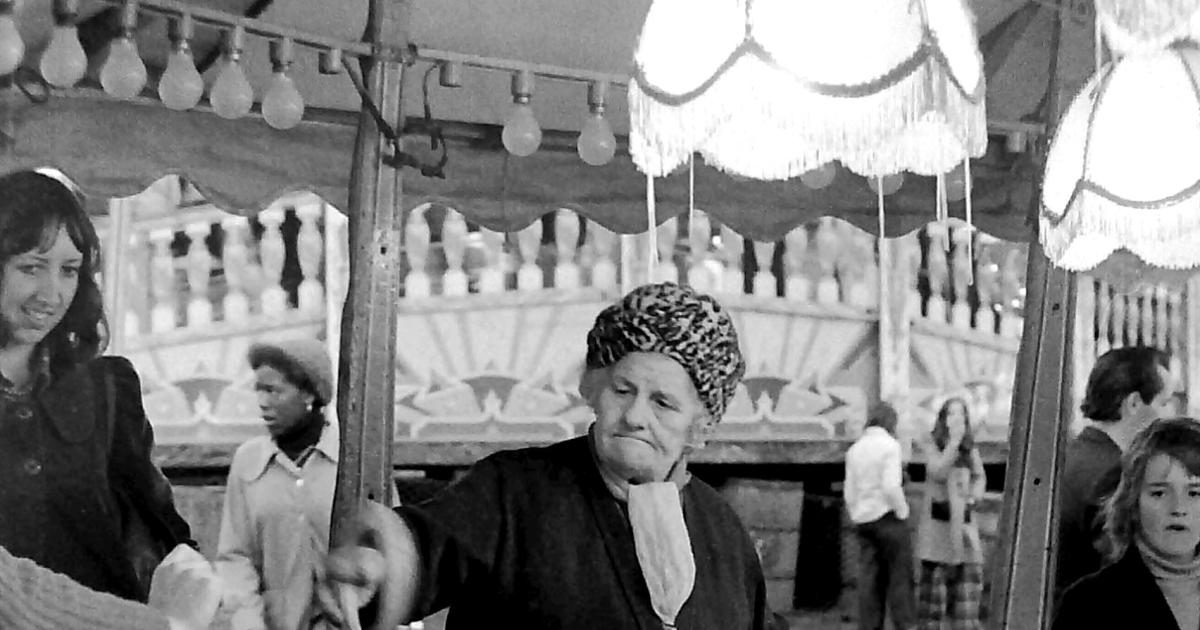
Stallholder at Manningham Fair, Lister Park, in 1974
Dad passed away peacefully in Sri Lanka in his late seventies after a battle with cancer. He lived in Bradford from 1972-1978 and worked at the Buttershaw Community Project. He later did an MA in Applied Social Studies at Bradford University. He lived in Hebden Bridge from 1986-2015, then in Sri Lanka where he and his wife built and ran a guest house called Jungle Tide. This is my Q&A with Dad:
* How did you first become interested in photography?
“Quick answer: steam trains. As a teenager in the 60s I loved the sight and sound of these giants and was aware, with an almost tragical sense, of their impending demise. I set about recording as much as I could, which meant travelling greater distances from my Somerset home, usually with a friend and without my parents’ knowledge. They thought I was trainspotting on Bridgwater station when in fact I was trespassing around some engine shed in Cardiff, Bristol or Birmingham, grabbing photos and trying not to be caught. Sadly, none of those photos now exist. I lost all the negatives when I was robbed in Manchester in 1969 and the prints have perished.”
* How did you learn about photography when you were young?
“One of my school friends and a fellow railway enthusiast was scientifically inclined, and together we built an enlarger and pooled pocket money for darkroom equipment. We taught ourselves black and white processing and experimented with techniques such as solarisation. Later, at university, I started to read photography magazines, especially Creative Camera, and got a huge amount of inspiration from them as well as from fellow students.”
The much-loved Kashmir Restaurant, June 1973 (Image: Jerry Smith)
* What was your first camera? And your favourite one?
“ I did have the ubiquitous Box Brownie when I was 12 or so, and in my railway days a few years later graduated to a cheap 35mm camera. But the camera I came to love as a student and for years afterwards was a Zeiss with waist-level viewfinder. I just adored the way that type of camera inspired one to focus and compose in every sense of both words, to think before pressing the shutter. Perfect for the landscapes I was mainly interested in taking.”
The Fleece, 1975. ‘I like the fashions, the car and the dog in the upstairs window!’ says Jo (Image: Jerry Smith)
* Who were your main influences at the time of your Bradford photographs?
“Of the big names at the time, probably Henri Cartier-Bresson, Robert Frank and Bill Brandt. But I was (and am) also massively influenced by the work of two photographers roughly my own age but immensely more talented – Daniel Meadows and Martin Parr.”
* Why did you concentrate on landscapes?
“Partly because they behave themselves and don’t make life difficult for the photographer, unlike people. One can take one’s time. But also because once I’d said my goodbyes to the steam trains a similar fascination took over with urban decay and dereliction, and the sometimes monstrous things we were putting in place of old buildings. That said, I think many of my best pictures do involve people, but they are pictures of human interactions with landscape, rather than people or of landscape pure and simple.”
Wardley House, 1973 (Image: Jerry Smith)
* Tell me more about the Buttershaw photographs.
“They were mostly taken as part of my community work, either recording things that community activists or kids on the estate were doing with our help, or to support campaigns around housing especially. I don’t rate them much in terms of creative photography, though looking back they do capture something interesting about the way life was lived on a council estate in the 1970s.”
* How about now? Are you still as keen on photography?
“Yes. But not so serious as when I was younger. Like most amateurs I have a digital SLR whose technical potential I’ve barely scratched the surface of. And I still take pictures as though my camera contained valuable film – in other words, I try to think hard before pressing the shutter, even though of course I could take multiple photos and delete almost all of them later. Maybe delusional, but it feels like good photographic discipline all the same.”
* These photographs include one of Dad’s many from Buttershaw where he worked – this main image of people working together is great, especially with the long brushes.
The old Kashmir is a place many Bradfordians remember and has prompted many memories on Facebook.
The woman at Manningham Fair is a wonderful capture of times at this fair. He took other great pictures at this event.
In The Fleece photo I like the mixture of fashion, cars and the dog in the upper window!
In the photo of Ann Place near Little Horton, the kids skipping has become a classic and a favourite of my dad’s photographs – it’s something you don’t see in the streets nowadays.
In ‘Wardley House’ the now demolished Chester Street Bus Station is reflected in the window. I love that the women stand together, with one man stood away.