

UK Lighting Market Size
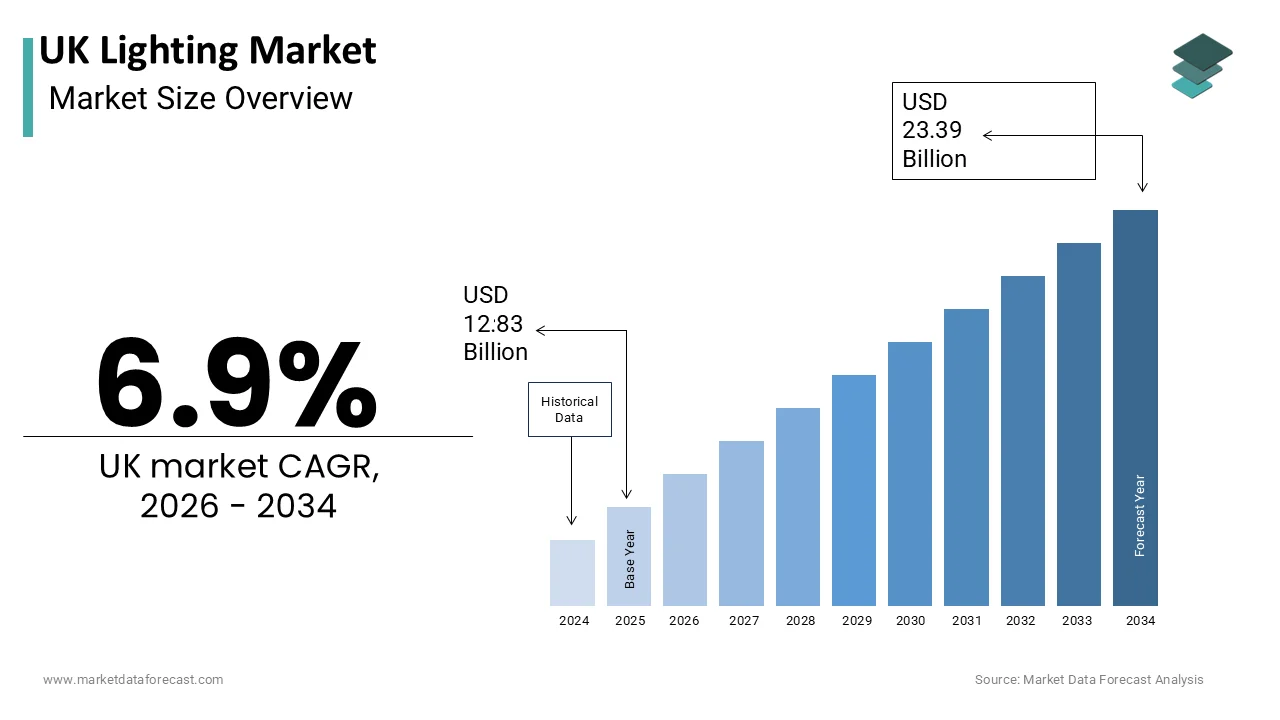
The UK lighting market was valued at USD 12.83 billion in 2025 and is estimated to reach USD 13.71 billion in 2026. The market is projected to grow to USD 23.39 billion by 2034, registering a CAGR of 6.9% during the forecast period from 2026 to 2034.
According to the Department for Business, Energy and Industrial Strategy, lighting accounts for approximately 15% of total electricity consumption in commercial buildings, making it a critical focus area for energy reduction strategies. The UK housing stock includes around 28 million dwellings, many of which are undergoing retrofitting to meet modern energy performance certificates. As per the Office for National Statistics, household expenditure on housing and utilities has risen significantly, prompting consumers to seek long-term cost-saving measures through efficient lighting upgrades. Furthermore, the construction industry contributes roughly 6% to the national gross domestic product, providing a robust foundation for new installations. Regulatory frameworks such as the Ecodesign for Energy-Related Products Regulations mandate strict efficiency standards, phasing out less efficient technologies. The market is also influenced by growing awareness of human-centric lighting, which aligns artificial light with circadian rhythms to improve well-being. This convergence of regulatory pressure, economic necessity, and technological innovation defines the current landscape of the UK lighting industry.
MARKET DRIVERS Stringent Government Energy Efficiency Regulations Drive LED Adoption
The implementation of rigorous government regulations is one of the major factors propelling the growth of the UK lighting market. The Ecodesign for Energy-Related Products Regulations have systematically phased out inefficient light sources, compelling manufacturers and consumers to transition to light-emitting diode technology. According to the Department for Business, Energy and Industrial Strategy, these regulations have resulted in the removal of millions of halogen and fluorescent lamps from the market annually. The mandate requires that new lighting products meet specific efficacy thresholds, ensuring that only high-performance options are available for purchase. Data from the Energy Saving Trust indicates that replacing traditional bulbs with LEDs can reduce lighting energy consumption by up to 80%, offering substantial savings for both households and businesses. As per the Ministry of Housing, Communities and Local Government, approximately 1 million private rented homes fall below the Minimum Energy Efficiency Standards threshold, creating a significant retrofit market as landlords must achieve an E rating or higher. Additionally, public sector bodies are required to adhere to strict carbon reduction targets, leading to large-scale street lighting replacement projects. According to the Local Government Association, local councils have reported saving up to 40% on energy bills after switching to LED street lights. These regulatory pressures ensure that efficiency is not merely an optional upgrade but a compliance necessity, sustaining consistent demand for advanced lighting technologies throughout the nation.
Rising Electricity Costs Accelerate Consumer Investment in Efficient Solutions
Escalating energy prices have fundamentally altered consumer behavior and are prompting a surge in voluntary lighting upgrades as households and businesses seek to mitigate utility expenses, which is further boosting the expansion of the UK lighting market. The volatility in global energy markets has led to record-high electricity bills, with the price cap reaching unprecedented levels in recent years. According to Ofgem, the energy price cap for typical dual fuel customers rose to 2,500 pounds annually, forcing entities to prioritize energy conservation measures. According to data from the National Energy Action charity, proper lighting upgrades can save an average household up to 75 pounds per year on electricity costs, while commercial entities can see savings exceeding 1,000 pounds annually, depending on scale. These financial incentives drive significant market activity, particularly among small and medium enterprises that operate on tight margins. According to the Carbon Trust, nearly 65% of businesses consider energy efficiency improvements when planning renovations, with lighting ranking as a top priority due to its rapid return on investment. Furthermore, the psychological impact of energy insecurity has heightened awareness regarding operational costs. As per surveys conducted by YouGov, over 70% of UK residents express concern about their ability to afford utility bills during the intervening months. This anxiety translates into proactive spending on smart lighting controls and high efficacy LEDs, thereby expanding the market base beyond regulatory compliance to include genuine consumer-driven demand for economic resilience and cost management.
MARKET RESTRAINTS High Initial Costs of Smart Lighting Systems Restrain Mass Adoption
The substantial upfront financial outlay required for comprehensive smart lighting installations is impeding the UK lighting market growth, particularly among residential consumers and small businesses. While long-term savings are evident, the initial investment for intelligent fixtures, sensors, and control hubs can be prohibitive. According to the Federation of Master Builders, the average cost for installing a fully integrated smart lighting system in a three-bedroom house ranges from 1,500 to 3,000 pounds, depending on the complexity and brand choice. This expense is often beyond the immediate disposable income of many consumers, especially in the current economic climate characterized by inflationary pressures. According to the Construction Products Association, hardware costs constitute nearly 50% of the total project expense, further inflating the price point. Although some government grants exist for energy efficiency, they often exclude smart controls, leaving homeowners to finance the remainder. According to data from the Money Advice Service, 35% of UK adults have less than 1000 pounds in savings, limiting their capacity to undertake major home improvements without borrowing. As per the Bank of England, base rate increases have made credit more expensive, reducing the affordability of financed renovation projects. Consequently, many consumers delay or abandon smart lighting plans, opting for basic LED replacements instead. This financial constraint restricts the market growth to wealthier segments and commercial clients with larger capital budgets, leaving a large portion of the residential market without access to advanced lighting automation despite the clear long-term benefits.
Complexity of Integration and Interoperability Issues Hinder User Experience
The lack of standardization and interoperability among various smart lighting ecosystems, which complicates installation and user experience, is further hindering the lighting market expansion in the UK. Consumers often face difficulties integrating products from different manufacturers, leading to fragmented systems that require multiple apps and hubs. According to the Tech UK industry body, over 40% of smart home users report compatibility issues when attempting to connect lighting devices with existing home automation platforms. This fragmentation creates frustration and reduces consumer confidence in smart lighting technologies. According to data from the Consumer Council, complaints related to smart home device connectivity have risen by 25% in recent years, highlighting the severity of the issue. Additionally, the rapid pace of technological change renders some products obsolete quickly, discouraging investment in proprietary systems. As per the Institute of Engineering and Technology, the lack of open standards slows down innovation and increases development costs for manufacturers who must support multiple protocols. This complexity also poses challenges for professional installers, who require specialized training to handle diverse systems. The resulting uncertainty discourages mainstream adoption, as consumers prefer simple plug-and-play solutions over complex configurations. Until industry-wide standards are universally adopted, interoperability issues will continue to restrain the full potential of the smart lighting market in the UK.
MARKET OPPORTUNITIES Expansion of Human Centric Lighting in Healthcare and Education Sectors
The growing recognition of the impact of lighting on human health and productivity presents a significant opportunity for the UK lighting market, particularly in the healthcare and education sectors. Human-centric lighting systems adjust color temperature and intensity to mimic natural daylight cycles, supporting circadian rhythms and improving well-being. According to the British Standards Institution, proper lighting design can enhance patient recovery rates and staff alertness in healthcare facilities. The National Health Service has begun incorporating these principles into new hospital designs, creating a steady demand for tunable white lighting solutions. According to data from the Department for Education, schools with optimized lighting environments report a 15% improvement in student concentration and academic performance. This evidence drives investment in educational infrastructure upgrades, with local authorities prioritizing lighting retrofits in older school buildings. According to guidelines from the Health and Safety Executive, proper illumination is emphasized as critical for reducing eye strain and fatigue among workers, further boosting demand in office environments. As per the Well Building Institute, certifications that reward healthy lighting practices are gaining traction among commercial developers, encouraging the specification of advanced lighting systems. This trend allows manufacturers to differentiate their offerings based on health benefits rather than just energy efficiency, opening new revenue streams. By capitalizing on the wellness economy, companies can secure long-term contracts in institutional sectors that prioritize occupant health and productivity, thereby expanding the market scope beyond traditional functional illumination.
Growth of Smart City Initiatives Drives Demand for Connected Street Lighting
The expansion of smart city initiatives across the UK offers a substantial opportunity for the UK lighting market through the deployment of connected street lighting infrastructure. Municipalities are increasingly viewing street lights as platforms for broader urban data collection and management, integrating sensors for traffic monitoring, air quality measurement, and public safety. According to the Local Government Association, over 50 local councils have launched smart city pilots that include intelligent lighting networks as a core component. These systems allow for remote dimming and fault detection, reducing maintenance costs and energy consumption. According to data from the Department for Transport, smart street lighting can reduce municipal energy bills by up to 50%, providing a strong financial incentive for adoption. The integration of 5G technology further enhances the capabilities of these networks, enabling real-time data transmission and analysis. As per the Smart Cities Council, connected lighting infrastructure serves as the backbone for other smart services such as electric vehicle charging points and environmental monitoring stations. This multifunctional approach justifies the higher initial investment by delivering additional value to city operators. Manufacturers who offer comprehensive solutions, including hardware, software, and data analytics, are well-positioned to capture this growing market. By aligning with government digitalization strategies, lighting companies can participate in large-scale public sector projects that promise sustained growth and long-term service contracts.
MARKET CHALLENGES Supply Chain Volatility Disrupts Production and Increases Costs
Fluctuations in the global supply chain are a persistent challenge to the UK lighting market, which is affecting the availability and cost of critical components such as semiconductors and rare earth materials. Many lighting products rely on electronic drivers and chips that are subject to global shortages and logistical bottlenecks. According to the Confederation of British Industry, lead times for electronic components have extended by an average of 12 weeks during peak disruption periods, delaying product launches and order fulfillment. This instability translates into unpredictable production costs for manufacturers, who struggle to maintain consistent pricing for customers. The reliance on imports for key raw materials exposes the industry to geopolitical risks and trade barriers. According to data from the Office for National Statistics, import prices for electrical equipment have increased by 15% in recent years, forcing producers to pass these expenses onto consumers. Such price hikes can dampen demand, particularly among price-sensitive residential buyers. Furthermore, logistical disruptions caused by global events have led to shortages of packaging materials, further complicating distribution. As per the Logistics Manager Index, freight costs remain elevated compared to pre-pandemic levels, squeezing profit margins for distributors and retailers. These supply chain uncertainties make it difficult for companies to maintain optimal inventory levels and honor fixed price contracts, eroding trust with clients. The inability to predict costs accurately hampers long-term planning and investment in innovation, constraining the market’s ability to respond effectively to surging demand.
Rapid Technological Obsolescence Creates Inventory and Waste Challenges
The rapid pace of technological advancement in the lighting sector leads to frequent product obsolescence, which is further challenging the expansion of the UK lighting market. As new standards and features emerge, older models become outdated quickly, leaving retailers and distributors with unsellable stock. According to the Waste and Resources Action Programme, the electrical and electronic equipment sector generates significant waste, with lighting products contributing a notable portion due to their short lifecycle. The transition from analog to digital controls has rendered many legacy fixtures incompatible with modern smart systems, accelerating their replacement cycle. According to data from the Environmental Agency, recycling rates for lighting products remain below 40%, posing environmental and regulatory compliance issues for manufacturers. The introduction of new connectivity protocols, such as Matte,r requires continuous updates to product lines, increasing research and development costs. As per the Chartered Institute of Procurement and Supply, managing obsolete inventory ties up capital and reduces operational efficiency for businesses. Consumers also face confusion regarding compatibility and future proofing, leading to hesitation in purchasing high-end smart lighting systems. The pressure to constantly innovate while managing end-of-life responsibilities creates a complex operational environment. Companies must balance the need for cutting-edge features with the sustainability imperative to design durable and recyclable products. Failure to address these issues can result in reputational damage and regulatory penalties, hindering long-term market stability.
REPORT COVERAGE
REPORT METRIC
DETAILS
Market Size Available
2025 to 2034
Base Year
2025
Forecast Period
2026 to 2034
Segments Covered
By Product Type, Light Source, Application, and Region
Various Analyses Covered
Global, Regional and Country-Level Analysis, Segment-Level Analysis, Drivers, Restraints, Opportunities, Challenges; PESTLE Analysis; Porter’s Five Forces Analysis, Competitive Landscape, Analyst Overview of Investment Opportunities
Countries Covered
United Kingdom
Market Leaders Profiled
Signify N.V. (Philips Lighting), Zumtobel Group AG, Acuity Brands, Inc., LEDVANCE GmbH, Havells India Ltd. (Sylvania), Thorn Lighting Ltd., Fagerhult Group, OSRAM GmbH, Lutron Electronics Co., Inc., Legrand S.A., Eaton Corporation plc, Wipro Lighting.
SEGMENTAL ANALYSIS By Product Type Insights
The luminaires and fixtures segment led the market by holding the largest share of the UK market in 2025 due to their essential role in both new construction projects and comprehensive renovation initiatives. Unlike lamps, which are replaceable components, luminaires represent the permanent infrastructure of lighting systems, driving higher value transactions and long-term procurement contracts. According to the Construction Products Association, the commercial construction sector alone accounts for over 40 billion pounds in annual output, with lighting fixtures representing a critical specification item in every project. The shift towards integrated LED fixtures, where the light source is built into the housing, has further cemented this segment’s leadership by offering superior thermal management and design flexibility. According to data from the British Electrical and Allied Manufacturers Association, fixture sales have grown steadily as businesses prioritize aesthetic integration and energy efficiency in office redesigns. The durability of modern luminaires ensures a replacement cycle of 10 to 15 years, creating a stable baseline demand. Furthermore, regulatory standards such as the Building Regulations Part L mandate specific luminous efficacy levels for entire lighting installations, compelling developers to purchase high-quality fixtures rather than retrofitting old housings with new bulbs. As per the Royal Institute of British Architects, 75% of new commercial builds specify integrated LED luminaires to meet sustainability certifications like BREEAM. This structural preference for complete lighting solutions over component replacements ensures that the luminaires segment maintains its substantial market share and revenue dominance across residential, commercial, and industrial applications.
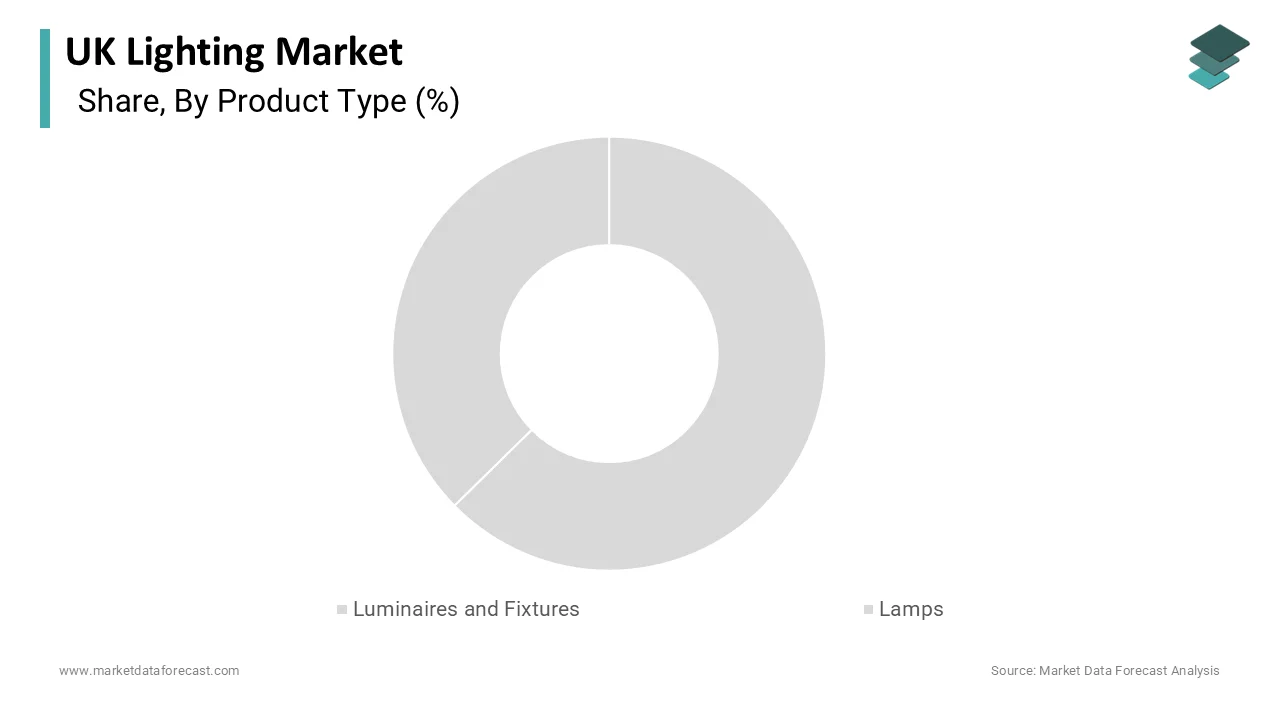
On the other hand, the lamps segment is a promising segment and is estimated to register a CAGR of 7.2% during the forecast period in the UK market, owing to the ongoing retrofit market where consumers and businesses replace existing light sources with energy-efficient alternatives without changing the entire fixture. The sheer volume of installed legacy lighting infrastructure in the UK creates a vast addressable market for replacement lamps. According to the Energy Saving Trust, there are still millions of halogen and compact fluorescent lamps in use across UK households and small businesses, providing a steady stream of replacement demand. The affordability and ease of installation of LED lamps make them an attractive option for budget-conscious consumers who cannot afford full fixture upgrades. According to data from the Office for National Statistics, household spending on home improvement goods has remained resilient, with lighting accessories being a frequent purchase. Furthermore, advancements in lamp technology, such as filament LEDs that mimic the appearance of traditional bulbs, have expanded their appeal in decorative residential applications. According to the Retail Consortium, online sales of lighting lamps have increased by 18% annually, driven by convenient e-commerce platforms. This combination of retrofit necessity, technological innovation, and accessible pricing positions lamps as a dynamic growth engine, particularly in the residential and small commercial sectors, where capital expenditure on full fixtures is limited.
By Light Source Insights
The LED segment held the largest share of the UK market in 2025. The dominance of LED is primarily driven by its superior energy efficiency, longevity, and versatility compared to traditional technologies. According to the Department for Business, Energy and Industrial Strategy, LED lighting consumes up to 90% less energy than incandescent bulbs and lasts 25 times longer, making it the economically rational choice for all sectors. The widespread phase-out of inefficient light sources through government regulations has effectively mandated the transition to LED, consolidating its market leadership. According to data from the Lighting Industry Association, over 95% of new lighting products sold in the UK now utilize LED technology. The versatility of LEDs allows them to be used in diverse applications ranging from street lighting to horticultural growth lights, expanding their market reach. Furthermore, the declining cost of LED chips has made them accessible to all consumer segments, eliminating price as a barrier to adoption. According to the Carbon Trust, businesses that switch to LED lighting typically see a return on investment within two years due to energy savings. The technology’s continuous improvement in color rendering and dimming capabilities has also addressed earlier performance concerns, making LEDs suitable for high-end retail and hospitality environments. This combination of regulatory support, economic benefit, and technical maturity cements LED as the undisputed leader in the UK lighting market.
On the other hand, the organic LED segment is estimated to register the fastest CAGR of 19.4% during the forecast period. Although currently niche, OLED is gaining traction due to its unique properties such as ultra-thin form factors, flexibility, and uniform surface illumination. According to the Advanced Materials Research Center, OLED panels offer superior visual comfort with zero glare, which makes them ideal for high-end residential and luxury commercial applications. The technology’s ability to be integrated into transparent or flexible surfaces opens new design possibilities that traditional LEDs cannot match. According to data from the Design Council, architects and interior designers are increasingly specifying OLED for feature lighting and bespoke installations in premium projects. The automotive sector is also driving growth, with UK-based luxury car manufacturers adopting OLED for interior ambient lighting and tail lights to enhance brand differentiation. As per the Society of Motor Manufacturers and Traders, the use of advanced lighting technologies in vehicles has increased by 15% annually. Furthermore, improvements in manufacturing processes are gradually reducing the cost of OLED panels, making them more accessible. According to safety evaluations by the Health and Safety Executive, OLEDs are recognized as safer due to lower heat emission and the absence of blue light hazards. These unique advantages position OLED as a high-growth niche that appeals to the premium segment of the market.
By Application Insights
The commercial segment dominated the market by capturing the highest share of the UK market in 2025 due to the extensive network of offices, retail spaces, hotels, and industrial facilities that require robust and efficient lighting solutions. The scale of commercial operations means that lighting constitutes a significant portion of operational expenses, prompting continuous investment in upgrades and maintenance. According to the Office for National Statistics, the services sector accounts for approximately 80% of the UK economy, encompassing a vast array of commercial premises that rely on lighting for productivity and customer engagement. The implementation of strict building codes and sustainability certifications, such as BREEAM and LEED, mandates high-performance lighting in new commercial constructions. According to data from the British Property Federation, over 60% of commercial real estate owners have undertaken lighting retrofits in the past five years to improve energy ratings and asset value. The rise of smart offices has further boosted demand, as companies integrate lighting with building management systems to optimize space utilization and employee well-being. As per the Confederation of British Industry, businesses prioritize energy efficiency as a key operational goal, with lighting being a primary target for cost reduction. The sheer volume of commercial floor space and the regulatory pressure to maintain high standards ensure that this segment remains the largest contributor to market revenue, dwarfing residential and outdoor applications in terms of total value.
However, the outdoor and infrastructure lighting segment is expected to register a CAGR of 8.4% during the forecast period, owing to the large-scale government initiatives to modernize public lighting infrastructure and enhance urban safety and sustainability. The transition of street lighting from high-pressure sodium to LED technology is a major driver, supported by central and local government funding. According to the Department for Transport, over 50% of UK local authorities have initiated or completed street lighting upgrade programs to reduce energy costs and carbon emissions. The integration of smart controls in outdoor lighting allows for adaptive brightness based on traffic and pedestrian activity, further improving efficiency. According to data from the Local Government Association, smart street lighting projects can reduce energy consumption by up to 60% compared to traditional systems. Additionally, the expansion of electric vehicle charging infrastructure requires associated lighting for safety and visibility, creating new demand avenues. As per the National Grid, the rollout of EV chargers is accelerating, with thousands of new points installed annually, each requiring compliant lighting. The focus on public safety and crime prevention also drives investment in well-lit public spaces and parks. According to reports from the Home Office, improved street lighting can reduce crime rates by up to 20% preceding encouraging councils to prioritize these upgrades. These factors combine to make outdoor and infrastructure lighting a dynamic and rapidly expanding segment.
COUNTRY LEVEL ANALYSIS UK Lighting Market Analysis
The UK had the largest share of the European lighting market in 2025 and is likely to experience robust growth for the next few years, fueled by rapid smart city deployments, accelerating public infrastructure upgrades, and strict national decarbonization targets. This prominent status is driven by the country’s advanced regulatory framework, mature construction industry, and strong commitment to sustainability goals. According to the Department for Business, Energy and Industrial Strategy, the UK has some of the most stringent energy efficiency standards in Europe, which accelerate the adoption of advanced lighting technologies. The market is characterized by a high penetration of LED solutions and a growing interest in smart and human-centric lighting systems. According to data from the Office for National Statistics, the construction and facilities management sectors are key drivers of lighting demand, with significant investment in retrofitting existing building stock. The UK government’s net zero strategy provides a clear roadmap for decarbonization, encouraging both public and private sector investment in energy-efficient lighting. As per the Lighting Industry Association, the UK is a hub for lighting innovation, with numerous research institutions and manufacturers developing cutting-edge solutions. The presence of major global lighting companies and a robust distribution network ensures the wide availability of products. The focus on wellness and productivity in commercial spaces further stimulates demand for high-quality lighting. The combination of regulatory pressure, technological leadership, and economic incentives positions the UK as a mature yet dynamic market that continues to drive trends in the wider European region.
COMPETITIVE LANDSCAPE
The competition in the UK lighting market is characterized by intense rivalry among established multinational corporations and specialized regional manufacturers. Market leaders differentiate themselves through technological innovation, product quality,y and comprehensive service offerings rather than price alone. The shift towards smart and sustainable lighting practices has intensified the focus on connected devices and energy-efficient solutions, prompting companies to invest in green technologies. Regulatory pressures regarding energy efficiency and waste disposal create high barriers to entry,y favoring incumbents with robust compliance frameworks and certification portfolios. Collaborative relationships with architects, contractors,ors, and government agencies are crucial for securing specifications in major projects. The market also sees increasing consolidation, with larger entities acquiring niche players to expand their product ranges and geographic reach. Customer loyalty is driven by reliability, technical support, rt, and brand reputation, making it challenging for new entrants to gain traction without significant investment. Overall, the competitive landscape demands continuous adaptation to regulatory changes and evolving consumer expectations to sustain market presence and profitability.
KEY MARKET PLAYERS
Some of the companies that are playing a dominating role in the UK Lighting Market include
Signify N.V. (Philips Lighting) Zumtobel Group AG Acuity Brands, Inc. LEDVANCE GmbH Havells India Ltd. (Sylvania) Thorn Lighting Ltd. Fagerhult Group OSRAM GmbH Lutron Electronics Co., Inc. Legrand S.A. Eaton Corporation plc Wipro Lighting TOP LEADING PLAYERS IN THE MARKET Signify operates as a global leader in lighting solutions with a substantial presence in the UK market. The company focuses on professional lighting systems and consumer connected lighting products under the Philips brand. Signify recently expanded its Interact IoT platform to help UK businesses optimize energy usage and improve workplace well-being. They have invested heavily in research and development for human-centric lighting technologies that support circadian rhythms. By partnering with local authorities, Signify has upgraded thousands of street lights to energy-efficient LED systems. Their commitment to sustainability is evident in their circular economy initiatives, which promote recycling and resource efficiency. This strategic focus on innovation and environmental responsibility strengthens their reputation as a key contributor to the UK lighting sector. Zumtobel Group provides high-quality lighting solutions for professional applications across the UK, including office,s healthcare, and retail spaces. The company emphasizes architectural lighting design that enhances visual comfort and aesthetic appeal. Zumtobel recently launched new product lines featuring advanced optical technologies that reduce glare and improve energy efficiency. They have strengthened their market position by offering comprehensive lighting management systems that integrate seamlessly with building automation platforms. The group actively collaborates with architects and designers to create bespoke lighting concepts for landmark projects. Their focus on digitalization enables remote monitoring and maintenance,e which reduces operational costs for clients. This dedication to technical excellence and customer-centric service solidifies their role as a premium provider in the UK lighting industry. LEDVANCE UK specializes in general lighting products for both professional and consumer markets with a strong distribution network across the country. The company offers a wide range of LED lamps, luminaires, and smart home lighting solutions. LEDVANCE recently introduced new smart lighting products that are compatible with major voice assistants and home automation systems. They have enhanced their supply chain resilience by optimizing logistics and warehousing operations in the region. The company focuses on providing affordable and reliable lighting options that meet strict energy efficiency standards. Their marketing campaigns emphasize the ease of upgrading to LED technology for cost savings and environmental benefits. This approach ensures broad market accessibility and reinforces their position as a trusted brand for everyday lighting needs in the UK. TOP STRATEGIES USED BY KEY MARKET PARTICIPANTS
Key players in the UK lighting market primarily focus on product innovation and digital integration to maintain a n competitive advantage. Companies invest heavily in developing smart lighting systems that connect to Internet of Things platforms for enhanced control and data analytics. Strategic partnerships with technology firms enable the creation of interoperable ecosystems that appeal to modern consumers and businesses. Expansion of sustainable product lines aligns with regulatory requirements and growing environmental awareness among customers. Manufacturers also prioritize supply chain optimization to mitigate disruptions and ensure the timely delivery of goods. Investment in research and development drives the creation of energy-efficient and human-centric lighting solutions. These strategies allow market participants to adapt to evolving technological trends and consumer preferences while driving long-term growth and operational efficiency in the sector.
MARKET SEGMENTATION
This research report on the UK lighting market is segmented and sub-segmented into the following categories.
By Product Type
Luminaires and Fixtures Lamps
By Light Source
By Application
Commercial Outdoor and Infrastructure Lighting
By Country