
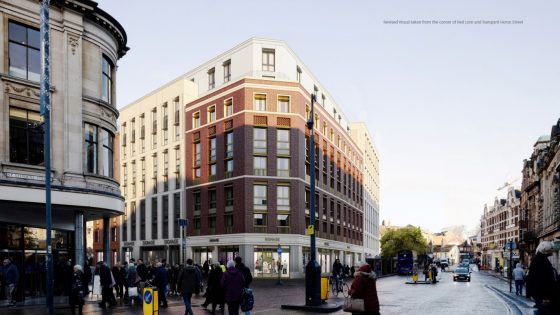
Orford House Developments and Benchmark Architects won permission in February to level the 1956-built empty retail store and replace it with 377 purpose-built student accommodation flats and ground-floor and lower ground-floor shops and leisure space.
The scheme took four years from concept to planning approval and drew opposition from groups including The Twentieth Century Society (C20), SAVE Britain’s Heritage, the Norwich Society and Historic England.
C20 said it was a handsome slice of 1950s Neo-Georgian architecture that should be preserved and called for a retrofit of the building.
Orford House Developments argued demolition was the only route to a financially viable scheme.
The University of East Anglia also objected to the plan, citing a lack of demand. Norwich University of the Arts did not comment during the planning process.
Orford House and Benchmark have confirmed the plans are no longer going ahead. BBC News reported that the building will be preserved and taken over by a children’s play group.
In February, the developer told Norwich City Council’s planning committee that nutrient neutrality requirements (a planning requirement ensuring that new developments do not cause a net increase in nutrient pollution in protected watercourses) had held up the scheme considerably. He added that the company listened and modified its plans over four years to meet planning officers’ wishes, claiming officers told him they ‘almost preferred the new building design over the existing Debenham’s building’.
An Orford House Developments spokesperson said this week that its vision for the site would have been ‘a transformational regeneration project’, bringing a high-profile building back into active use.
‘However, the significantly prolonged planning process – particularly the extended period spent addressing nutrient neutrality requirements – has regretfully meant that a project which was fully viable four years ago is no longer viable in today’s economic environment, given the substantial increases in construction costs,’ they said.
Mark Doohan, managing director of Milton Keynes-based Benchmark, told the AJ that the process of bringing forward developments in city-centre locations were hard enough without long delays in the planning process. He said: ‘It is a shame; but it does demonstrate that there are many other influencing factors to the success of a development beyond the quality and sustainability of architecture and design.
‘The process of bringing forward high-quality developments in sensitive city centre location is complex enough without additional layers of difficulty being added in with seemingly indefinite periods of delay.’
He added: ‘Unfortunately, the timescales associated with the extended period of delay spent addressing nutrient neutrality has had a terminal impact.
‘We hope that a way forward can be found and that the consented building can be brought forwards in the future.’
C20 campaigns director Oli Marshall said the demolition plan had been ‘wasteful and wholly unnecessary’.
‘While a vacant building is of little use to anyone and we all want to see new life in the city centre, this handsome slice of 1950s Neo-Georgian architecture was always too good to be bulldozed for unwanted new-build student flats.’
He added: ‘We welcome the proposed children’s adventure park and believe this has the potential to be an exciting new chapter for a building that already carries so many memories as a popular department store over many decades.
‘Times change and our cities are constantly evolving, but imaginative and sustainable reuse of such historic buildings is to be celebrated.’