‘They convincingly demonstrate that heritage-led architecture is not a niche discipline; it’s an essential part of how the profession has to respond to the climate emergency,’ said the judges, who described the practice as leading the profession in this kind of work as it becomes more mainstream.
‘You can see their impact. They are clear on their identity and it feels tangible and of the time,’ the judges said. ‘They are not paralysed by the heritage piece. They are really good architects. They do it all very well.’
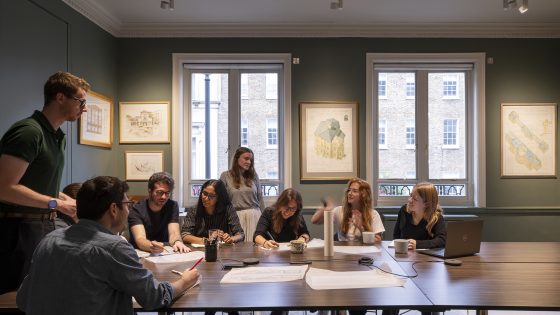
Visiting the practice’s classy offices in the former Chilean Embassy in Devonshire Street, central London, any initial impressions of a traditional conservation practice are soon upended by 39-year-old chief executive Dorian Proudfoot and his passionate and thorough approach to reinvigorating the practice. The results – 15 per cent growth in revenue and an extra 40 staff (taking it to a total of 150) over the last year – are tangible indicators of the changes afoot at the practice founded by Donald Insall in 1958.
Proudfoot joined the firm’s Chester office as an architectural assistant in 2011 and was made chief executive just over a year ago. ‘We’ve got quite a few lifers,’ he tells me. ‘I’ve worked at every level in the practice, and I think that gives me some good empathy to my colleagues.’ That empathy comes across in his straightforward demeanour. His father was a stonemason, as is his brother. ‘I would love to reopen quarries,’ he says. ‘What’s more sustainable than that?’
Keen to hone the practice’s USP, Proudfoot’s first move in his new role was to commission an external study to ascertain perceptions of the practice by current and prospective clients, staff, peers and the industry at large.
Dissatisfied with the answer that came back –basically ‘a safe pair of hands’ – Proudfoot set about developing a rebrand with a new website and acronym (DIA) and a business plan. Since then, the practice has appointed a new head of communications/marketing and a business development lead (a new position), upped its HR capability from one part-timer to three people, and hired a head of sustainability (not an architect). The practice aims to pay in the upper quarter of benchmarked salaries and benefits.
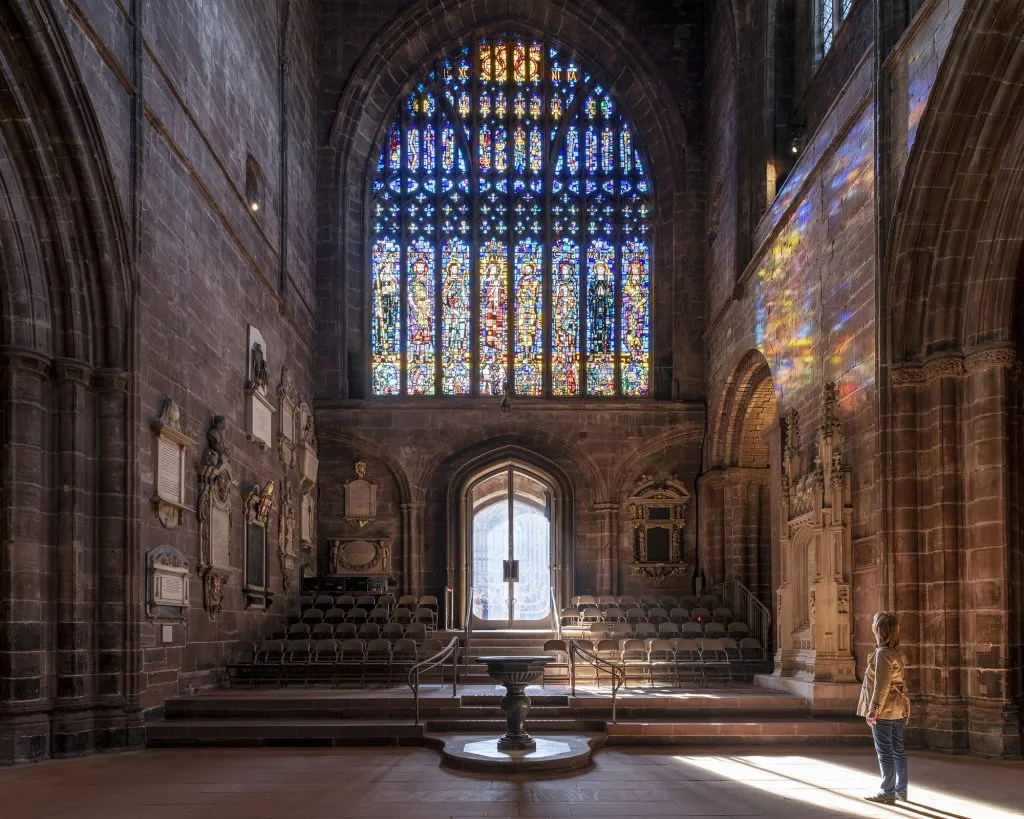
Reordering of the West Entrance of the Grade I-listed Chester Cathedral
Source: James Newton
The change in leadership coincided with a new generation moving up within the practice. Studio leaders were formalised into a senior leadership team, creating a platform for better collaboration. Proudfoot consolidated the practice’s seven UK offices, which had previously worked as independent cost centres, into three regions. Offices in Bath and Cambridge were closed as people retired or projects completed.
‘Retrofit is in our DNA,’ says Proudfoot, ‘but we’ve never called it that – and actually we’re still not calling it that.’ His vision is for DIA to be the most sought after practice for complex heritage projects, setting the gold standard.
‘We are deep subject matter experts, not generalists,’ Proudfoot explains. ‘I want everyone to find their passion. We’ve got really nerdy people who are the absolute guru on a particular thing. We embrace our staff’s passion to solve clients’ problems– and the business benefits.’
With an astonishing 500 live projects on the go, the practice categorises its workload by client or client type rather than by sector. The top 20 clients generate 46 per cent of revenue. Not surprisingly, these include the Royal Household, the Crown Estate, heritage bodies such as the National Trust and English Heritage, and private estates, such as Blenheim. Other sizable projects include public buildings for local authorities, such as the recently completed Rochdale Town Hall. A stream of very small clients, including churches, require intermittent intervention.
In addition, a busy heritage consultancy staffed largely by ex-conservation officers represents 25 per cent of the practice’s revenue. The London team recently secured a blanket listed building consent order for Eaton Square, Belgravia, which enables residents to implement certain energy upgrades without an individual application.
DIA’s main target growth area is ‘prime residential’, country houses in need of physical repair, often being taken on by the next generation. ‘They want a cosy house that’s not going to cost an arm and a leg, whereas their parents used to just put on another woolly jumper,’ explains Proudfoot. ‘We need to make that house warm and liveable and sustainable, but also make money for them.’ These clients have an urgent need to grow and diversify their revenue. The challenge is how to sweat the asset in an appropriate way and invite the public in. DIA is positioning itself as a one-stop shop for this market, able to simultaneously tackle repairs, environmental upgrades, enhance a building’s intangible significance and deliver social value.
Conservation architects must, first and foremost, have a deep understanding of building fabric. Currently 43 per cent of DIA architects are conservation-accredited– just short of Proudfoot’s target of 50 per cent. He views leading-edge sustainability expertise as central to DIA’s future, and it achieved SBTi (Science Based Targets Initiative) validation in 2025. Environmental upgrades of building fabric have become increasingly sophisticated, with new modelling tools and sensors enabling more precise evidence-based interventions. Continual upskilling of staff is crucial – a cohort of 10 architects are currently undertaking Passivhaus training, and DIA offers its own internal conservation course. The practice is also trialling a sustainability framework that will soon be applied to all projects.
When asked about the biggest challenge facing the practice, Proudfoot reiterates ‘changing the way we are perceived’. Traditionally heritage was a bolt-on, but now it’s about ‘unlocking potential’ – considering a building in the round, not as heritage police but as enablers of change. He cites B Corp certification, achieved in 2024, as having the biggest impact in attracting talent to the practice as well as driving social value in projects.
Proudfoot recounts February’s 100th birthday party for Insall – one of the few living architects with a knighthood – where the practice founder stole his mic to give a toast. Yet client expectations have evolved since the days when Insall visited clients in a Rolls Royce. Today, clients expect quality climate-resilient interventions that are economically and socially robust and secure a building’s future. If the revitalised DIA is able to marry its attitude of overarching integrity – doing what’s right for a building – with the complexity of evolving client needs, its success seems assured.
Shortlist: the 2026 AJ100 Champions
Foster + Partners
Orms
Populous
Sheppard Robson
Judges
Practice of the Year is selected from the AJ100 Champions cohort by the AJ editorial team
Sponsored by