
Sign up for the Slatest to get the most insightful analysis, criticism, and advice out there, delivered to your inbox daily.
There are TV seasons that pick up right where the last season left off, but House of the Dragon’s third season, premiering on HBO this Sunday night, kicks off where the previous one was meant to end. If it felt like Season 2 stopped right when it was about to get going, building up to what George R.R. Martin readers know as the Battle of the Gullet before anticlimactically wrapping up, that’s because the season was originally planned to end with a giant naval confrontation before budget cuts forced showrunner Ryan Condal to kick the can two years down the road. It’s not an ideal circumstance, given that, rather than leaping right into the fray, Season 3 now has to open with a bunch of table-setting and refamiliarization. (Even so, when HBO showed the first two episodes to press, the “previously on …” montage lasted a full six minutes.) But beginning a season with a massive sea battle rather than climaxing with it shifts the balance in what turns out to be a critical way, with the focus rerouting from who emerges victorious to what happens after they win.
Although he’s still listed as a co-creator, Martin has essentially disavowed House of the Dragon, reportedly responding to Condal’s initial Season 3 outline with “This is not my story any longer.” But the show retains his interest in the complex politics of governance, as well as, for better or worse, the sprawl of a multicharacter saga better suited to the page than the screen. Despite the attempts by Condal and his writers to work hand-holding reminders into their dialogue—if they had a nickel for every time a character is greeted by their full name and title, we might have gotten to the Gullet a whole lot earlier—it’s still a show you have to watch with the Wiki at hand, if only so you don’t mix up your Rhaenys and Rhaenyra. That’s not a problem for people who enjoy flipping to the maps at the front of fantasy novels, but a show that will, by its conclusion, have likely taken eight years to tell a 30-odd-episode story can’t afford to blunt what little momentum it’s built up, especially without streamlining its cast of characters or at least allowing the actors who play the smaller recurring roles to make a more memorable impression. It’s like watching a movie with a person who keeps leaning over and asking, “Wait, who is that?” and realizing the person is you.
Fortunately, the third season, the first half of which was shown to critics in advance, finally starts to zero in on what feels like it might be the show’s core story, which is less to do with the rise and fall of the Targaryen family fortunes than what bloody wars of succession do to the people those squabbling rulers are meant to rule. As the knighted Criston Cole (Fabien Frankel) observes in the aftermath of one muddy battle, “Doom and ruin surround us. We will all become beasts before our end.”

Joshua Rivera
House of the Dragon Is Not Game of Thrones. Herein Lies the Problem.
Read More
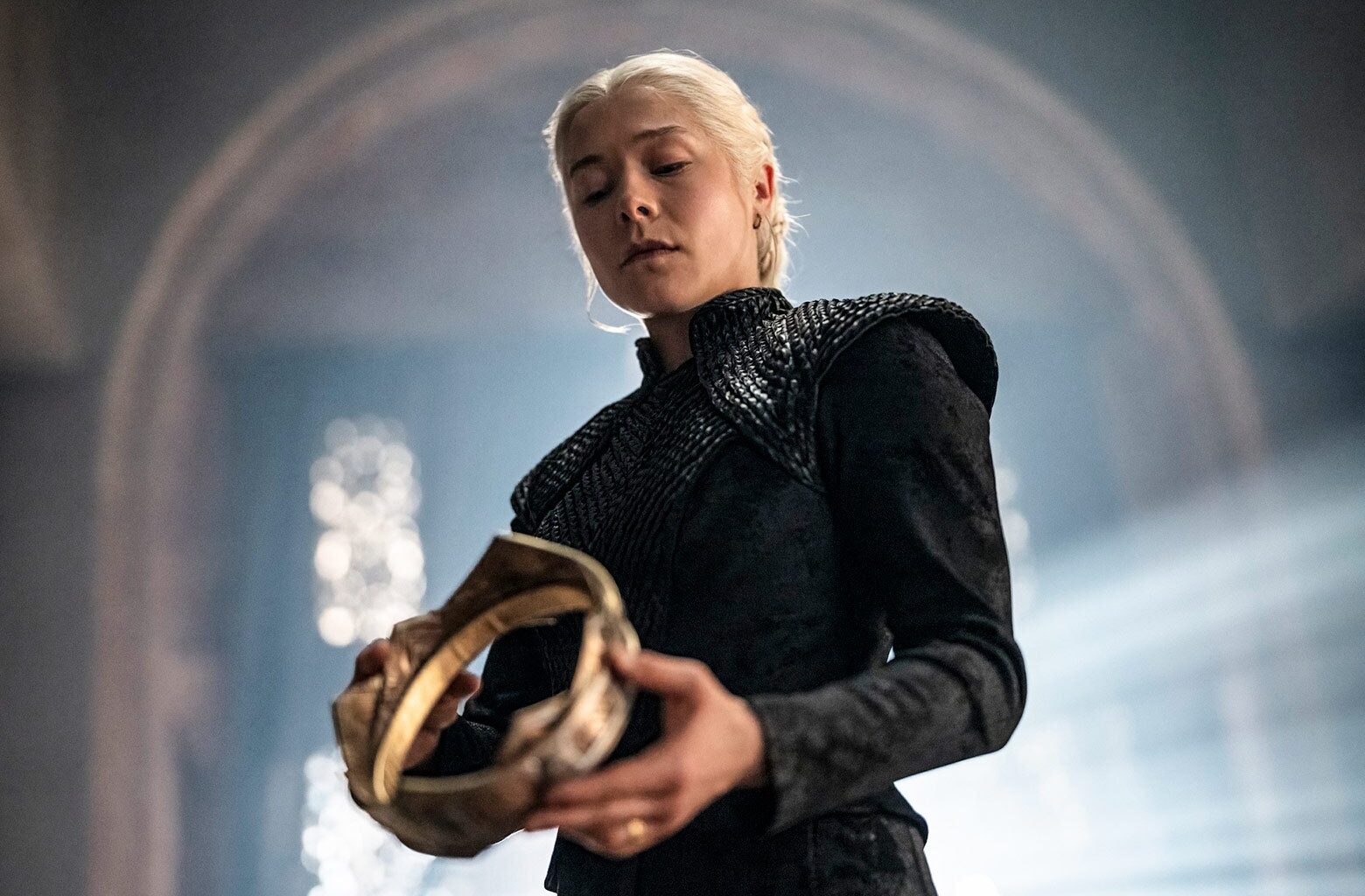
The Targaryens, at least, are meant to control beasts, not become them. Mastery of the all-powerful dragons is what has defined them for centuries, the cornerstone of their power and the impetus behind their platinum-blond inbreeding. But the split between Targaryen factions—namely, those loyal to rightful but usurped queen Rhaenyra (Emma D’Arcy) and her uncle-slash-husband Daemon (Matt Smith), and those who back the psychotic Aemond (Ewan Mitchell) and his brother Aegon (Tom Glynn-Carney)—has set those dragons against each other, and necessitated both factions calling up the reserves, the lineage of half-Targaryen offspring that various predecessors have left scattered across Westeros. That means putting commoners with no inherent loyalty atop the most potent living weapons in the world, and also pairing some legitimate descendants with dragons they can’t fully control. The arms race is in full flower, and that means handing out nukes to anyone willing to use them.
It also means making temporary allies with some dangerous folks, namely the Essos-based pirates of the Triarchy, whom Aemond’s Greens set loose on their historical enemy, Corlys Velaryon (Steve Toussaint). Inviting the rapacious and unstable bandits into Westeros’ affairs may not prove to be the wisest move long term. But it does set up a genuinely thrilling encounter in the first episode between the Sea Snake and the Triarchy armada captained by the enthusiastically bloodthirsty Sharako Lohar (Abigail Thorn). Thorn gets the rare opportunity, at least on this show, to sink her teeth into a supporting part, and she makes the most of it, creating a formidably, fearfully enjoyable adversary in a handful of scenes and setting up a head-to-head confrontation whose outcome, for once, feels genuinely uncertain.
Game of Thrones famously knocked Tyrion Lannister unconscious to avoid the cost of staging a battle in its first season, but when Corlys comes to after a blow to the head on House of the Dragon, it’s in the midst of dozens of blade-wielding combatants on the deck of a ship that’s just been nearly split into two by another—a sign not only of the newer show’s substantial budget (reported to be just shy of $20 million an episode) but how far the bar for epic TV storytelling has been raised in the past 15 years. Director Loni Peristere’s staging of the Battle of the Gullet isn’t quite up to the level set by Miguel Sapochnik, the “Battle of the Bastards” director who departed as House of the Dragon co-showrunner after the show’s first season, but it’s still a solidly entertaining spectacle with enough senseless brutality to foreshadow what the rest of the season will bring.
If A Knight of the Seven Kingdoms rocked the expanded Thrones-verse by allowing for the possibility that any of its inhabitants might be genuinely good at heart, House of the Dragon seems headed firmly in the other direction: toward the conclusion that none of its characters have the noble heart of a great ruler. The late king Viserys was kind but weak, too indecisive to even set up a firm enough plan of succession to prevent his children from wrecking the realm by squabbling over it, and by the time any of them ascend the throne, they’ve forgotten why they’ve wanted to hold it in the first place, except as a way of making sure that none of their siblings can.

Nadira Goffe
A Cult-Favorite Show Is Back With Some Major Changes. Not Everyone Is Happy With Them.
Read More
The New Toy Story Shows the Best That Parents Can Hope for, and It’s Honestly Devastating
House of the Dragon Is Finally Getting Somewhere
It’s still, unlike A Knight of the Seven Kingdoms, a story told from the top down—a dragon’s-eye view, as it were. But the first few episodes take time to remind us of the toll this unending conflict takes on the people unwillingly drafted into it: the men burned alive, the women raped by wandering soldiers, the families left without food because all the realm’s resources have been diverted toward military ends. (Any resemblance to current geopolitical realities is, of course, completely coincidental.) The series started off as a tragedy about gender, with both the rightful monarch, Rhaenyra, and her lifelong friend, Alicent (Olivia Cooke), forced to fight for power and their own survival in a way their husbands and brothers never had to. But, though the third season has Rhaenyra echo Queen Elizabeth I’s claim that she has the heart of the king trapped in the “weak and feeble” body of a woman, we’re past thinking that’s her only problem, or that her feminine disadvantages excuse her unwise, and increasingly dangerous, actions. She’s not any worse than the men who ruled before her, but she’s not noticeably better, either. There are no good kings, and no good queens.
It’s not the sunniest of conclusions, but then, as one character remarks, “Life is short, the gods are cruel, and we all find what enjoyment we can as the world heads into darkness.” A few minutes later, he gets his head cut off.
Get the best of movies, TV, books, music, and more.