
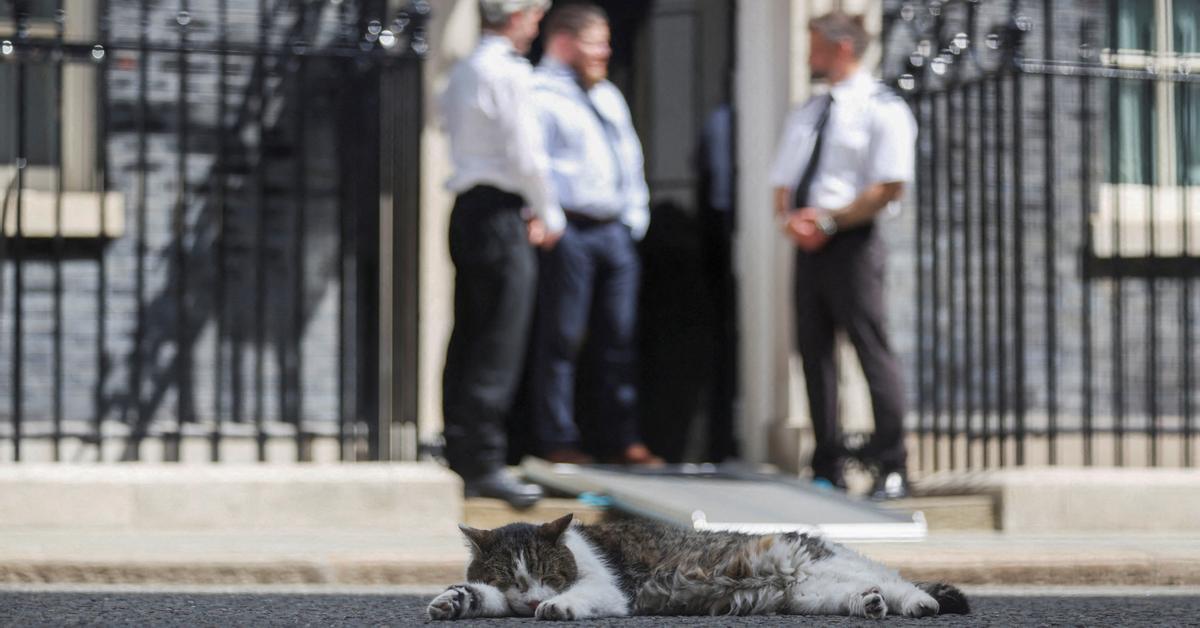
LondonThe UK’s most famous cat is waiting for a new owner. Larry, adopted by the Prime Minister’s office and officially named chief mouser to the cabinet in February 2011, saw on Sunday that journalists, photographers and television cameras had gathered outside the door of 10 Downing Street awaiting events. While the big animal watched to ensure no stranger – and even less so any rodent – crossed the threshold of the cute but uncomfortable Georgian house on the famous Whitehall alley, Keir Starmer spent the weekend at Chequers, his official country residence, just over sixty kilometres north-west of London.
A discreet retreat to reflect on his political future, which, at this point, already seems decided. It has been a slow-motion fall. Officially, however, he has not yet retracted his words from Friday, when he assured that he would stand up to any attempt to unseat him.
But this Sunday, one of his now few allies, the Trade Minister, Peter Kyle, stated in an interview with the BBC that Starmer “is very aware of the political challenges ahead of him, and he wants to listen to people and reflect on what they are telling him”; a way of implying that he has realised he has no support.
The pressure is immense and the only major unknown to be resolved is the timetable he will set for an orderly transfer of power. Indeed, most of the British press assures that he will announce it first thing this Monday from the door of Downing Street. Not even Larry will be able to prevent the triumphal entry, not of a stranger, but of the Mayor of Manchester, Andy Burnham, who will become the seventh premier of the last decade, precisely since the Brexit referendum (23 June 2016), a plebiscite that has haunted the country and its leaders ever since.
following his victory in the by-electionWithout authority
On Friday in the early hours, following his victory in the partial election in Makerfield, in northern England, the still mayor Burnham – who will take office this Monday and resign as mayor of the great northern city – has established himself as the only solid alternative to Starmer. With dizzying speed, the credit that the premier achieved in the July 2024 elections has gone down the drain.Mortally worn out, like the cherry on a bitter cake, by the electoral catastrophe of the local elections in early May
, this was only the culmination of a series of inexplicable mistakes and changes of course that have weighed down his two years in government. Five weeks ago, almost a hundred of his MPs already asked him to resign. At the same time, prominent ministers from his government also joined the fray: Yvette Cooper, Foreign Affairs; David Miliband, Energy; Shabana Mahmood, Home Affairs. At that time, the Health Minister, Wes Streeting, resigned, and last week the Defence Minister, John Healey, did so. In the last 48 hours, Heidi Alexander, head of the Transport portfolio, has joined the demand for his departure.

As usual, British politics finds in Shakespeare a recurring mirror, whether in tragedies, historical dramas, or comedies. And Starmer’s farewell, which can also be read as a new echo of the Brexit earthquake, admits parallels with Richard III, Henry IV, or King Lear. In Richard III, the dramatic knot revolves around who holds legitimate authority to wear the crown. In Henry IV, the conflict is articulated between the king who occupies the throne and the charismatic rival who challenges him from outside. In the case of King Lear, authority unravels as the monarch discovers, too late, that power only exists as long as others agree to obey him. Similarly, Starmer’s authority has been eroding to the point where he himself has had to accept that a significant part of the party no longer recognizes him as leader.
In this regard, a survey commissioned by the National Education Union teaching union and conducted by YouGov reveals notable discontent among the Labour base with the government’s management. The poll, conducted among 800 party members, shows that 48% consider the executive has acted worse than they expected since the elections.
The study, conducted before Burnham’s victory in Makerfield, also points to a clear preference as a hypothetical prime minister, with 45% of support, far above Keir Starmer (24%), Angela Rayner (7%), and Wes Streeting (4%). A second survey, among 4,000 education workers affiliated with the union, is even more critical: 66% state that the Labour government is performing below expectations.
In the recent history of British politics, Starmer will go down as the ultimate example of a bluff, who came to power not because he generated any enthusiasm among the electorate, but due to the weariness of years of conservative government and the economic failure of Brexit. In any case, among the most controversial episodes of the still premier are the withdrawal of heating assistance for millions of pensioners, cuts or reforms in certain social benefits, and a flat economy. Added to this is the scandal surrounding the appointment of Peter Mandelson as ambassador to Washington, despite his known links to the pedophile Jeffrey Epstein. Starmer appointed him and had to dismiss him nine months later (September 2025). All of this has contributed to the image of a cautious, technocratic, and continuity government, without ambition, project, or narrative, far from the profound change the country expected after fourteen years of conservative governments.
Whether Starmer makes the announcement of his departure this Monday or in the coming days, it is certain that there is no going back. Meanwhile, the Labour Party is debating what the succession will look like. Whether it will be a coronation for Burnham or if there will be at least one more candidate with 81 parliamentarians willing to support him to, at the very least, hold a leadership race.