
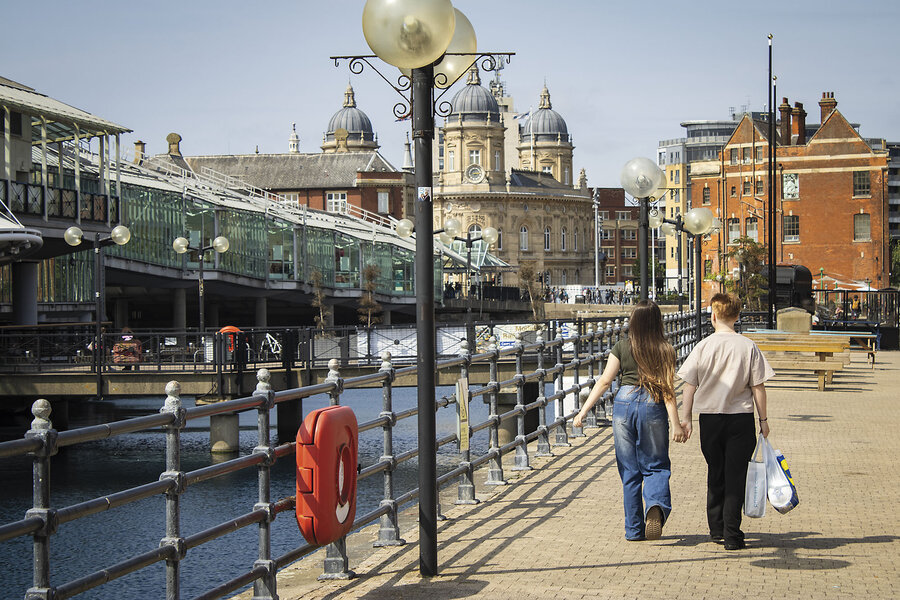
Tim Rix can remember being full of hope. It was some nine years ago, and his hometown of Kingston upon Hull was thriving.
As the United Kingdom’s then-latest City of Culture, a new energy crackled from its art museums to its waterfront. Bit by bit, a bygone past of salt-seasoned fishermen and creaking trawlers was being reimagined as trendy lofts and tapas bars.
Looming over all was Brexit, and for many here, Mr. Rix included, that was a good thing. Some 68% of area residents voted to leave the European Union. As a local businessman, Mr. Rix saw opportunity in a future free from Brussels’ shadow.
Why We Wrote This
Voters who wanted out of the European Union were motivated by issues such as sovereignty and immigration. But today, the United Kingdom doesn’t feel freer, and immigration is still a hot-button topic. Why does Britain seem stuck in a rut?
But today, as the 10th anniversary of the June 23, 2016, vote nears, Mr. Rix can’t help but wonder what it was all for. Polls show some sense of buyer’s remorse across the country, with a majority now wishing Britain could return to how things were before. Yet here in the city known universally as Hull, that sentiment comes across less as buyer’s remorse than as deep-seated despondence.
The broad impression that Brexit has failed to deliver virtually any of its promised benefits is not really about Brexit itself. It is about the sense that Britain is on a dramatic downhill slide, and nothing voters have done has been able to stop it.

Mark Sappenfield/The Christian Science Monitor
“I have never known so many people across the political spectrum who say we need a reset,” says Tim Rix, chairman of Rix Group in Hull, England.
Ten years ago, Brexit was as much a wake-up call as a referendum on EU membership – sent straight to the heart of business-as-usual in Parliament. Then came COVID, a stream of weak and unpopular Conservative governments, and now an unpopular Labour government. Through it all, the political dirge continues: costs rise, public services falter, the economy stagnates.
Mr. Rix complains so much about the government, he jokes, that his son started bringing his dog to work because it was the only one willing to listen to him. In that way, Hull is emblematic of voters’ increasing frustration that the country is not on a new path. While support for Brexit has cooled, the fervor for change that fueled the historic vote most certainly has not.
“It’s not about Brexit, it’s a much bigger picture,” says Mr. Rix from his corner office with a commanding view over Hull’s transformed marina. “I have never known so many people across the political spectrum who say we need a reset.”
Brexit, in some ways, was just the beginning. “We might go through a lot more chaos before we get out the other end of this,” he adds.
A Brexit that didn’t deliver?
The Monitor visited Hull nine years ago as post-vote negotiations for Brexit got underway. We returned recently to talk to many of the same people and to get the temperature of a city that viewed Brexit with such promise.
The national picture is becoming clearer. Polls show that some 55% of Britons would undo Brexit. But if Hull is any indication, this is not a rekindled affection for the EU. It is a result of dashed hopes.

Mark Sappenfield/The Christian Science Monitor
“What we’re doing by the back door is handing a lot of power back to the EU,” says Paul Salvidge, a freelance negotiator and leading figure in the pro-Brexit campaign in 2016.
How much Brexit was ever really about the EU is debatable. But EU organizations in far-off Brussels made a compelling target. “Most people have no interest in things like EU treaties,” says Simon Lee, a senior fellow at the Centre for British Politics at the University of Hull. “It was about blaming Brussels when the real problem is in London.”
The Brexit slogan “Take back control” struck a deep chord. But 10 years on, there is little sense that Britain has taken back control of anything at all.
When asked how much progress Brexit has made, Paul Salvidge doesn’t hesitate: “Zero progress.”
It is a statement of arresting candor. Mr. Salvidge, after all, was chair of the United Kingdom Independence Party, or UKIP, which was created to bring Brexit about. He was a primary figure in Hull’s successful pro-Brexit campaign. Sitting in a Hull café, his jacket, tie, and unbuttoned collar suggesting a casual propriety, Mr. Salvidge remembers how it was: volunteers shimmying up lampposts to put up marquees, and residents asking him for posters they would immediately put in their windows.
“We seemed awash in resources,” he says fondly, speaking not of money but of an equally precious political capital: energy.
But politicians in Parliament frittered away the opportunity, he says. They thought the voters made a mistake and tried to make nice with the EU even as they were leaving it. “If you are a collaborative negotiator, you get hammered if you are up against a competitive negotiator,” says Mr. Salvidge, himself a freelance negotiator. “The EU was in competitive mode, and we were in collaborative mode.”
As a result, “my view is that we haven’t even started yet,” he says. Britain got all the bad and none of the good – “BRINO,” or “Brexit in name only.” “What we’re doing by the back door is handing a lot of power back to the EU.”
What is important is the principle, he says. Britain is better off outside the EU, where it has more control over its own affairs.
Brexit’s bite
But that has come at a cost, says Mike Ross, leader of the Hull City Council. The lack of EU funding has left a hole. For example, Hull Kingston Rovers, one of Hull’s two rugby Super League teams, renovated its stadium with EU money before Brexit. Now, such a move would be impossible. “The funding scheme following Brexit just wasn’t there,” he says. “We aren’t able to do it in quite the same way now.”
Still, thumbing its nose at others is a cherished Hull tradition. The city had to build its own train service to London because it is on the way to nothing else, and is not particularly close to any other major cities. Perched on England’s North Sea coast, its fishermen once got into an economic war with Iceland over fishing rights.

Mark Sappenfield/The Christian Science Monitor
Friends Jess Hogg (left) and Archie Heslewood (center) speak with Russ Litten in Hull, England, May 29, 2026.
“There’s a bit of a chip on our shoulder,” says Neil Hudgell, a prominent local lawyer connected with Hull KR. “It has given us an energy at times, but it also feeds into a persecution complex.”
Brexit has brought out a darker side, too, say others.
Russ Litten stops abruptly on his walk down Spring Bank and points to the side of the road. That was where rioters pulled a driver out of his car to beat him up. Not far away, a wall of flaming tires kept police at bay as people threw bricks at a local mosque.
The 2024 riot against immigrants, “that shook me,” says the local novelist and spoken-word musician. Mr. Litten had always rather liked Hull’s attitude: a mentality that embraced those who didn’t want to follow the crowd. But he is convinced that Brexit was a tipping point, normalizing intolerance.
Much of the support for Brexit, after all, came from a sense that immigration was out of control. In some ways, observers say, Brexit has made it worse. Where before migration was inside the EU and comparatively orderly, now, Britain lacks the same sort of European assistance it once had. That has made stemming the current international migration – mostly coming across the English Channel – that much more chaotic.
But Brexit, Mr. Litten says, validated a culture of grievance. “It has gradually taught people it’s OK to be a racist and to shout the first dumb thing that comes into their head.”
No quick fixes
Not far away at a local diner, Mr. Litten falls into conversation with neighbors about Brexit. Jess Hogg talks about how her daughter has seen open racism in her workplace and how a friend of Nigerian heritage was berated the day after the Brexit vote. The mindset of some in Hull, Ms. Hogg says, seems to be, “My life is terrible, so who can I blame for it?”
If anything, this is perhaps the most indelible lesson of the decision to leave the European Union. Through Brexit and repeated elections, British voters have sought change through every means possible and not gotten it. To historian Dr. Lee, pointing the finger at immigrants was as misguided as pointing it at the EU.
“The problem has very little to do with migrants crossing the channel,” he says.
“They want quick fixes, but there are none to be had,” he says. “This kind of reinvestment would take a generation.”
Different people point to different solutions. Some say government is too large, others too small. But all agree that Britain needs a plan and leadership. Time and again, Brexit shows, attempts to find quick fixes have failed.
Looking out his third-story window, Mr. Rix can just about see the contours of an answer. Across the marina, women in sunglasses sip £4.50 ($6) matcha lattes as servers dressed all in black flit among tables. Where once warehouses tended to the fishing vessels and their catch, now the cobbles and redbrick facades lend theaters and bistros a bohemian air.
That was only possible because Hull came together when it was named a City of Culture. “I was not convinced to start with, but I had my eyes opened,” says Mr. Rix.
It has been hard to maintain that momentum. Sometimes, it has felt impossible. Looking back, he says, Brexit was not the problem, nor maybe even the solution. What Britain needs is more of that spirit.
“It created a group of people that started to come up with ideas of what you could do to change the dial for Hull,” he adds. “That shows what could happen when everyone works together.”