
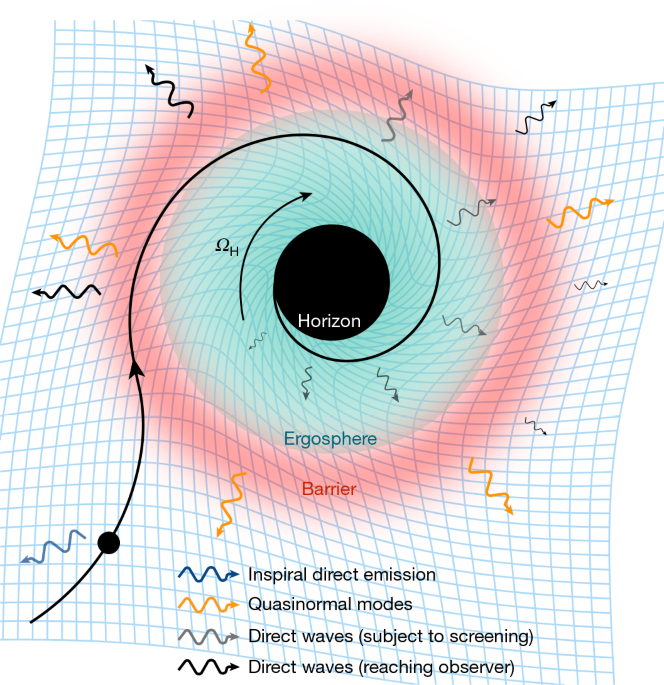
Oshita, N., Ma, S., Chen, Y. & Yang, H. Probing direct waves in black hole ringdowns. Preprint at https://arxiv.org/abs/2509.09165 (2025).
Abac, A. G. et al. GW250114: testing Hawking’s area law and the Kerr nature of black holes. Phys. Rev. Lett. 135, 111403 (2025).
Akiyama, K. et al. First M87 Event Horizon Telescope results. I. The shadow of the supermassive black hole. Astrophys. J. Lett. 875, L1 (2019).
Reynolds, C. S. Measuring black hole spin using X-ray reflection spectroscopy. Space Sci. Rev. 183, 277–294 (2014).
Blandford, R. D. & Znajek, R. L. Electromagnetic extraction of energy from Kerr black holes. Mon. Not. R. Astron. Soc. 179, 433–456 (1977).
Aasi, J. et al. Advanced LIGO. Class. Quantum Gravity 32, 074001 (2015).
Acernese, F. et al. Advanced Virgo: a second-generation interferometric gravitational wave detector. Class. Quantum Gravity 32, 024001 (2014).
Akutsu, T. et al. Overview of KAGRA: detector design and construction history. Prog. Theor. Exp. Phys. 2021, 05A101 (2020).
The LIGO Scientific Collaboration, the Virgo Collaboration & the KAGRA Collaboration. GWTC-4.0: updating the gravitational-wave transient catalog with observations from the first part of the fourth LIGO–Virgo–KAGRA observing run. Preprint at https://arxiv.org/abs/2508.18082 (2025).
Teukolsky, S. A. Perturbations of a rotating black hole. I. Fundamental equations for gravitational, electromagnetic, and neutrino-field perturbations. Astrophys. J. 185, 635–648 (1973).
Berti, E. et al. Black hole spectroscopy: from theory to experiment. Class. Quantum Gravity https://doi.org/10.1088/1361-6382/ae59e2 (2026).
Carter, B. Axisymmetric black hole has only two degrees of freedom. Phys. Rev. Lett. 26, 331–333 (1971).
Robinson, D. C. Uniqueness of the Kerr black hole. Phys. Rev. Lett. 34, 905–906 (1975).
Chrusciel, P. T., Lopes Costa, J. & Heusler, M. Stationary black holes: uniqueness and beyond. Living Rev. Relativ. 15, 7 (2012).
Yang, H. et al. Quasinormal-mode spectrum of Kerr black holes and its geometric interpretation. Phys. Rev. D 86, 104006 (2012).
Cardoso, V., Franzin, E. & Pani, P. Is the gravitational-wave ringdown a probe of the event horizon? Phys. Rev. Lett. 116, 171101 (2016); erratum 117, 089902 (2016).
Mino, Y. & Brink, J. Gravitational radiation from plunging orbits: perturbative study. Phys. Rev. D 78, 124015 (2008).
Zimmerman, A. & Chen, Y. New generic ringdown frequencies at the birth of a Kerr black hole. Phys. Rev. D 84, 084012 (2011).
Abac, A. G. et al. Black hole spectroscopy and tests of general relativity with GW250114. Phys. Rev. Lett. 136, 041403 (2026).
Dreyer, O. et al. Black-hole spectroscopy: testing general relativity through gravitational-wave observations. Class. Quantum Gravity 21, 787 (2004).
Nichols, D. A. & Chen, Y. Hybrid method for understanding black-hole mergers: inspiralling case. Phys. Rev. D 85, 044035 (2012).
Xin, S. et al. Gravitational-wave echoes from spinning exotic compact objects: numerical waveforms from the Teukolsky equation. Phys. Rev. D 104, 104005 (2021).
Ma, S. et al. Gravitational-wave echoes from numerical-relativity waveforms via spacetime construction near merging compact objects. Phys. Rev. D 105, 104007 (2022).
Buonanno, A. & Damour, T. Effective one-body approach to general relativistic two-body dynamics. Phys. Rev. D 59, 084006 (1999).
Wardell, B. et al. Gravitational waveforms for compact binaries from second-order self-force theory. Phys. Rev. Lett. 130, 241402 (2023).
Pan, Y. et al. Inspiral–merger–ringdown waveforms of spinning, precessing black-hole binaries in the effective-one-body formalism. Phys. Rev. D 89, 084006 (2014).
Blanchet, L. Post-Newtonian theory for gravitational waves. Living Rev. Relativ. 17, 2 (2014).
Poisson, E. & Will, C. M. Gravity: Newtonian, Post-Newtonian, Relativistic (Cambridge Univ. Press, 2014).
Zimmerman, A., Mark, Z. & Chen, Y. Revisiting the emission from an extreme mass ratio plunge [Abstract]. In Proc. APS April Meeting 2018 (APS, 2018).
De Amicis, M., Cannizzaro, E., Carullo, G. & Sberna, L. Dynamical quasinormal mode excitation. Preprint at https://arxiv.org/abs/2506.21668 (2026).
Kuntz, A. Green function of the Pöschl–Teller potential. Preprint at https://arxiv.org/abs/2510.17954 (2026).
Arnaudo, P., Carballo, J. & Withers, B. Beyond quasinormal modes: a complete mode decomposition of black hole perturbations. Preprint at https://arxiv.org/abs/2510.18956 (2025).
Bardeen, J. M., Carter, B. & Hawking, S. W. The four laws of black hole mechanics. Commun. Math. Phys. 31, 161–170 (1973).
The LIGO Scientific Collaboration, the Virgo Collaboration, & the KAGRA Collaboration. GW250114_082203 data release. Gravitational Wave Open Science Center https://doi.org/10.7935/1g4j-2028 (2025).
Ma, S. et al. Quasinormal-mode filters: a new approach to analyze the gravitational-wave ringdown of binary black-hole mergers. Phys. Rev. D 106, 084036 (2022).
Ma, S., Sun, L. & Chen, Y. Black hole spectroscopy by mode cleaning. Phys. Rev. Lett. 130, 141401 (2023).
Ma, S., Sun, L. & Chen, Y. Using rational filters to uncover the first ringdown overtone in GW150914. Phys. Rev. D 107, 084010 (2023).
Varma, V. et al. Surrogate models for precessing binary black hole simulations with unequal masses. Phys. Rev. Res. 1, 033015 (2019).
The LIGO Scientific Collaboration, the Virgo Collaboration & the KAGRA Collaboration. GWTC-4.0: methods for identifying and characterizing gravitational-wave transients. Preprint at https://arxiv.org/abs/2508.18081 (2026).
Lu, N., Ma, S., Piccinni, O. J., Sun, L. & Finch, E. Statistical identification of ringdown modes with rational filters. Phys. Rev. D 112, 064047 (2025).
Isi, M. & Farr, W. M. Analyzing black-hole ringdowns. Preprint at https://arxiv.org/abs/2107.05609 (2021).
Carullo, G., Del Pozzo, W. & Veitch, J. Observational black hole spectroscopy: a time-domain multimode analysis of GW150914. Phys. Rev. D 99, 123029 (2019); erratum 100, 089903 (2019).
Mitman, K. et al. Nonlinearities in black hole ringdowns. Phys. Rev. Lett. 130, 081402 (2023).
Ho-Yeuk, M. et al. Nonlinear effects in black hole ringdown. Phys. Rev. Lett. 130, 081401 (2023).
Chavda, A., Lagos, M. & Hui, L. The impact of initial conditions on quasi-normal modes. J. Cosmol. Astropart. Phys. 07, 084 (2025).
Leaver, E. W. & Chandrasekhar, S. An analytic representation for the quasi-normal modes of Kerr black holes. Proc. R. Soc. Lond. A 402, 285–298 (1985).
Berti, E., Cardoso, V. & Starinets, A. O. Quasinormal modes of black holes and black branes. Class. Quantum Gravity 26, 163001 (2009).
Giesler, M. et al. Overtones and nonlinearities in binary black hole ringdowns. Phys. Rev. D 111, 084041 (2025).
Li, X. et al. Angular emission patterns of remnant black holes. Phys. Rev. D 105, 024016 (2022).
Bustillo, J. C., Lasky, P. D. & Thrane, E. Black-hole spectroscopy, the no-hair theorem, and GW150914: Kerr versus Occam. Phys. Rev. D 103, 024041 (2021).
Ghosh, A., Brito, R. & Buonanno, A. Constraints on quasinormal-mode frequencies with LIGO-Virgo binary–black-hole observations. Phys. Rev. D 103, 124041 (2021).
Finch, E. & Moore, C. J. Searching for a ringdown overtone in GW150914. Phys. Rev. D 106, 043005 (2022).
Wang, Y.-F. et al. Gating-and-inpainting perspective on GW150914 ringdown overtone: understanding the data analysis systematics. Phys. Rev. D 112, 083023 (2023).
Correia, A., Wang, Y.-F., Westerweck, J. & Capano, C. D. Low evidence for ringdown overtone in GW150914 when marginalizing over time and sky location uncertainty. Phys. Rev. D 110, L041501 (2024).
Capano, C. D. et al. Multimode quasinormal spectrum from a perturbed black hole. Phys. Rev. Lett. 131, 221402 (2023).
Siegel, H., Isi, M. & Farr, W. M. Ringdown of GW190521: hints of multiple quasinormal modes with a precessional interpretation. Phys. Rev. D 108, 064008 (2023).
Chandra, K. & Calderón Bustillo, J. Black-hole ringdown analysis with inspiral-merger informed templates and limitations of classical spectroscopy. Preprint at https://arxiv.org/abs/2509.17315 (2025).
Wang, H.-T., Tang, S.-P., Li, P.-C. & Fan, Y.-Z. Detection of a higher harmonic quasi-normal mode in the ringdown signal of GW231123. Preprint at https://arxiv.org/abs/2509.02047 (2025).
Wang, H.-T. Decisive evidence for the first overtone mode in the ringdown signal of GW231028. Preprint at https://arxiv.org/abs/2509.08657 (2025).
Ma, S. et al. Merging black holes with Cauchy-characteristic matching: computation of late-time tails. Phys. Rev. D 112, 024003 (2025).
De Amicis, M. et al. Late-time tails in nonlinear evolutions of merging black holes. Phys. Rev. Lett. 135, 171401 (2025).
Islam, T. et al. Phenomenology and origin of late-time tails in eccentric binary black hole mergers. Phys. Rev. D 112, 024061 (2025).
De Amicis, M., Albanesi, S. & Carullo, G. Inspiral-inherited ringdown tails. Phys. Rev. D 110, 104005 (2024).
Ma, S. et al. Einstein–Klein–Gordon system via Cauchy-characteristic evolution: computation of memory and ringdown tail. Class. Quantum Gravity 42, 055006 (2025).
Cardoso, V. et al. Hushing black holes: tails in dynamical spacetimes. Phys. Rev. D 109, L121502 (2024).
Khera, N., Ma, S. & Yang, H. Quadratic mode couplings in rotating black holes and their detectability. Phys. Rev. Lett. 134, 211404 (2025).
Ma, S. & Yang, H. Excitation of quadratic quasinormal modes for Kerr black holes. Phys. Rev. D 109, 104070 (2024).
Bucciotti, B., Juliano, L., Kuntz, A. & Trincherini, E. Quadratic quasinormal modes of a Schwarzschild black hole. Phys. Rev. D 110, 104048 (2024).
Bourg, P. et al. Quadratic quasinormal mode dependence on linear mode parity. Phys. Rev. Lett. 134, 061401 (2025).
Ma, S. et al. Emergent turbulence in nonlinear gravity. Phys. Rev. Lett. 136, 061401 (2026).
Bourg, P. et al. Quadratic quasinormal modes at null infinity on a Schwarzschild spacetime. Phys. Rev. D 112, 044049 (2025).
Redondo-Yuste, J., Carullo, G., Ripley, J. L., Berti, E. & Cardoso, V. Spin dependence of black hole ringdown nonlinearities. Phys. Rev. D 109, L101503 (2024).
Bucciotti, B., Juliano, L., Kuntz, A. & Trincherini, E. Amplitudes and polarizations of quadratic quasi-normal modes for a Schwarzschild black hole. J. High Energy Phys. 09, 119 (2024).
Khera, N. et al. Nonlinear ringdown at the black hole horizon. Phys. Rev. Lett. 131, 231401 (2023).
Lagos, M., Andrade, T., Rafecas-Ventosa, J. & Hui, L. Black hole spectroscopy with nonlinear quasinormal modes. Phys. Rev. D 111, 024018 (2025).
Welch, P. The use of fast Fourier transform for the estimation of power spectra: a method based on time averaging over short, modified periodograms. IEEE Trans. Audio Electroacoust. 15, 70–73 (1967).
Siegel, H., Isi, M. & Farr, W. M. Analyzing black-hole ringdowns. II. Data conditioning. Phys. Rev. D 111, 044070 (2025).
Lu, N., Ma, S., Piccinni, O. J., Chen, Y. & Sun, L. Data and code release for ‘GW250114 reveals signatures of post-merger black-hole horizon’. Zenodo https://doi.org/10.5281/zenodo.20017347 (2026).