
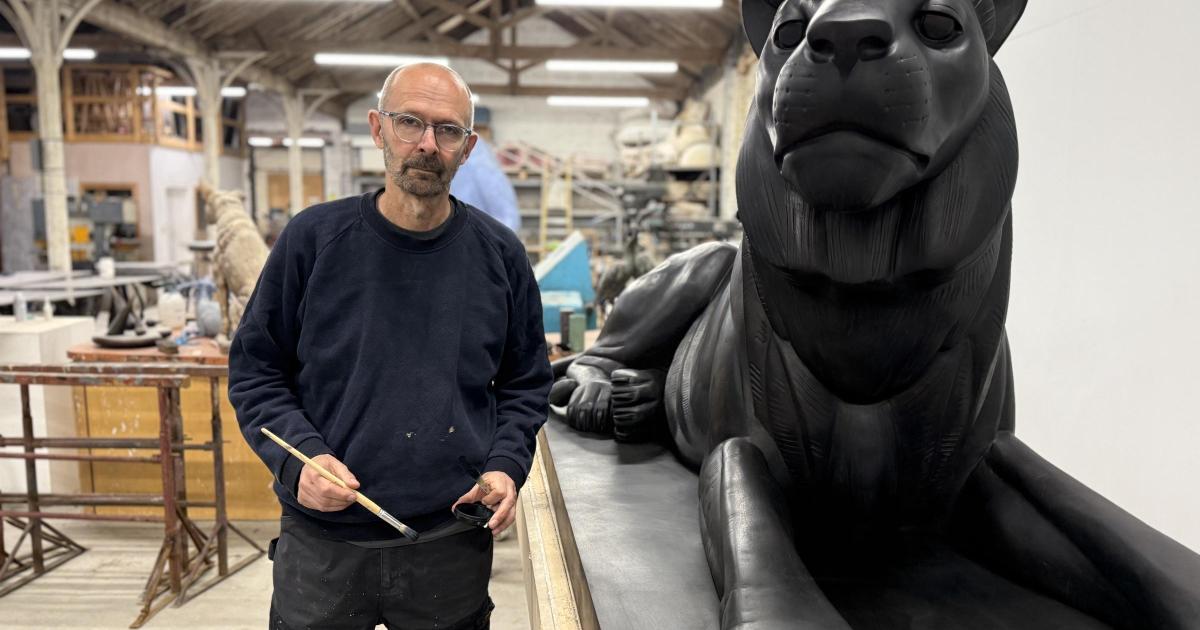
Edinburgh-born Kenny Hunter has been putting the finishing touches to a life-size work inspired by the cap badge of the Royal Regiment of Scotland, which will be unveiled in the city’s West Princes Street Gardens next month.
Read more:
The new work of art, commissioned to mark the 20th anniversary of the infantry regiment, has been earmarked for a site between the Ross Bandstand and the Ross Fountain, below its Edinburgh Castle headquarters.
The bronze lion, which was developed from early clay maquettes, will rest on a stone plinth formed from six sections representing the six historic Scottish army regiments that merged 20 years ago.
The new work of art, which has been nearly three years in the planning, will be unveiled on July 1 after a 20th anniversary parade through the city centre by the Royal Regiment of Scotland. It hopes the statue will become “a meaningful space for serving soldiers, veterans, families and visitors to connect with the regiment in the heart of the capital”.
The regiment had published a brief for artists to produce proposals for a “timeless, inclusive memorial, not a war monument” to honour officers and soldiers past and present.
Although it did not specifically request that a lion be featured in the new statue, the regiment said Hunter’s design “avoids glorification or heroic posturing, instead offering a grounded, empathetic presence that invites personal connection and reflection”.
Hunter told The Herald: “Animal forms are timeless. They don’t age in the way that uniforms or haircuts do.
“There are a lots of different sculpted lions out there. It was quite hard to find a way into the subject that felt new, different and authentic to the situation, but I think I got there.”
Speaking at Powderhall Bronze foundry in Edinburgh, where the lion statue has been created, Hunter said he had studied TV documentaries and scoured the internet for pictures of lions to make his statue as realistic as possible.
He added: “It’s a life-size young, male lion. I really wanted it to have a sense of youth, which I felt hadn’t been done so much before.
“I wanted to create something that was forceful and had power, without exaggerating it or dramatising it.
“I also wanted it to be a very still beast. For me, sculpture is at its best when it is still. I try to capture the moment that precedes action.
“The lion is at peace, but alert. Its hindquarters are quite relaxed, but its chin is raised, its gaze is focused and its shoulders are twitchy.
“Its head is up as if some kind of scent has entered its nostril and has alerted its brain. It has seen something on the horizon that it is alert to.
“I saw the lion as a metaphor for the armed forces. It is happy to be at peace and just guarding. But the key thing is its alertness. The armed forces are all about readiness. They have to be ready.”
A graduate of Glasgow School of Art, Hunter’s best known works include his Citizen Firefighter statue outside the city’s Central Station and life-size sculptures of NTS staff who worked through the Covid pandemic, which is in the grounds of the Royal College of Surgeons in Edinburgh.
Previous animal works by Hunter which can be seen in Scotland include a mouse monument near the Robert Burns Birthplace Museum in Alloway in Ayrshire and a life-size elephant in Bellahouston Park in Glasgow.
Hunter added: “It’s a great honour to be working on a project for Princes Street Gardens, but it’s also a heavy load as well. There’s a responsibility to deliver something that lives up to expectations.
“When I’m making something, I feel quite liberated. It’s my work and I’m in control of it. When it moves towards unveiling, and more people become involved, it all becomes much more logistical.
“We had to go through a very rigorous planning process and the site was moved around quite a bit because of the demands on the council over the use of the gardens but we are perfectly happy where it is going in near the Ross Fountain.
“The gardens are a really nice place to look at sculpture. There’s no traffic and people go there to relax. It has a good atmosphere considering it is in the city centre.”
Major General Robin Lindsay, colonel of The Royal Regiment of Scotland, said: “This statue will stand as a proud symbol of Scotland’s senior line infantry regiment.
“It reflects our heritage, honours all who have served, and looks ahead to the next generation.
“It will provide a fitting place for reflection and recognition, not only for the serving and veteran community, but for all who visit our city and its gardens.”