
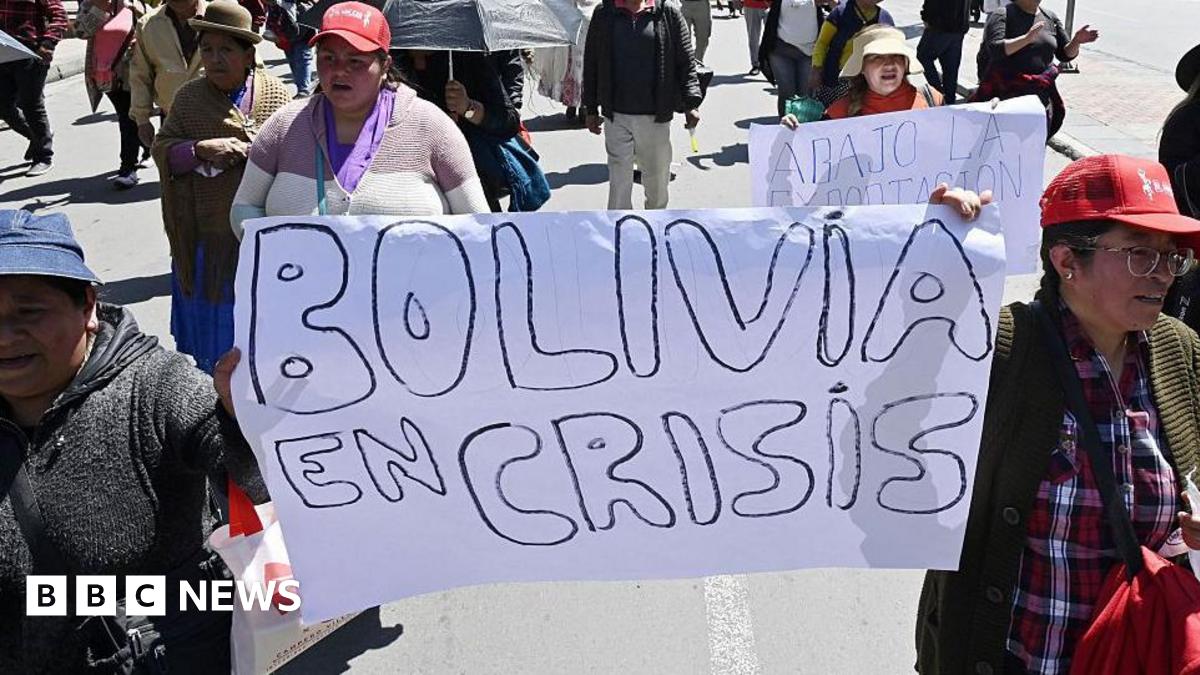
For almost 20 years the Bolivian government kept fuel prices artificially low through subsidies. This started when the government of then President Evo Morales nationalised the country’s hydrocarbon sector in 2006.
But in 2023, state energy company YPFB said Bolivia was running out of domestically-produced natural gas, due to a lack of investment in new exploration.
Without this gas to export, the Bolivian government is struggling to continue to find the funds to subsidise petrol and diesel. Last year it spent $2bn (£1.5bn) on such subsidies, according to a recent statement by a former minister of hydrocarbons and energy.
Outgoing left-wing President Luis Arce, who is not seeking re-election on 17 August, blamed the Bolivian parliament for the fall in natural gas production, accusing MPs of blocking vital oversea loans. His opponents in turn blame him for the economic turmoil.
The official exchange rate of Bolivia’s currency, the bolivianos, is certainly not helping matters. Since 2011 the government has fixed the exchange rate at 6.96 bolivianos to one US dollar.
But unofficially you can get 14 to 15 bolivianos per dollar. This has led to a thriving black market, especially of exports, from which the government misses out on tax revenue.
Economist Gary Rodriguez, the general manager for the Bolivian Institute of Foreign Trade, explains: “A product that costs seven bolivianos here in Bolivia can be sold for 15 bolivianos abroad,” he says.
“The problem is that businesses would prefer to sell items on the [overseas] black market rather than here in Bolivia which leads to food and fuel shortages.”