
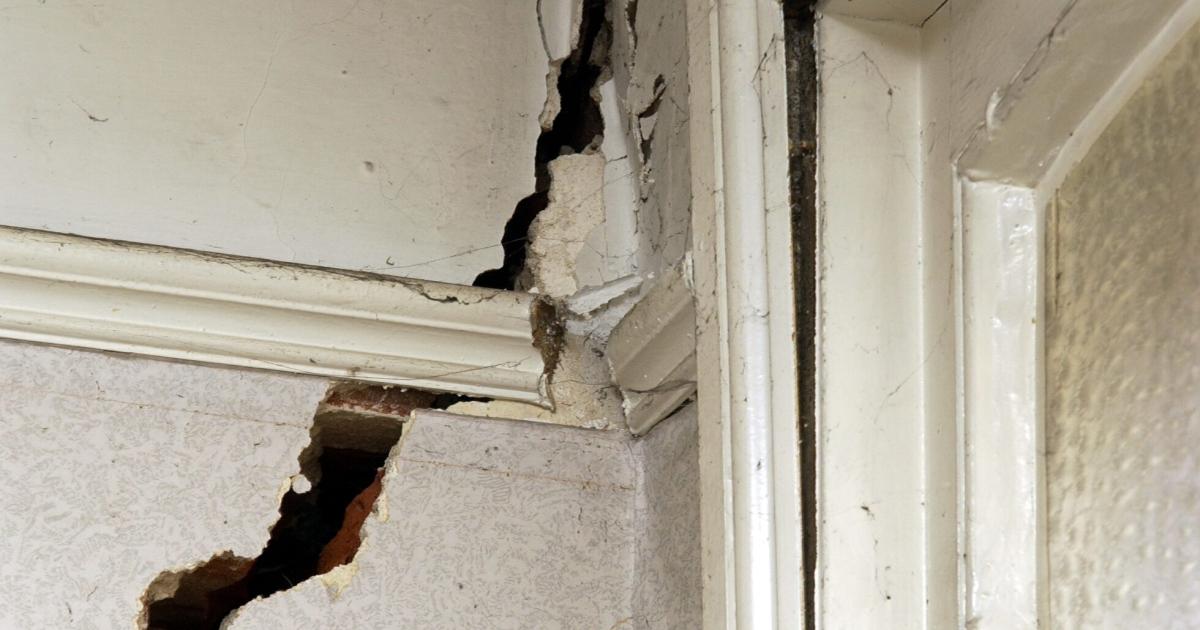
Experts say properties built on clay soils, which are common across the region are increasingly vulnerable to so-called shrink swell behaviour.
This is when the ground beneath their foundations expands after heavy rainfall and contracts during dry spells, like the current heatwave.
The movement can undermine building foundations leading to cracking walls, distorted doors and windows, and in some cases severe structural damage.
The British Geological Survey (BGS) has published maps highlighting how conditions could change as the climate warms.
Its worst-case scenario assumes fossil fuel use and other pollution keep rising strongly over the coming decades, bringing more extreme heat, droughts and heavy rain.
Maps showing areas at risk from subsidence caused by climate change produced by the British Geological Survey, with the worst-case scenario affecting much of East Anglia on the right (Image: British Geological Survey)
It shows large swathes of Norfolk, including Norwich, south Norfolk and Breckland would be impacted, along with much of Suffolk.
Parts of west Norfolk around the Wash, the Fens along the Great Ouse river and north Norfolk would also be affected.
BGS scientist Anna Harrison said: “Dry weather and high temperatures are a major factor in the emergence of shrink–swell subsidence.
“Looking ahead, these increases in hotter, drier summers and warmer, wetter winters are projected to continue.”
Kevin Hiscock, a professor at the School of Environmental Sciences at the University of East Anglia, said: “Soils in Norfolk are highly-variable, which means that risks to homes can differ significantly from one area to another, depending on local soil conditions and recent weather patterns.
Prof Kevin Hiscock, from the UEA (Image: UEA)
“During hot dry weather in a long drought, there is a risk that clay soils which cover much of central East Anglia can experience shrinkage and ground movement, sometimes causing cracks to develop in walls, driveways and foundations.”
Insurer Aviva says 1.4m properties could be at risk of subsidence across the country within decades, with East Anglia among the most vulnerable regions.
“One in seven (15pc) of properties in Norfolk and Suffolk could be at risk of subsidence by 2050,” it said in a statement.
“This is largely due to the region’s clay-rich soils, which, when combined with rising temperatures, prolonged dry spells and older housing, can increase the likelihood of subsidence.”
A house under repair after subsidence was discovered (Image: Newsquest)
Figures from the Association of British Insurers (ABI) reveal £153m in subsidence-related insurance claims were recorded in the first half of 2025 alone, affecting nearly 9,000 households across the UK.
It says the average household subsidence claim is now £17,820.
Charlie Inwood, policy adviser for general insurance at the ABI, said: “As extreme heatwaves and heavy rainfall become more common, subsidence continues to take a toll on households across the UK.
“Areas with clay-rich soils are particularly at risk, as changing moisture levels cause the ground to shift, leading to cracks in walls, uneven foundations, and structural damage.”
WHAT SHOULD YOU TO LOOK FOR?
Damage to a property caused by subsidence (Image: Newsquest/Archive)
Cracks wider than 3mm (roughly the thickness of a £1 coin), particularly those that are diagonal, wider at the top than the bottom and visible on both the inside and outside of the property, should raise concern.
Other warning signals include doors and windows sticking for no apparent reason, or wallpaper that begins to ripple or tear in areas not affected by damp.
These cracks and changes often appear suddenly rather than developing slowly over time.
WHAT CAN YOU DO?
Experts say homeowners can reduce the risk by managing nearby trees and shrubs that they own, which may sap water from the soil close to their properties during dry spells, compounding any problems.
Cracking caused by ground movement beneath a home (Image: Danielle Booden/Archive)
Gutters, pipes and plumbing should also be well maintained to avoid leaks, while soil surveys should be carried out before properties are extended.
Charlie Inwood, policy advisor for general insurance at the ABI, said: “While property insurance is there to cover these perils, earlier detection and more resilient design remain essential steps to ensure homes can withstand the effects of our changing climate.
“If you spot signs of subsidence, contact your insurer as soon as possible.”