
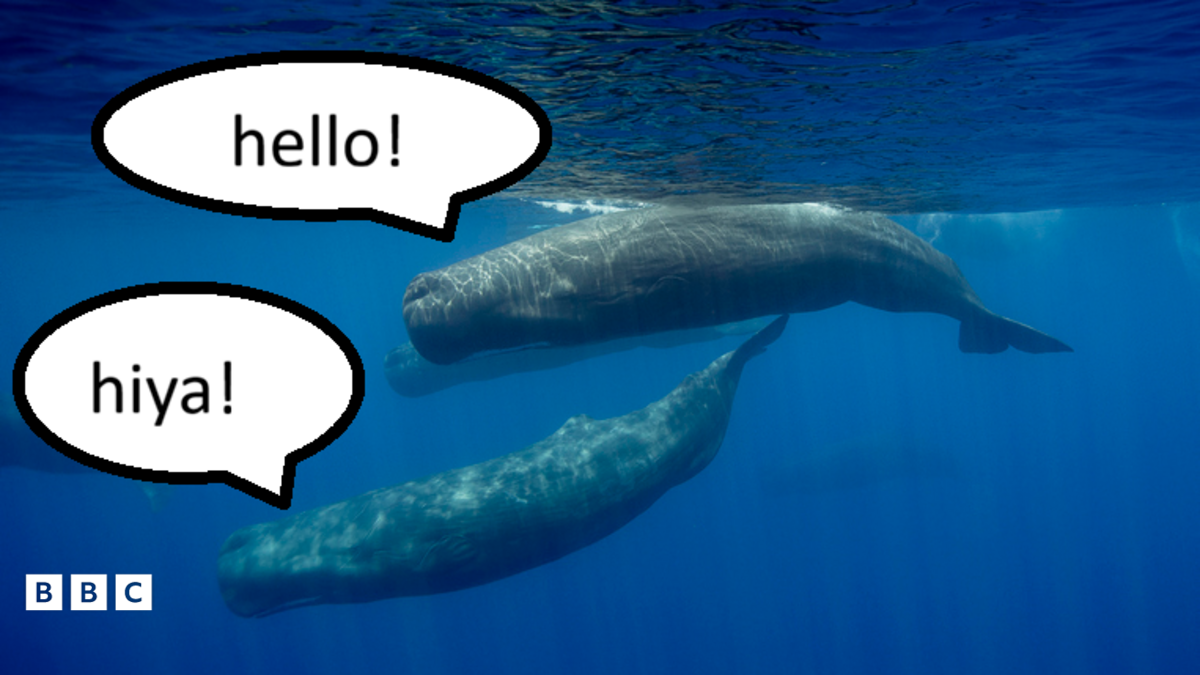
Sperm whales communicate using short bursts of clicking sounds, called codas.
The mammals use these codas to stay in touch with members of their family groups.
An international team of researchers, led by the University of St Andrews in Scotland, decided to take a closer look at sperm whales living across southern Europe.
They studied recordings, collected over nearly 20 years, from whales living near Greece in the eastern Mediterranean, and near Spain’s Balearic Islands in the west.
They found that whales in both areas often used groups of four clicks – however the rhythms were different.
Whales in the western Mediterranean used a pattern with three clicks followed by a pause, and then a final click.
While whales living further east used a faster version of the same pattern.
Scientists think the whales’ ancestors first settled in the western Mediterranean around 20,000 years ago, before some moved east.
Over thousands of years, their clicking patterns then slowly changed.
Experts say this is the first time they have been able to spot signs about how a new type of sperm whale communication may have developed.
The team added that it shows that how whales interact with each other can evolve when groups spend long periods of time apart.