
The Netflix documentary The Crash revisits the 2022 case of Mackenzie Shirilla, a young Ohio woman convicted of intentionally driving a vehicle into a building at over 100 miles per hour, killing her boyfriend and another passenger. Yet much of the public conversation surrounding the case has focused not on the tragedy itself, but on something else entirely. Just scroll through the social media comments to see the striking pattern of discussion about the alleged killer’s youth, beauty, and the unsettling contrast between appearance and action. “How can someone who appears so young, attractive, familiar, or ordinary be capable of something so devastating?” was the question on the public’s mind.
Psychologists have long documented what’s known as the halo effect: the tendency to assume that attractive individuals possess other positive qualities, including intelligence and moral goodness. When an attractive person commits a horrific act, our brains experience a kind of cognitive conflict. The story doesn’t fit our expectations, and we tend to instinctively search for explanations that preserve the image we’ve already formed so that we can reconcile what we see with what we believe.
Shouldn’t we scrutinize the evidence more carefully?
But what about the mitigating circumstances?
The facts don’t change, but our interpretation of them shifts, or at least stretches. Thus it’s not so much the “truth” as our own previously formed image and idea that we’re protecting.
So when reality questions our belief that beauty, charm, youth, power, or even familiarity somehow correspond with goodness, we question reality rather than the belief.
When Villains Become Heroes
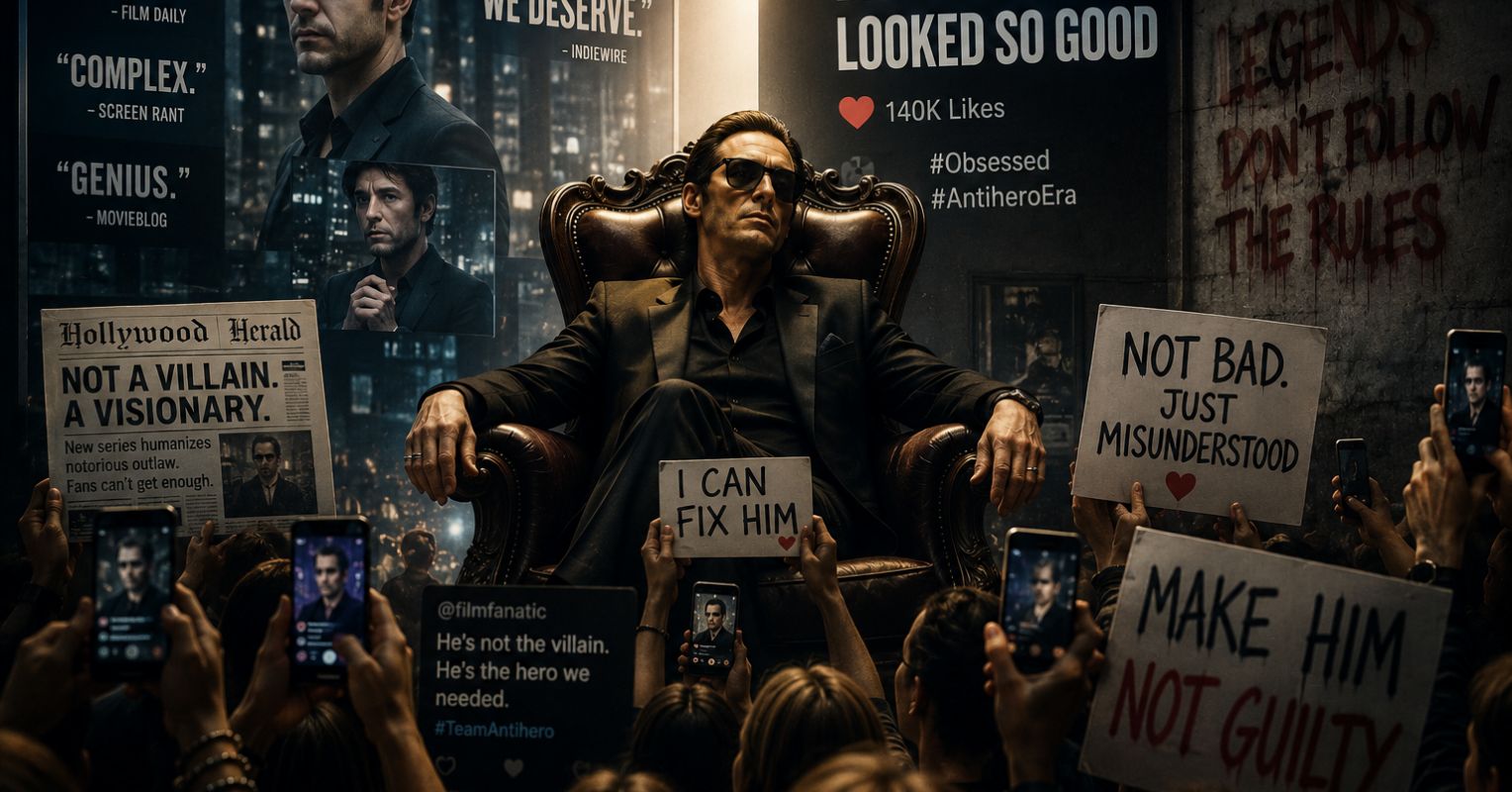
This tendency extends far beyond the world of true crime. It’s become one of the defining features of modern entertainment. Again and again, we’re invited to inhabit the villain’s perspective. We see the world through the eyes of the charismatic drug dealer, the morally ambiguous assassin, the brilliantly written master thief, the ruthless strategist, or the antihero who leaves a trail of destruction behind him yet somehow retains our loyalty. We’re encouraged to understand them, empathize with them, and often, despite ourselves, root for them.
Wow, that outlaw is clever enough to succeed!
Look at him, refusing to be constrained by the rules.
Then, typically without realizing it, we begin to confuse effectiveness with virtue and power with strength, blurring the line between fascination and admiration.
It isn’t that audiences (well, we humans) are immoral, but rather that stories are powerful for beings so inexplicably wired for narrative. We naturally identify with protagonists, adopt their perspectives, and experience their victories and defeats as if they were our own. The longer we travel alongside a character, the easier it becomes to view the world through their eyes and, at times, to excuse what we would otherwise condemn. Before we know it, we’re celebrating dominance and manipulation instead of wisdom and virtue.
Modern Scientific Support for Ancient Stoic Training
When Marcus Aurelius said, “the soul becomes dyed with the color of its thoughts,” the Roman emperor knew nothing of the neuroscience he seemed to intuit. Indeed, the brain is constantly adapting to repeated patterns of attention. Neuroscientists refer to this process as neuroplasticity: the brain’s ability to strengthen neural pathways that are repeatedly activated. Hebb’s famous principle, often summarized as “neurons that fire together wire together,” captures the idea. In other words, repeated thoughts and patterns influence the architecture of the brain itself, making admiration a kind of training ground. Every person we place on a pedestal becomes a teacher, whether we realize it or not. This gradual shaping of character resembles what I describe in my latest TEDx talk as ethical drift: the quiet process by which repeated, seemingly insignificant shifts in our attention and judgments slowly carry us away from the person we intended to become.
When Entertainment Becomes Moral Education
None of this means we should stop watching crime documentaries, reading complex novels, or enjoying morally ambiguous characters. In this article, I’m advocating for awareness, not avoidance or censorship. Rather, after the movie, ask whether you find the most interesting characters admirable. Is their behavior courage or dominance? Confidence or narcissism?
The distinction matters because many of the qualities that initially attract us exist uncomfortably close to qualities that ultimately harm us. Confidence shades into arrogance, charm becomes manipulation, fearlessness transfers to recklessness, and strength takes on a sense of cruelty. We must, therefore, train our minds to recognize more of what’s good than what is attractive.
Seeing Clearly
The Stoics believed that wisdom begins with the courage to see things as they truly are, rather than as we wish them to be. It’s true that in today’s world we are overwhelmed by an economy of attention, where visibility is often mistaken for value and virtue. Social media rewards engagement, not character. Yet the challenge facing us is the same one that confronted the Stoics two thousand years ago: to separate appearance from substance and remember that a captivating story isn’t necessarily an honorable life.
Neuroplasticity Essential Reads
This is why the people we admire matter. The stories we celebrate matter. The qualities we praise matter.
They may not change the world overnight, but they change us. Yes, the soul does become dyed with the color of its thoughts. Day after day, thought after thought, admiration after admiration, we’re coloring our character with the things to which we give our attention.
So ask.
Am I being shaped?
By whom? And
What color am I choosing for my soul?