
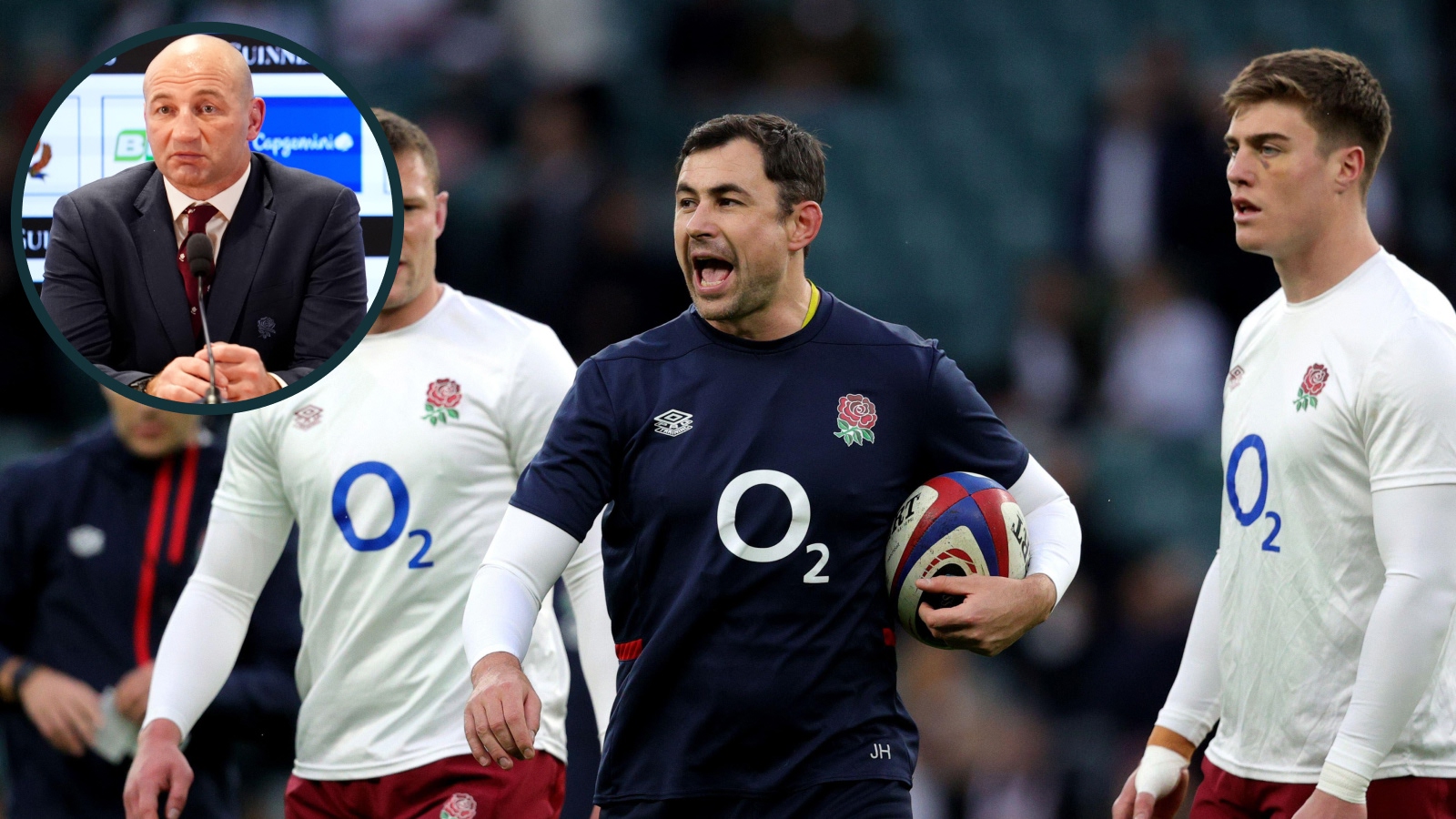
Felix Jones will be busy preparing the Springboks for their Nations Championship opener on Saturday, against his former side, England.
Just two years ago, Jones dramatically handed in his resignation letter to the bigwigs at the RFU following a disappointing summer series in New Zealand, which saw England lose both of their matches against the Southern Hemisphere opposition.
His reason for exiting was described at the time as being due to “unstable working environments”, but nothing else was made public. That was, until Telegraph Sport recently uncovered further details surrounding the fallout.
“Steve was very inflexible and didn’t really like people challenging him,” a source told the English paper.
“It became, ‘You are in charge of defence. Stick to your lane,” which didn’t bode well for the Irishman, who it appeared felt restricted within the structure.
“Felix’s argument is that defence does not operate in a silo. It has to be connected to the set-piece, it has to be connected to your kicking game and your attacking game,” continued the source.
Want more from Planet Rugby? Add us as a preferred source on Google to your favourites list for world-class coverage you can trust.
Jones spent less than a year with England after joining the camp after the 2023 World Cup, but despite relative success in the 2024 Six Nations, he struggled to make his mark on the side. A source told Telegraph Sport that Jones was “prevented from giving input to certain players,” and was informed, “You can’t talk to these players because they are not part of your group.”
Attempting to implement a very aggressive defence, he was given little scope to impact other parts of the game, including set-plays, which Jones believes are important cogs in the defensive machine.
Jones was also left frustrated with the coaching staff’s lack of ambition.
“He was absolutely gutted because he thought there was a chance of winning the series,” a fellow coach recalled.
“He felt the management were saying, ‘Isn’t it great that we were in with a shout.’ The Boks are ruthless about winning. He has come from that environment and couldn’t understand why that is not part of the DNA.”
The RFU claimed that Jones worked from home during England’s 2024 Autumn Nations Series campaign. However, the side saw a major dip in defensive form during this time period, shipping almost 100 points in their three high-profile losses, including 42 to a very unfancied Wallabies side.
The trigger of Aled Walters’ exit
It has been suggested that the exit of Aled Walters, England’s former head of strength and conditioning, was also a key reason behind Jones’s departure. The two had reportedly created a close bond, having worked closely together at Munster and the Springboks in the years prior.
“There’s no doubt the Aled thing played into that because they are very close and so are their wives and partners,” an RFU source said, reflecting on the fact that Jones handed in his resignation letter just weeks after Walters vacated.
Both members of staff now have employment elsewhere: Walters, now the Head of Athletic Performance at Ireland, and Jones, the understudy to Rassie Erasmus at the Springboks.
Despite the controversy that came with Jones’ exit, there remains no animosity within camp – certainly not from the players.
“I loved working with Felix,” full-back George Furbank said. “We weren’t expecting it. Nobody really saw it coming. [The blitz system] helped us go from a defence that was ranked fourth or fifth in the world to first or second. We definitely saw massive improvements.”
Jones’ exit allowed for a reshuffle within the coaching staff, with Borthwick instead choosing to replace him with a more generalised coach in Joe El-Abd, a former flatmate of Borthwick’s. While El-Abd may not have the defensive expertise that Jones possesses, perhaps the level of trust is more important to the England head coach.
In terms of trust levels, Erasmus appeared to hit out at the England coaching staff in a statement when Jones returned to the Springboks, saying: “After spending some time in England, his experience of working in the UK and studying the opposition teams in the Six Nations and other international tournaments will add immense value in assisting us to adapt and improve as we cast an eye on a tough international season ahead,” Erasmus said.
“I’m not sure why things didn’t work out for him over in England, but we are happy to have him back. We don’t have egos in the team, and we believe in sharing responsibilities as coaches, so he will be a valuable asset to the coaching team.”
There’s been no official confirmation that Erasmus approached Jones during his time at England, but a source told the Telegraph: “Bottom line, South Africa wanted him back. That’s the reality.”