
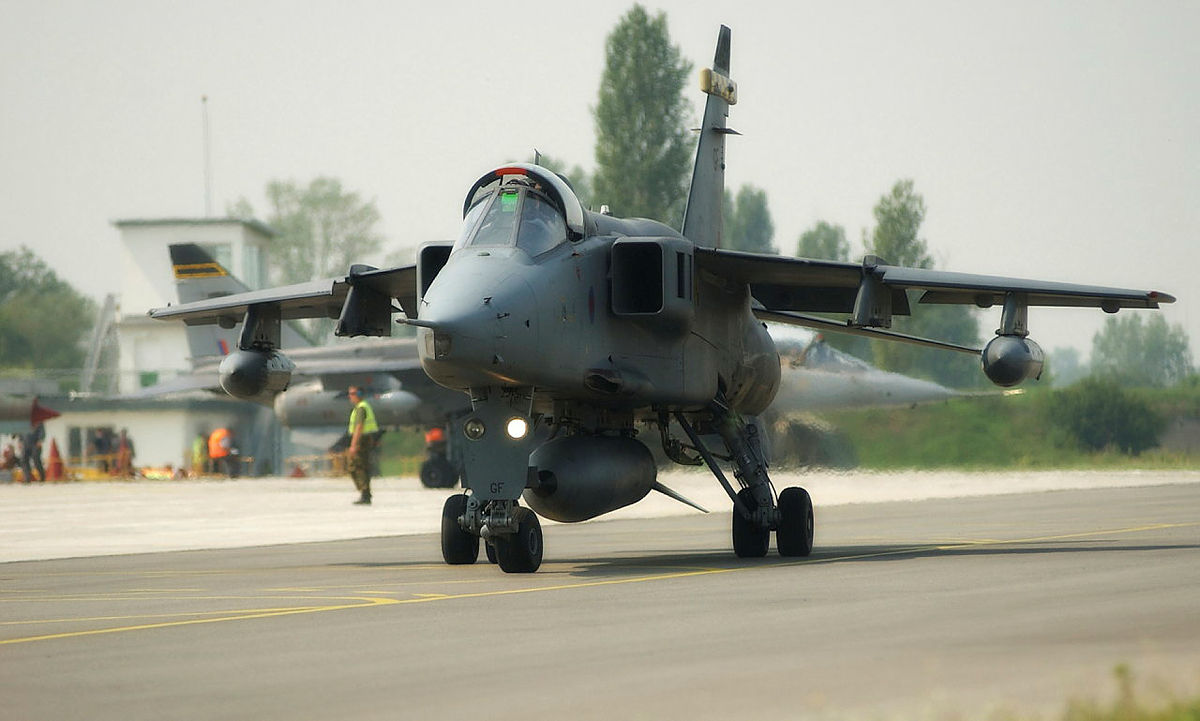
The Ministry of Defence still holds 42 SEPECAT Jaguar aircraft almost two decades after the type retired from Royal Air Force service, with nine more having been transferred to the Indian Air Force, the department has said.
The figures came in a written parliamentary answer from Minister for Defence Readiness and Industry Luke Pollard on 3 July, responding to a question from Ben Obese-Jecty, the Conservative MP for Huntingdon, who asked how many GR1 and T2 variant Jaguars the department still holds.
“A total of nine Jaguar aircraft have been transferred to the Indian Air Force. Of these, five were the GR1 variant, and four the T2 variant,” the minister said. “Of the 42 Jaguar aircraft the Ministry of Defence still holds, 13 are the GR1 variant and none are the T2 variant.” The answer does not specify the variants of the remaining 29 airframes, which the question’s scope did not cover, though the balance of the surviving fleet would be expected to comprise later marks including the upgraded GR3 series and T4 two-seaters.
The Jaguar was developed jointly by Britain and France under the SEPECAT consortium as a low-level strike and reconnaissance aircraft, entering RAF service in 1974 and flying combat operations in the 1991 Gulf War and over Iraq and the Balkans through the 1990s before its retirement in 2007, when the fleet was withdrawn earlier than planned as a savings measure. A substantial number of airframes were retained after withdrawal, most prominently at RAF Cosford, where the School of Technical Training has used Jaguars for decades as ground instructional airframes on which RAF engineering technicians learn their trade, keeping many of the jets in remarkably complete condition.
India is the last nation still flying the Jaguar, operating a fleet built largely under licence by Hindustan Aeronautics and known locally as the Shamsher. With the type long out of production and spares increasingly scarce, the Indian Air Force has turned to retired operators for support, and the transfer of British airframes provides a source of components to sustain the fleet through its final years of service, with India planning to phase the aircraft out over the coming decade.
The answer does not state the condition of the 42 retained aircraft, but we understand them to be purely used as ground instructional airframes; they’re not flight-capable.