
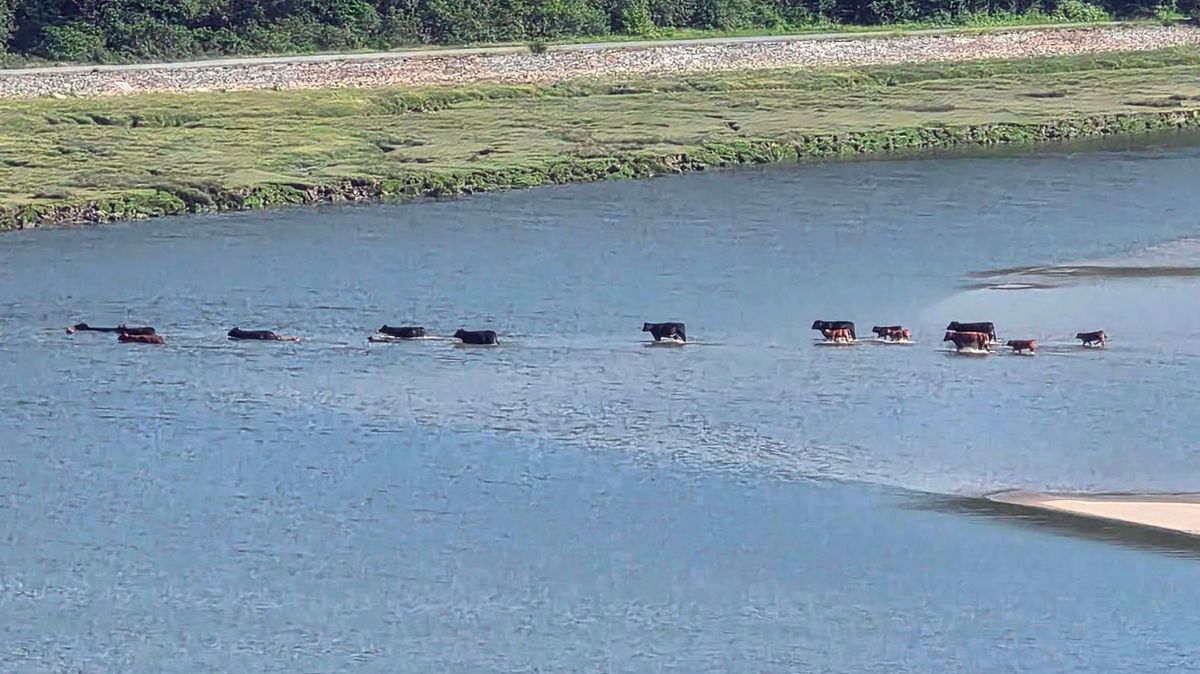
For these cows, the grass really was greener on the other side. To reach it, they splashed and swam across a Gwynedd estuary with shifting sandbars and fast tides considered too dangerous for most wild swimmers.
Cattle are accomplished paddlers and, at low tide, local herds occasionally cross the Afon Mawddach between Barmouth and Penmaenpool in search of fresher grazing. Set against wooded riverbanks framed by the towering peaks of Eryri national park, it’s a majestic sight reminiscent of the days of droving.
“How cool is that!” said a man when photos of the river-fording cattle were posted online. “It’s like something you see in an Attenborough Serengeti programme.”
A woman reckoned it made the Mawddach look like “Wales’ own Yellowstone”. Another also referenced the hit drama series, saying it “looks just like a Dutton Ranch scene.”
More often, cattle gather on the Mawddach’s sandbars at low tide just to cool off in on-shore breezes. During the recent heatwave, a quick dip in the river would have been just the ticket.
Watching the scene unfold was Steve Burrows, who took these captivating images. He said: “We view the Mawddach estuary from our house. I glanced over and saw the cattle ‘lining up’ to cross and watched with interest as they proceeded to swim to the distant bank.
“I was relieved to see that they all made it, even the younger calves. They seem to have an in-built instinct to know when it is safe to cross.”
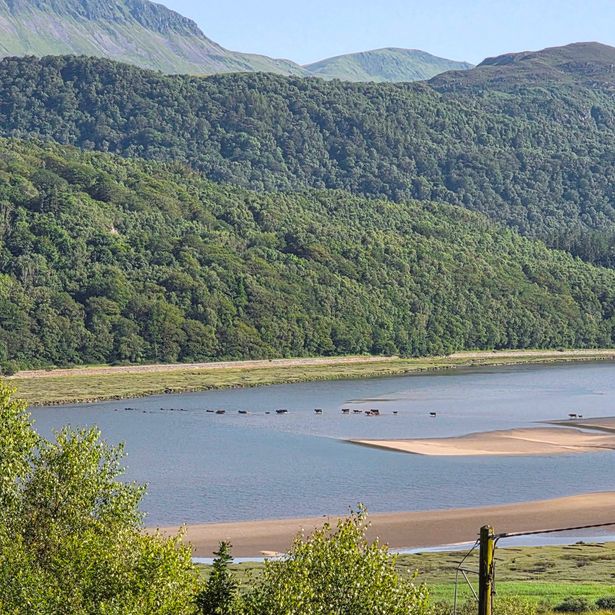
Neo-Western sight on the Afon Mawddach(Image: Steve Burrows)
On land, cattle can appear cumbersome but in water they are strong swimmers. Thanks to their large barrel-shaped bodies and digestive gasses, cows have a surprising amount of buoyancy. Keeping their heads above the surface, they swim with a rhythmic, four-legged paddle.
Moving cattle across water to fresh grazing was once common practice. In a shrinking number of places, it still is. Although the practice ended in the Inner Hebrides 10 years ago, Irish farmers in Connemara and County Mayo still swim their cattle across short stretches of sea to graze on remote offshore islands.
One of history’s most incredible examples were the mass Welsh Black cattle drives across the Menai Strait between Anglesey and the North Wales mainland. By the time the Menai Suspension Bridge was being conceived, some 14,000 cows were making the perilous trip each year, often swimming in a single dark mass en route to England’s markets.
Most went via Lavan Sands, a 25 sq km intertidal flat on the mainland at the eastern end of the Menai Strait. This was an ancient crossing route for travellers that, after a ferry trip from Anglesey, could be walked at low tide. Cattle had no such luxuries, and some perished while swimming the fast-flowing channel.
This tradition ended with the arrival of the railways, though Welsh livestock droving didn’t completely die out until the 1930s. These days, most cattle that cross bodies of water do it for their own reasons. Bulls, famously dismissive of fences and ditches, often don’t need a reason.
Cattle crossing Afon Glaslyn estuary near Porthmadog Cob – Video: Ron TargettCrossing the Glaslyn
More “Yellowstone” scenes can be found in the Glaslyn estuary near Porthmadog, where free-ranging cattle roam riverbanks and marshes for salt-enriched greens. They too will ford shallow crossings to graze remote floodplain pastures like Traeth Bach.
They’re also found nearer Porthmadog Cob on Traeth Mawr, the great sweep of reclaimed land and waterways whose mountainous backdrop featured in countless Victorian paintings, often studded with waterside cattle.
“It’s quite a regular occurrence to see them crossing parts of the estuary,” said Ron Targett, a Ffestiniog Railway enthusiast who recently filmed a procession of frisky cows splashing across the Glaslyn.
“It seems to be a natural herding instinct and it’s fascinating to watch. Not all cows stay with their calves – there always seem to be one mum standing apart and watching the others as if making sure they’re safe.”
With heat set to return to Wales in the coming days, the country’s estuaries may again see an outbreak of Yellowstone ranch scenes.