

Death rates from cancer rose significantly during the period of 1922 to 2023, while deaths from heart disease and tuberculosis declined, according to a new study by the Central Statistics Office.
The analysis is the first time the CSO has examined more than 100 years of data on deaths in Ireland, revealing the changing nature of life expectancy and causes of death.
Death rates in Ireland declined significantly over the period from 1922 – with 1,474 deaths per 100,000 population to 675 per 100,000 in 2023.
Male death rates fell from 1,488 per 100,000 in 1922 to 715 per 100,000 in 2023, while female death rates decreased from 1,460 per 100,000 in 1922 to 636 per 100,000 in 2023.
The proportion of overall deaths in the 0-5 years age range dropped significantly between 1922 and 2023, from 14.7% of all deaths, or 6,537 out of 44,547, in 1922 to 0.6% of all deaths, or 206 out of 35,649, in 2023.
While the proportion of overall infant deaths, those under the age of one, fell from 9.1% of all deaths, or 4,054 out of 44,547, in 1922 to 0.5% of all deaths, or 180 out of 35,649, in 2023.
We need your consent to load this rte-player contentWe use rte-player to manage extra content that can set cookies on your device and collect data about your activity. Please review their details and accept them to load the content.Manage Preferences
Speaking on RTÉ’s News At One programme, CSO Statistician Sean O’Connor said there is “really rich historic data available on births, deaths and marriages going all the way back to the 1800s”.
He said the data shows a decline in death rates and increase in life expectancy over the last 101 years.
“One of the things that stand out to me is in 1922 there was around 44,500 deaths and in 2023 there was around 35,500,” he said.
Mr O’Connor said in the 1920s life expectancy was around 57 years for men and 58 for women, while in the 2010s that has increased to 80 for males and 83 for females.
He said there were some really interesting long-term trends on the impact of cancer, heart disease and tuberculosis on death rates.
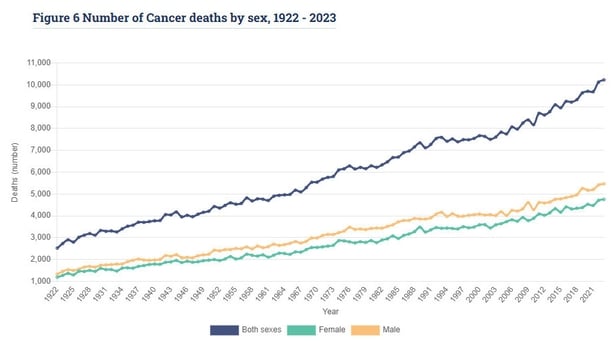
In 1922, cancer was the cause of death for 2,523 people, with the number rising to 10,221 people in 2023.
There was an increase in death rates from 84 per 100,000 population in 1922 to 194 per 100,000 in 2023.
The study stated that the exact reasons for this increase are “widely debated”.
It said: “Hypotheses including increased rates of diagnosis and improved testing, changes in classification of diseases, the potential impacts of improved longevity with age being considered a major risk factor for numerous cancers, as well as lifestyle factors such as consumption of alcohol and tobacco, which is to a lesser extent in recent years due to lower levels of tobacco consumption, environmental factors and negative elements of certain modern dietary choices.”
It added: “Therefore, great care should be taken in interpreting this increase.”
Looking at heart disease as a cause of death, rates have fluctuated over the 101 years analysed, rising from 153 deaths per 100,000, or 4,609 deaths total, in 1922 to a peak of 412 deaths per 100,000, or 11,890 total, in 1966 before falling to 125 deaths per 100,000 in 2023.
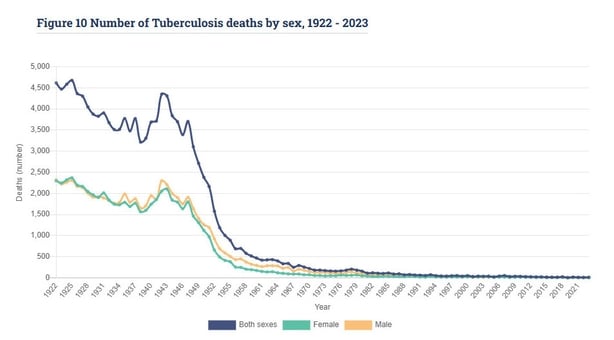
Tuberculosis decreased greatly from 4,614 deaths in 1922, when it was more prevalent than heart disease, to 14 deaths in 2023.
Rates of death due to TB have also fallen from 153 per 100,000 in 1922 to almost 0 per 100,000 in 2023.
The study said: “Tuberculosis or TB is a disease that loomed over Irish life up to the mid-20th century as a major cause of death.
“While TB has not been completely eradicated, the number of deaths is now low in comparison to historic years with 14 deaths occurring in 2023.”