
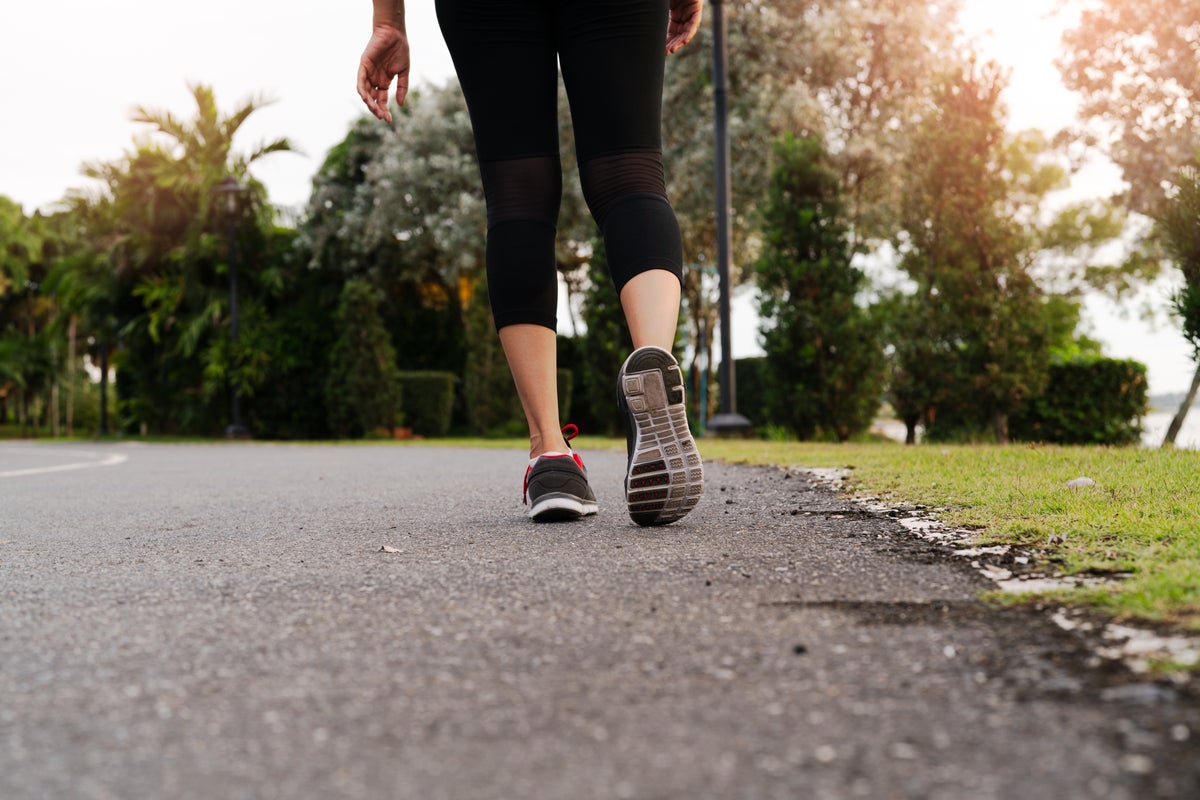
You are probably familiar with the “vital signs” – the key measures of the body’s ability to keep you alive and functioning: blood pressure, heart rate, breathing rate and body temperature.
Dr Courtney Conley and Dr Milica McDowell, co-authors of Walk: Your Life Depends On It, believe there should be another vital sign: walking speed.
“When you see someone walking with a slower cadence, it can be a predictor of a decline in mental health years in advance,” Dr Conley says. “If you see someone walking slowly, it’s usually because something hurts. Walking speed can also predict problems with balance, foot strength and calf strength.”
On top of this, studies have linked lower walking speeds to an increased risk of dementia, heart disease and death. Maintaining the strength and capacity needed for a speedy stride also translates to more mobility and independence as you age.
Below, Dr McDowell reveals what science suggests a slower walking speed could mean for your health. She also shares a simple test you can use to test your walking speed, and accessible ways you can improve it.
How to measure your walking speed
Dr McDowell suggests using the five-metre walking test to measure your walking speed. To do this, mark a straight, uninterrupted five-metre path, then walk it at your everyday pace.
“Walk as if you’re walking around your neighbourhood – not rushed, but not dawdling,” Dr McDowell advises. “If we look at your basic walking speed, this reveals your typical functional capacity and overall health versus having you walk at a pace that is unnaturally fast.”
Measure your time with a stopwatch, then divide the distance in metres (five) by the time it took you in seconds to find out your score in metres per second.
This is how to interpret your score:
10 seconds = 0.5 m/s (slower) 7 seconds = 0.7 m/s (below target) 5 seconds = 1.0 m/s (optimal threshold) 4 seconds = 1.25 m/s (strong) 3 seconds = 1.7 m/s (excellent)
“One metre per second is the threshold where mortality risk, cognitive decline and frailty risk show marked increases below it,” says Dr McDowell.
“Even a gain of 0.1 m/s is a predictor of improved well-being in those without normal walking speed.”
Read more: Expert warns why this daily habit is shortening your life – even if you exercise
 You can take a three-pronged approach to improving your walking speed, according to Dr McDowell. Look to increase your leg strength, balance and cardiovascular fitness (Getty)
The surprising science-backed link between walking speed and longevity
Consciously walking slowly is not going to shorten your lifespan. Rather, your default walking speed is a signifier of wider health problems that can impact longevity. For example, if you naturally walk more slowly, your body may not be as strong and mobile as that of a faster walker, or your heart and lung function might not be as efficient.
“Walking speed is one of the most predictive health markers available, and it is easy to measure at no cost,” says Dr McDowell.
“The latest science essentially says that if you can walk faster, you have greater cardiovascular fitness, greater leg strength, better balance, reduced fall risk and a higher level of cognitive processing and executive brain function.
“Walking faster is also an indicator of greater metabolic health, which means your ability to generate energy is better.”
A 2020 study published in the Atherosclerosis journal concluded that “walking pace is inversely associated with risk of death and cardiovascular disease”. In layman’s terms, the faster you tend to walk, the less likely you are to die or suffer from heart disease.
Read more: New research reveals the exercise six times more effective than walking
 Strong, healthy walking patterns help us maintain mobility, function and independence as we age (Harry Bullmore/The Independent)
Research from 2009 followed more than 3,000 people aged 65 and above for an average of 5.1 years. Those with a low walking speed were found to be three times more likely to die from a heart condition than faster walkers.
Another meta-analysis looked at 17 existing studies on the topic before determining that “slow or decreased walking pace is significantly associated with elevated risk of cognitive decline and dementia in elderly populations”.
And this is not just relevant to older populations. A 2019 cohort study of 1,037 45-year-olds discovered that “gait speed is associated with more than geriatric functional status; it is also associated with midlife ageing and lifelong brain health”.
“If you have a slower walking speed, it can indicate cognitive decline as far as seven years before the problem starts to surface, because it’s an indicator that your cells are having difficulty regulating your overall coordination,” Dr McDowell explains.
“Walking speed signals a decrease in many systems before clinical symptoms appear, so it is a good indicator that your medical team should look a little bit deeper to see what’s going on.”
Read more: Walking experts reveal the number of daily steps you need to boost health – and it’s not 10,000
 Walking speed is a strong indicator of mental and physical health as you age, research suggests (Getty/iStock)
How to improve your walking speed
“If you’re someone who’s at the lower end of the walking speed measurements, the solution is to improve your leg strength, overall cardiovascular fitness and balance in order to improve your ability to walk a little bit faster,” Dr McDowell says.
To address the first point, she recommends strength training at least two days per week.
“You want to focus on the lower body, and you can do this with just body weight exercises,” Dr McDowell continues. “Think squats, step-ups, lunges and bridges. Holds [such as wall sits, squat holds and standing on your toes] are another excellent type of exercise that can improve your lower leg strength.”
For improved cardiovascular fitness, any exercise or movement that raises your heart rate will be effective.
“Walking itself is a great way to get better at walking, while other good low-impact options include swimming, cycling or rowing,” Dr McDowell says.
These other exercise options might make it easier to sprinkle a little bit of extra intensity into your workouts – or, in other words, go a little bit faster and get a bit more out of breath – which is likely to deliver greater heart health perks over time.
“Finally, working on balance every day – such as standing on one leg while you’re brushing your teeth or waiting for the kettle to boil – can be a very helpful way to improve your walking speed,” Dr McDowell explains.
Read more: The easiest way to strengthen your entire body, according to this expert coach