
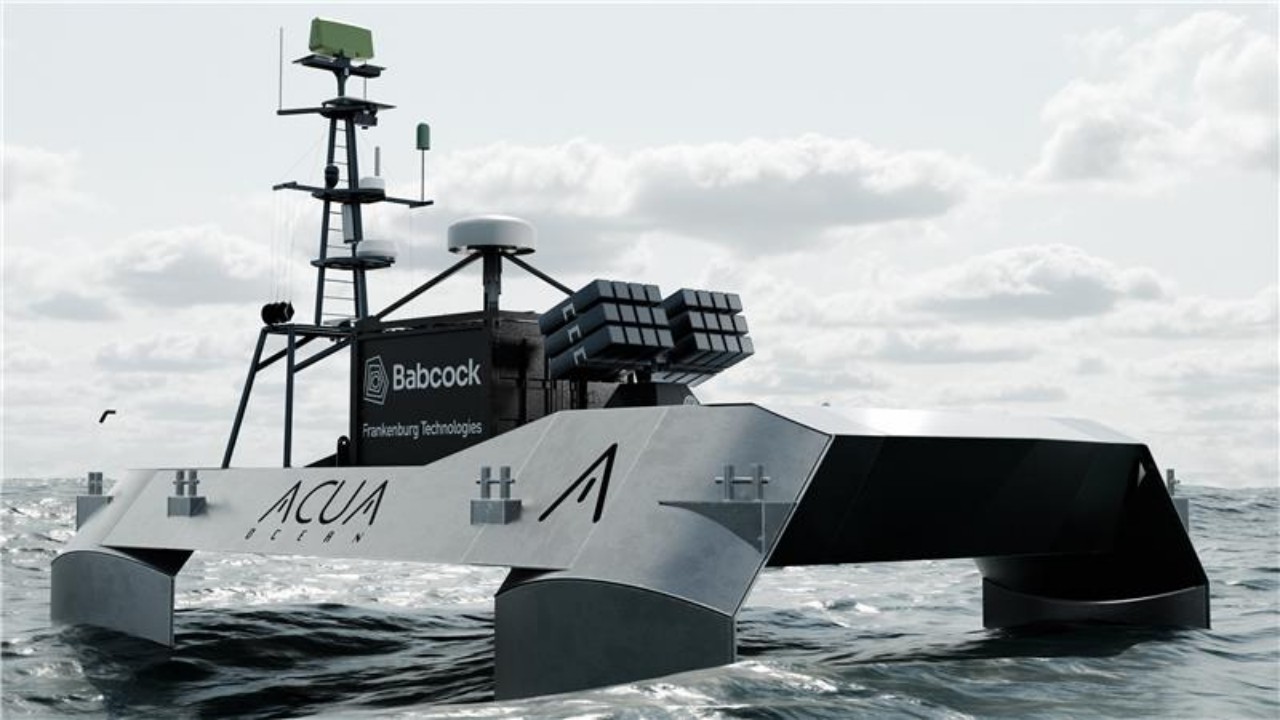
Babcock has signed an agreement with ACUA Ocean Technologies and Frankenburg Technologies to explore arming uncrewed vessels with low-cost missiles to counter drone attacks in the maritime domain, with the memorandum of understanding signed at the Farnborough International Airshow, the company stated.
The memorandum of understanding brings together three distinct elements: Babcock’s multi-domain launcher system, Frankenburg’s low-cost precision guided missiles, and the uncrewed surface vessels built by Plymouth-based marine technology firm ACUA, with the partners aiming to create integrated counter-drone solutions for the marine domain as the threat from cheap uncrewed aircraft continues to evolve.
The agreement builds on the partnership Babcock signed with Frankenburg in January to explore air defence systems able to withstand the rapid rise in one-way attack drones, with ACUA now adding the platform to carry the result to sea.
“We’re excited to partner with innovative companies to develop an integrated approach that directly addresses some of the biggest challenges our customers face in today’s defence landscape,” Babcock said in a statement attributed to Sir Nick Hine, its Chief Growth Officer, and its Future Capabilities Director, as quoted in the release. “As a trusted systems integrator, collaborations like this will help protect critical national assets and infrastructure from attritable one-way attack drones.”
The seakeeping of the host vessel is central to the pitch. “To counter mass drone attacks, maritime air defence must be uninterrupted, yet rough weather often forces traditional systems out of limits. The unique stability of ACUA’s Pioneer-class, which we’ll be using for this collaboration, ensures these counter UAS and interchangeable payloads remain online and fully operational in high seas where other platforms fail,” said Neil Tinmouth, ACUA’s Chief Executive, as quoted in the release. The company’s PIONEER vessel recently operated 16 to 20 nautical miles offshore for more than 100 hours at sea without hands-on intervention, according to the release, and Babcock says its launcher can be fitted to crewed and uncrewed vessels alike, built at pace and scaled quickly.
Frankenburg, the Estonian-founded firm whose UK arm is led by Daniel Hallett, develops small, mass-manufacturable interceptor missiles aimed at bringing the cost of engaging drones down towards the cost of the drones themselves. “Affordable missile defence is heading farther out to sea. By equipping ACUA’s uncrewed vessels with Frankenburg’s mass-manufacturable missiles and Babcock’s launcher technology, we aim to create a persistent and low-cost way to protect the UK’s ships, ports and critical maritime infrastructure against mass drone attacks,” he said, as quoted in the release.
The concept the three companies describe, persistent armed pickets holding station offshore in weather that would defeat conventional platforms, speaks directly to the Royal Navy’s hybrid fleet ambitions, which Babcock says the agreement supports as it develops technologies to underpin next-generation autonomous capability.