

The north is on course to surpass one million workforce jobs by 2032, new research from Ulster University suggests.
Analysis published by the university’s Economic Policy Centre (EPC) found Northern Ireland’s labour market continued to outperform the rest of the UK over the past year.
While employment has contracted across much of Britain, the north recorded the fastest annual growth in workforce jobs of any UK region between the first quarter of 2025 and the first quarter of 2026.
Economists at Ulster University believe one reason is the north’s retail sector being largely shielded by the major structural changes driven by online shopping across the water.


Whereas ‘wholesale and retail’ employment has declined across much of Britain since the pandemic, Northern Ireland has continued to see growth in the sector.
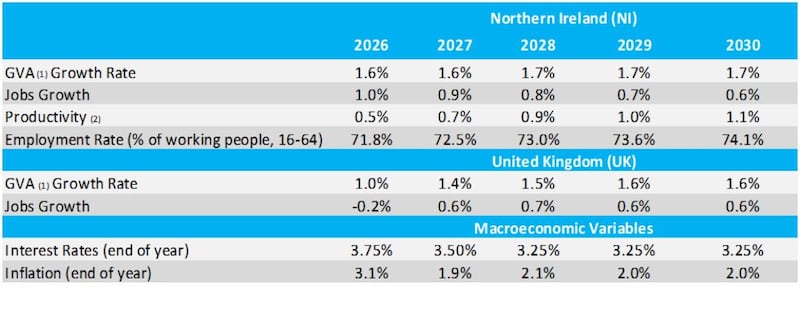 Summary of latest Ulster University Economic Policy Centre Economic Outlook. (Ryan)
That is unlikely to continue in the long-term said principal economist Myles Patton, with the retail trend expected to eventually filter through.
However, the latest EPC economic outlook forecasts the Northern Ireland economy will grow by 1.6% in gross value added (GVA) terms this year and next, rising to 1.7% by 2028. The UK economy is expected to growth by just 1% this year, rising to 1.6% by 2029.
The UUEPC anticipates the north’s economy will expand at a faster rate than the wider UK over the next four years.
“The actual figures show how resilient the Northern Ireland economy has been despite the geopolitical tensions,” said Dr Patton.
That resilience has been underpinned by the strength of the labour market.
 Ulster University principal economy, Myles Patton. (Nigel McDowell)
“Partly that’s reflected by the importance of the public sector, with expansions in jobs in education and health.
“But the private sector is continuing to do well.”
Ulster University’s research shows 107,000 jobs were added across the north between 2015 and 2025, with health and education responsible for around one-third of that.
Around 11,000 jobs were added across manufacturing in that ten year period, with the ‘professional & scientific’ sector responsible for around 15,000.
The university’s EPC expect a baseline of 63,000 jobs to be created in the ten years to 2035.
However, that could rise to 89,000 depending on economic performance.
As many as 12,000 construction jobs could be added if major infrastructure schemes go ahead as planned, the economists say.
Healthcare will continue to be a major driver of job growth, but new research from the university has flagged up the cost of high rates of staff turnover in the health and social care system.
It estimates the financial burden of losing dozens of social workers in particular cost around £7m in 2024/25 due to the costs associated with hiring, training and productivity losses while vacancies remained unfilled.
The search found that cutting the number of social workers leaving by 20% could have saved £1.43m, which could in turn fund 42 band 5/6 social workers.
 Senior economist Gillian Martin. (Nigel McDowell)
Senior economist Gillian Martin said: “The research demonstrates that investing in employee wellbeing, professional development and workforce planning can deliver significant benefits, both financially and socially.”
Meanwhile, research into productivity growth and employment has challenged the notion that higher productivity inevitably results in fewer jobs.
It found that while productivity improvements can reduce labour demand in some sectors, it also generates positive spill over effects that support job creation elsewhere in the economy.
“The research suggests that productivity growth is more commonly associated with job reallocation across the economy than with widespread job destruction, while highlighting the growing importance of skills development and workforce adaptability as technologies such as artificial intelligence continue to evolve,” added Dr Patton.