
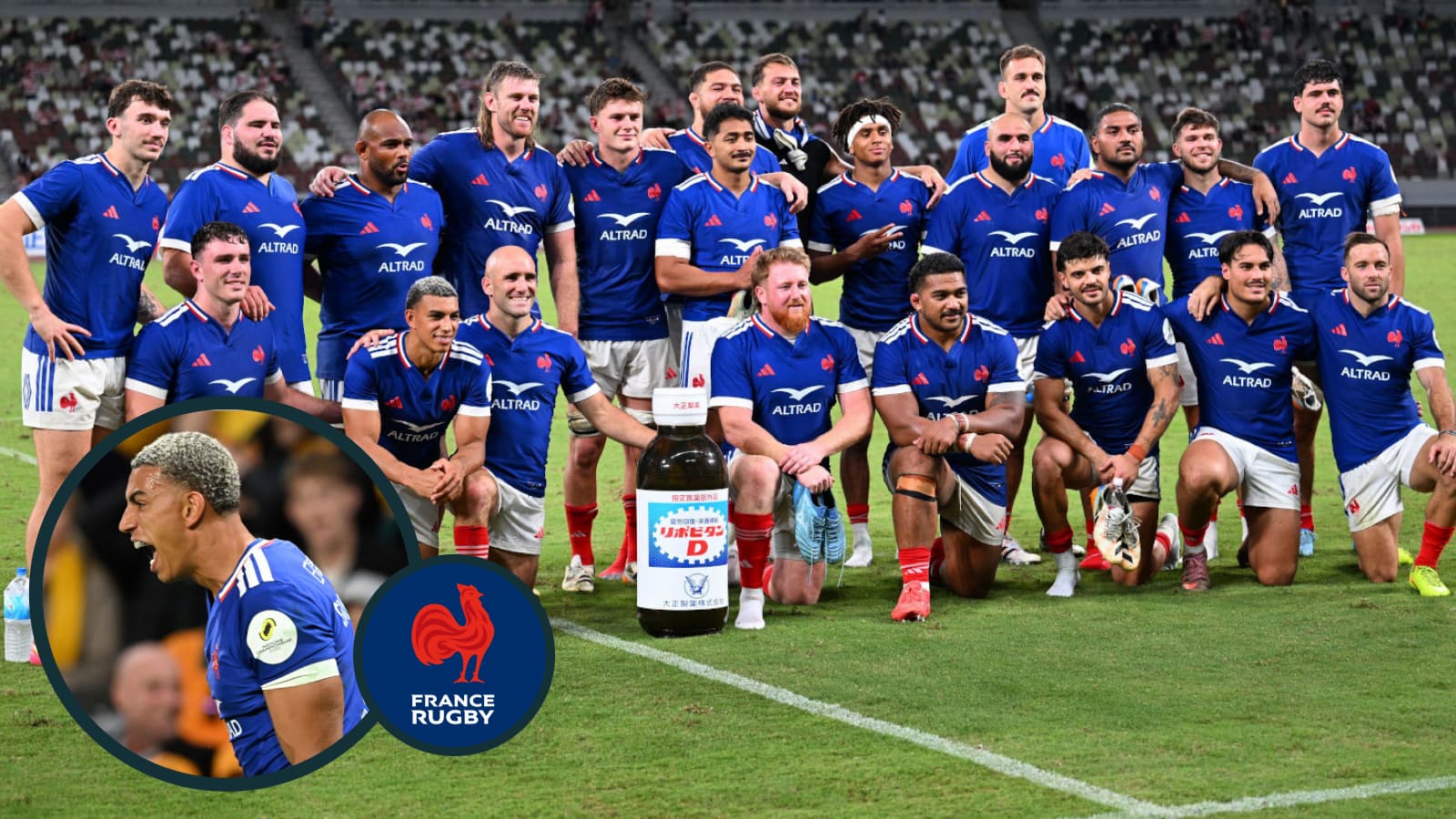
Following the conclusion of the Southern Hemisphere leg of the 2026 Nations Championship, we update you on the state of the participating nations. Next up, it’s Fabien Galthié’s France.
Consider, for a moment, the team France left at home in July. Jean-Baptiste Gros, Julien Marchand and Dorian Aldegheri as a front-row, Thibaud Flament and Cameron Woki behind them, François Cros, Charles Ollivon and Grégory Alldritt across the back of the scrum, Antoine Dupont and Thomas Ramos as a half-back pairing, Gaël Fickou and Pierre-Louis Barassi in midfield, Louis Bielle-Biarrey out wide and Baptiste Serin covering the lot from the bench. That is a first XV and change, a side that would fancy itself against anyone on earth, and not one of them played a minute of the Southern Hemisphere leg. Alldritt was injured, Bielle-Biarrey and Woki were rested, the Toulouse and Montpellier contingents were withheld until after the Top 14 final, and Dupont, though released to the squad once Toulouse were done, was never used. So Galthié went south with the understudies, and the understudies went top of the table.
This year matters enormously for Les Bleus; back-to-back Six Nations champions with a maiden Nations Championship to chase, a November home leg that opens against Fiji, and beyond it the 2027 Rugby World Cup in Australia, the one trophy this generation still owes itself.
Nations Championship summary
Three Tests, three away grounds, 16 tries, 116 points scored, 75 conceded, a try bonus point in every match, and top spot in the Northern Hemisphere standings on 12 points despite losing the opener. 35 players contributed. It was some month.
It began in Christchurch, where Test rugby returned to the city at the magnificent new Te Kaha stadium and the occasion got the game it deserved: nine tries, seven lead changes and a 34-32 All Blacks escape. Damian Penaud scored inside 90 seconds, Matthieu Jalibert conducted the whole evening and crowned it with a 77th-minute try, and a French side shorn of its entire spine went within one score of a first win in Christchurch since 1994. Two table points travelled home with them, along with the nagging sense of a Test that was there to be taken.
Brisbane a week later was the statement. Emmanuel Meafou, the one who got away from Australian rugby, opened the scoring inside three minutes by carrying three gold shirts over the line with him, yet France trailed 21-12 at half-time after Fraser McReight crossed twice in a first half the Wallabies largely controlled. Both yellow cards proved seriously expensive: Australia scored 14 points in Meafou’s absence, France 17 in Tom Wright’s, and each bin arrived at the exact hinge of its half. From 21-12 down, Les Bleus scored 30 unanswered points to win 42-26, their first victory in Brisbane in 54 years and their highest score against Australia on Australian soil. Aaron Grandidier-Nkanang marked his debut with a brace, Romain Ntamack, Florian Verhaeghe and Théo Attissogbé also crossed, and the bench, with Killian Tixeront immense in the loose, broke the hosts completely. Joe Schmidt has seen his side lose plenty of ways; few will have stung like watching a French second string dismantle them from nine points up.
Tokyo closed the leg with a 42-15 stroll. Maxime Lucu captained France to the win with a try and five conversions, running the evening from first whistle to last, whilst Maxime Lamothe’s lineout and maul work throttled Japan at source. The softest fixture of the round, treated with proper ruthlessness.
Standout players
Marko Gazzotti has spent a month making the base of the French pack his own. The Bordeaux number eight led all tacklers in Brisbane with 20, carried with the ease of a man who has been doing it in European finals, and gave his half-backs a platform so clean that France’s attack purred even when the scoreboard did not. Alexandre Roumat took the shirt for Tokyo and wore it well, which is exactly the kind of selection headache Galthié will take all day, but the trajectory belongs to Gazzotti.
Tixeront’s July may prove the most significant of any French forwards. The Clermont flanker moved up the depth chart in a single Brisbane evening, all leg drive and breakdown menace arriving at the precise moment the Wallabies began to soften, and the second-half surge is fast becoming his signature. Fabien Brau-Boirie grew into the Brisbane contest in midfield and finished among the dominant-tackle leaders, a centre who defends like a back-rower and distributes like a first receiver, and he looked more at home with every minute.
And then there is the superb Aaron Grandidier-Nkanang. The Olympic sevens gold medallist scored three tries in his first two Tests, the most electric debut fortnight of the entire tournament, and his pace and aerial command look Test-grade already, the odd rush of blood aside. Both of his Brisbane finishes were created by a boot, which brings us to the quietest big story of the month: the Jalibert-Ntamack axis, the pairing France have theorised about for half a decade, finally given a full Test together at 10 and 15. Jalibert conducted the whole of Christchurch from fly-half and scored in the 77th minute; in Brisbane he shifted to full-back to accommodate the returning Ntamack, and the pair bent Australia from two different depths, Ntamack’s perfectly weighted grubber creating Grandidier-Nkanang’s first and Jalibert’s kick his second. The structural truth of the Galthié era is that France do not really pick a full-back, they pick a second fly-half, a job Ramos does in the first-choice side, and July proved the shape survives any change of personnel. Two distributors, two kicking games, one defence permanently guessing. The 2027 implications are obvious, and for once the oldest selection debate in French rugby has an answer that keeps both men on the pitch. Behind them, Théo Attissogbé quietly built the best three-round wing portfolio outside Will Jordan, Lenni Nouchi topped the Brisbane match for sheer involvement, and Maxime Lucu captained the side with a calm authority that has settled every game he has run.
Stat leaders
Grandidier-Nkanang finished as France‘s top try scorer with three, ahead of Attissogbé and Jalibert on two apiece from the team’s total of 16. Gazzotti‘s 20 tackles in Brisbane stood as the side’s single-game high for the month, whilst Nouchi‘s 17 carries and 14 tackles in the same Test topped the entire fixture from either side. Attissogbé‘s Brisbane shift of 14 carries for 84 metres alongside 13 tackles was back-row volume with strike-runner output. Lucu, with the try and five conversions in Tokyo added to his Brisbane goal-kicking, ended the leg as the team’s leading points contributor.
Success story
The depth. Rassie Erasmus spent July flexing South Africa’s riches, using 49 players across the month and handing 23-shirts to rookies by the armful, and France are the only nation on earth entitled to read that and shrug. Les Bleus used 35, left an entire first XV at home, and still traded score for score with New Zealand’s strongest side at their tempo and in their conditions, produced a record afternoon in Brisbane and strolled Tokyo. The question Christchurch forced is the one that should worry everyone else: is this a B side at all, or an emerging A side sorting its internal hierarchy? France now share with South Africa the one problem that only this kind of success creates: nobody, quite possibly including the head coach, knows what the real first XV is any more.
There is a respectable argument that it is something close to the touring side plus Dupont, Ollivon, Gros, Cros, Ramos and Bielle-Biarrey, which would mean the B side has quietly become the A side minus a few. Nouchi, Tixeront, Brau-Boirie and Grandidier-Nkanang all moved up the pecking order inside a fortnight, the Toulouse men slotted in mid-tour without a ripple, and France ended the leg above England, Ireland and Scotland in the table.
In sheer depth, only the double world champions can live with them, and it is no accident that the two nations with the deepest pools are the two everyone expects to contest the biggest prizes between now and Australia 2027. 14 months out, no other northern nation could absorb those absences and produce that ledger.
Main regret
Two regrets, and neither is small. The first is Christchurch, the one that got away, because France had the winning of a Test that would have ended a 32-year wait in that city, against the All Blacks, with half a team, and it slipped by two points. That result may yet decide the seedings when the hemispheres cross again in November.
Want more from Planet Rugby? Add us as a preferred source on Google to your favourites list for world-class coverage you can trust.
The second is the flaw every elite analyst has now circled in red; France still cannot win a turnover.
In Brisbane they managed precisely one all night, and it came from Yoram Moefana at centre rather than anyone in the back-row, whilst McReight ran a one-man harvest at the other end of the same breakdowns. Oscar Jégou, who started at seven in Christchurch, and the absent Marchand are the only genuine fetchers in the entire French pool, and even with one of them on the pitch the turnover column barely moved. That is by design rather than neglect: France prioritise winning the primary contact, and if you win the collision every single time, you never need to fetch. The trouble is that nobody wins it every single time, and when the shoulder loses, Les Bleus have no plan B on the floor. Japan lacked the tools to punish it and Australia lacked the composure, but France’s nemesis is neither of them, and somewhere in South Africa, Paul de Villiers, fresh from a breakout month stealing ball a metre from his own line, is waiting patiently for theirs.
Results
New Zealand v France (New Zealand won 34-32)
Australia v France (France won 42-26)
Japan v France (France won 42-15)
READ MORE: Five reasons the Nations Championship won rugby’s heart and the flaws it must fix