
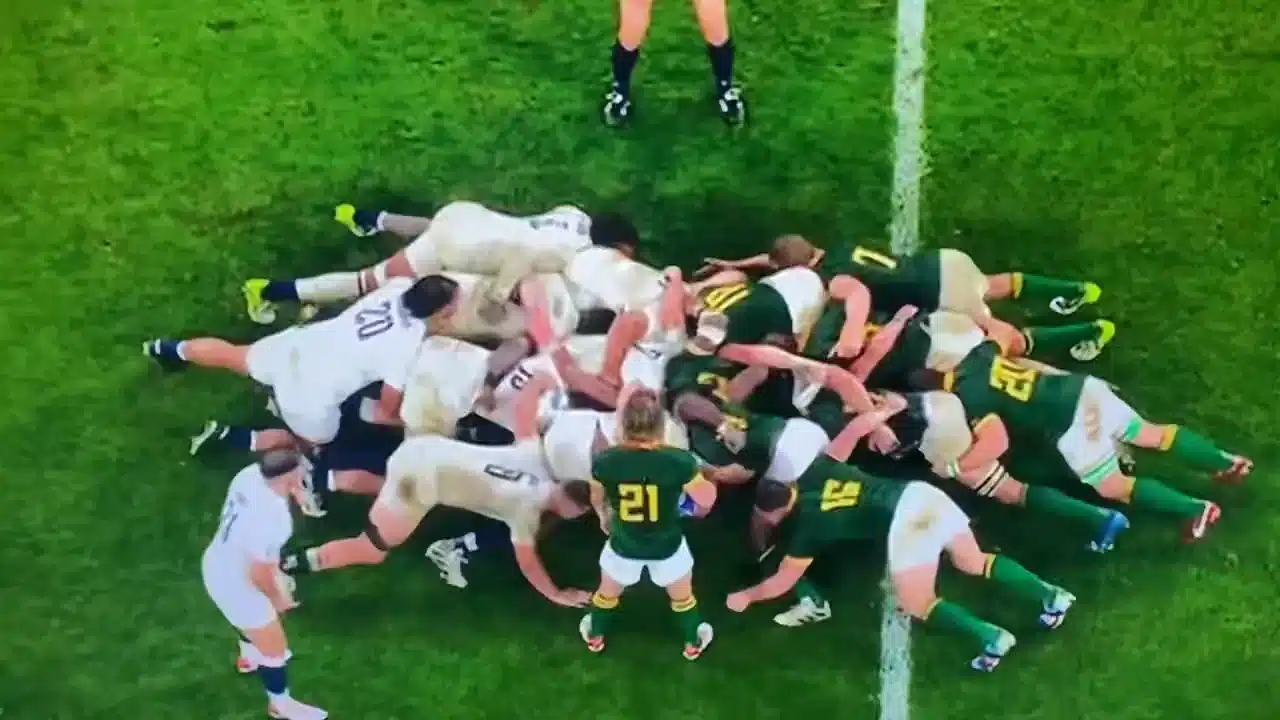
World Rugby is considering a controversial law change that could reduce the influence of the scrum – a move that many believe would have the biggest impact on world champions South Africa.
The debate centres around whether teams should continue to receive escalating punishments, including yellow cards and penalty tries, simply because they are being overpowered at the scrum rather than deliberately offending.
⭐ Save us to your Google Favourites for nonstop RUCK content!
The issue came into sharp focus following the Springboks’ dominant Six Nations victory over Ireland, where repeated scrum penalties eventually led to Irish front-rowers being sent to the sin bin.
Join the RUCK mailing list for the latest rugby news, exclusive features, and breaking updates straight to your inbox.
The proposal is expected to form part of ongoing discussions by World Rugby’s Shape of the Game working groups, which continue to explore ways of improving the spectacle while maintaining the sport’s core traditions.
The governing body has already introduced several law changes in recent years aimed at speeding up matches, with further reviews of set-piece management and officiating remaining on the agenda.
Supporters of the idea argue that teams should not effectively lose matches because they are physically inferior in one area of the game. They believe yellow cards should be reserved for cynical or dangerous offences, rather than technical dominance by an opposition pack.
However, the proposal has sparked fierce opposition.
Join RUCK’s Instagram broadcast channel and get the latest rugby news straight to your phone.
Many former players and referees believe weakening scrum sanctions would remove one of rugby’s defining contests and discourage teams from investing in one of the sport’s most technical skills.
Former international referee Nigel Owens has previously warned against making changes that diminish the value of the scrum, arguing it should remain a genuine weapon rather than simply a way to restart play.
Despite speculation that the changes are aimed at curbing South Africa’s dominance, World Rugby chairman Brett Robinson has insisted there were no discussions about “depowering” the scrum, saying the focus remains on improving safety, reducing unnecessary resets and speeding up the game rather than weakening the set-piece itself.
With no formal law change yet approved, the debate is set to continue – and if any amendment is eventually introduced, few teams would be affected more than the Springboks, whose world-class scrum has become one of the most feared weapons in international rugby.
Poll
Editors Picks:
Nigel Owens demands law changes:
1. World Rugby must create one global standard of officiating
Owens believes one of rugby’s biggest issues is the lack of consistency between competitions, particularly those played in the northern and southern hemispheres. While he accepts different tournaments have different styles, he says international rugby should be officiated under the same interpretations wherever matches are played.
“World Rugby has to make sure everyone’s aligned and consistent, no matter what tournaments the teams play in outside the international window.”
“There will always be a slight variation, I think, in terms of how the two hemispheres want to referee the game.”
He added that consistency should be one of World Rugby’s biggest priorities as officials from different competitions continue to referee Test matches throughout the Nations Championship.
2. Introduce a more consistent approach to foul play
Owens believes supporters and players have been left confused by inconsistent decisions surrounding dangerous play, particularly when incidents are reviewed by the bunker.
He wants referees to apply the laws more consistently so identical offences receive identical punishments.
“One of the big things I’d like to see from referees is a bit of consistency around foul play, especially if it’s sent to the bunker.”
“During the Six Nations… we did maybe see a lack of consistency around the sanctions for foul play. Something that was a clear red card in some games wasn’t given in others.”
3. Scrap the 20-minute red card
One of Owens’ strongest opinions remains his opposition to the 20-minute red card.
While the law has been backed by several southern hemisphere nations, he believes a player guilty of serious foul play should not be replaced after 20 minutes.
“For me, a straight red should also be a full red. Not a 20-minute red card.”
“There’s still some work to be done on that area.”