
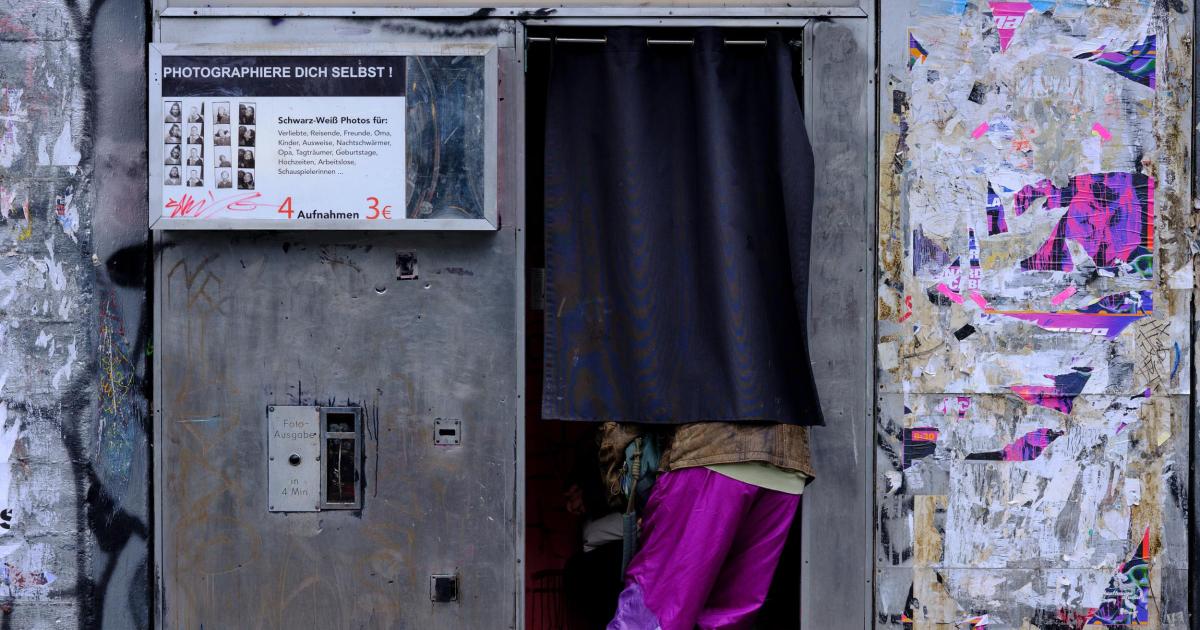
For giggling school pals, they were a magnet: exactly how many teenagers could fit in a single photobooth?
And for love birds, they captured first hugs and kisses either to be treasured forever or ripped to shreds.
One of the Photoautomats in Berlin which has inspired an artist to bring a booth to Glasgow. (Image: Simon Murphy)
Outside came the nervous wait for the strip of damp pictures, inside and out of sight was a mini darkroom of mechanical moving parts, chemicals, paper and guillotine.
For photography enthusiasts like artist Simon Murphy, while the digital gives users more control over poses and choice of pictures, it is at the cost of the simple joys of the slower, less predictable analogue world.
Now, to coincide with the 100th anniversary of the invention of the analogue Photomaton, he’s brought a restored vintage booth from Berlin to Glasgow as part of an art project that enables a new generation to experience what was once a feature of almost every town and city.
The booth, modernised to accept card payments, has been brought from the workshop of Asger Doenst and Ole Kretschmann, two friends who reintroduced restored analogue photobooths to the streets of Berlin in 2004.
Photographer and artist Simon Murphy in the Glasgow Photoautomat booth. (Image: Adam Holmes)
Having started with just one, they now have more than 30 dotted around the city attracting tourists and locals to have their images captured using the ‘old’ technology.
Simon, a photography lecturer at Glasgow Kelvin College, says they sparked his interest during a visit when he saw their impact on users, how they fitted into the street landscape and their old style of photo processing.
“All of my projects are rooted in a celebration of the medium of photography,” he adds.
“I asked myself ‘what could I photograph as a metaphor to describe the camera’s ability to break down barriers and connect people with other people?’.”
Having decided the answer lay in photographing the 34 vintage Photoautomat machines of Berlin, Simon then began to explore the possibility of bringing one to Glasgow.
A Berlin photobooth photographed by Simon Murphy (Image: Simon Murphy)
Now after months of planning and a £2,500 bill to bring the Photoautomat booth through customs, it is now in place at Street Level Photoworks, Trongate 103.
As well as being the focal point for workshops and collaborative art projects between Simon and Street Level Photoworks, visitors using the booth can share their images to be scanned and then used as part of an exhibition.
Simon says there are unique qualities about the old-style booths. “These days people will use a photobooth for a digital passport photograph which is very serious, you can’t wear glasses, you need to look straight at the camera and then you pick the best one.
“So, although you might get the most perfect version of yourself it’s not the most honest.
Photobooths have become a feature of Berlin’s urban landscape (Image: Simon Murphy)
“In Berlin, these analogue booths were out in the street, and people came out of clubs with their friends to use them.
“They were not used by just one person, static. They were full of energy.”
The Berlin booths became places to socialise, while the images produced by the chemical process had their own quirks and unique qualities.
“I would meet people at the booths, get talking to them,” he says.
Berlin now has more than 30 analogue photobooths. (Image: Simon Murphy)
“I’d find lost strips of photographs that people had either thrown away or got fed up waiting for.
“Operating an analogue photobooth is a physical act where moments of established friendships are affirmed and chance meetings with others can lead to opportunities, connection and conversation.
“The experience of using a vintage machine and holding a physical print in the hands can be something completely new for many and the excitement and laughter when the strip is delivered is something rarely experienced when viewing photographs purely on a screen or when scrolling. ”
A similar analogue booth is in Edinburgh: Stills Centre for Photography in Cockburn Street introduced a vintage booth two years ago.
Simon says the old-style booths particularly resonate with younger people seeking connections with a past age when life appeared to be slower-paced and more ‘authentic’.
Read more by Sandra Dick:
“It’s like ‘why do people like vinyl records when there’s something more convenient now?’, he says. “There’s something about it being more hands on, closer to reality and less AI.
“The analogue photobooth captures people as they are.
“There’s a lot more emotion in them and there’s something special about them.”
It’s 100 years since the world’s first fully automated coin-operated photo booth was unveiled by inventor Anatol Marco Josepho, a Russian immigrant to the US.
Detail from a Berlin analogue photobooth (Image: Simon Murphy)
The ‘photomaton’ was installed near Times Square in New York City and became an instant sensation: 280,000 people are said to have queued to use it in the first six months, spending 25 cents in return for eight photographs.
Within a couple of decades, commercial booths were becoming commonplace across the US and western European cities, coinciding with the rise of mass tourism and demand for passport photos.
Their arrival also offered the first taste of cheap and ‘instant’ photographs, produced by the booth’s internal clockwork like mechanism, and which turned portrait photography into fun.
“Inside is just like an old school darkroom, but it’s automated,” says Simon, who has launched a Kickstarter campaign to raise fund to produce a book based on the project.
Inside one of Berlin’s colourful photobooths (Image: Simon Murphy)
“There’s a roll of paper and what looks like an old school film cannister that fits to a big, bulky camera.
“From there, when coins go in – although I have set it up to take card payments – a mechanism kicks in called the spider or transmission.
“It takes the strip of paper and dips it in a serious of 12 baths of chemicals and water. That’s why it takes five minutes.
“When people sit inside the booth, they are mesmerised because of the old, vintage technology.”
The Photoautomat booth at Glasgow’s Street Level Photoworks, Trongate 103 (Image: Simon Murphy)
The thumb-sized photographs they produced, however, could be hit or miss. With no option to edit or delete, users could be caught with more chins than they’d like or photographs capturing the tops of their heads as they try to adjust the seat at precisely the wrong time.
Inevitably, the final snap would catch them as they stand up to leave, thinking their session is already done.
That was before chemical blips in the processing could also create images that were less than perfect.
Yet that was part of their charm, says Simon, who points to artists such as Andy Warhol and Andre Breton who used them in their works.
“Sometimes the shots that are not quite the best are the beautiful ones. There’s something about the mistakes that are special.”