
The modern, liberated Anglo-American woman is “medicated, meddlesome, and quarrelsome,” and we would do well as a country to reinstate the “old standard of public men and private women” (Yenor). Scott Yenor’s 2021 claim implies that the woman who kept to the private, domestic sphere (for whom he is nostalgic) was, in part, unmedicated or at least less medicated than the unhappy, friendless, independent woman of today. The 1850s and 1950s—periods of the sacrosanct “Angel in the House” and the “Happy Housewife,” respectively—can stand as two temporal test cases for this nostalgia: Were these celebrated housewives unmedicated or minimally medicated? In this post, I focus on the Victorian period, asking: Did domestic duty correlate with a lack of chemical “management”?
What we find when we look back at the historical archive is that this unmedicated housewife is a myth.
The Willingness to Medicate
In October 1851, a Louisville medical journal ran a book notice on a new London volume by Dr. Tilt, calling it “a very useful little work,” and reproduced the following passage: “During the last thirty years there has been too much timidity in the employment of sedatives, and particularly in that of opium… We have already seen how useful is opium in the relief…of the change of life [menopause]” (“Miscellaneous Notices”).
American physicians took the advice. Fordyce Barker at Bellevue built his reputation on the routine use of opiates for women’s complaints, making Tully’s powder (a morphine-camphor mixture) his favorite prescription. Charles Meigs, whose Woman: Her Diseases and Remedies was a dominant American text, recommended opium routinely for menstrual pain (Meigs). As Elizabeth Kelly Gray has shown, American opiate consumption escalated sharply but quietly between 1842 and 1867, driven primarily by doctors prescribing them to middle-class women (Gray). The 1850s American woman was living in a culture whose most respected medical voices were encouraging her physicians to medicate.
By the year 1900, almost two-thirds of those addicted to opium in the United States were women (Courtwright). This statistic derived from surveys and represents the middle- and upper-class white population, but this demographic is precisely that of the longed-for domestic ideal. At large, women “were, as a rule, more medicated than men” (Diniejko).
What They Were Prescribing
A number of patent drugs and proprietary medicines were called “women’s friends” (Diniejko). For nerves, hysteria, and restlessness, Victorian women were prescribed bromides, chloral hydrate, and McMunn’s Elixir.
Potassium bromide had been in medical use since the late 1820s, but its identity as a sedative came only in 1857 when Sir Charles Locock (Queen Victoria’s physician) reported using it in women “in which there was a great deal of sexual excitement and disturbance,” finding it had “the effect of calming the excitement to a marked degree.”
Chloral hydrate followed. Introduced into clinical medicine in 1869 by the Berlin pharmacologist Oscar Liebreich as a hypnotic and anesthetic, it became within a decade one of the most widely prescribed sedatives of the era, used for insomnia, nervous mania, and what we would now call anxiety.
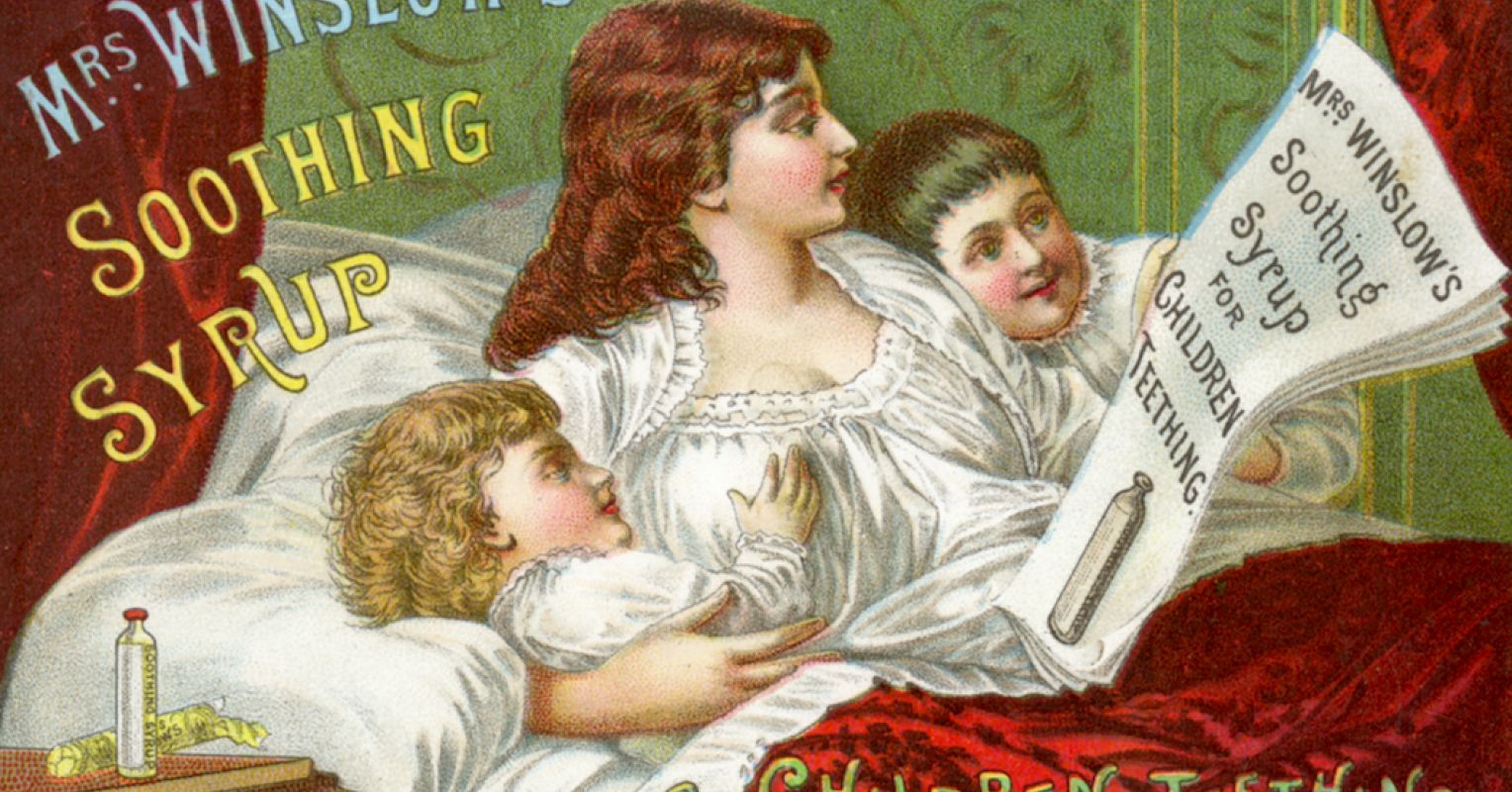
McMunn’s Elixir of Opium, formulated in the mid-1830s and marketed nationally from 1841 onward by the New York druggists A. B. & D. Sands, was advertised as a “denarcotized” opium preparation that had been “entirely robbed of its narcotic property” while retaining “all the sedative, anodyne, and antispasmodic powers of Opium” (Sands). The nonaddictive opiate was marketed heavily to women for menstrual pain and nervous exhaustion. In April 1864, Samuel R. Percy, Professor at New York Medical College, exposed the fraud: What McMunn had removed was narcotine, a substance with no narcotic effect, while the morphia (the active and addictive alkaloid) remained (Percy).
A woman’s medicine cabinet was stocked with patented herbal compounds especially marketed for female complaints. Lydia Pinkham’s Vegetable Compound, for commercial sale from 1875 onward from Lynn, Massachusetts, contained unicorn root, pleurisy root, life root, fenugreek, and black cohosh. But it also consisted of 18 to 20 percent ethyl alcohol, making it roughly 40 proof. The trade-cards advertised Lydia E. Pinkham’s Vegetable Compound as “a positive cure for all those painful Complaints and Weaknesses so common to our best female population. It will cure entirely the worst form of Female Complaints…” (“Lydia E. Pinkham’s Vegetable Compound”).
“Dr. Pierce’s Favorite Prescription for Women,” made in Buffalo, N.Y., claimed to cure “nervousness, backache, headache, sleeplessness, mental anxiety, and despondency” (“Dr. Pierce’s Favorite Prescription”). The package listed its ingredients as valerian, black haw, blue cohosh root, unicorn root, black cohosh root, and Oregon grape root with a label specification of “no alcohol.” However, before 1890, this medicine was said to have contained mostly alcohol and opium tincture (“Dr. Pierce’s Favorite Prescription”).
In his work on female Romantic opiate use, Joseph Crawford observes, “literary figures including Coleridge and De Quincey took the drug as a stimulant and to seek inspiration, but women often took it to alleviate the drudgery and hardships of everyday life, including anxiety and insomnia” (Crawford). Ironically, patent medicines were sold to middle-class women through everyday domestic-ideology imagery.
Conclusion
In Charles Kingsley’s Alton Locke (1850), Farmer Porter shares a critique of women’s opium consumption (here called “elevation”) and a rather shocking praise for its effect:
“Oh! ho! ho! — yow goo [you go] into druggist’s shop o’ market-day…and you’ll see the little boxes, doozens and doozens…and never a ven-man’s wife goo by, but what calls in for her pennord o’ elevation, to last her out the week. Oh! ho! ho! Well, it keeps women-folk quiet, it do” (Kingsley 116; emphasis added).
The historical record refuses the “unmedicated past” framing on which domestic nostalgia depends. If the Victorian woman seemed quieter, more compliant, less “meddlesome,” it might have been, at least partly, because she was, quite literally, sedated.