
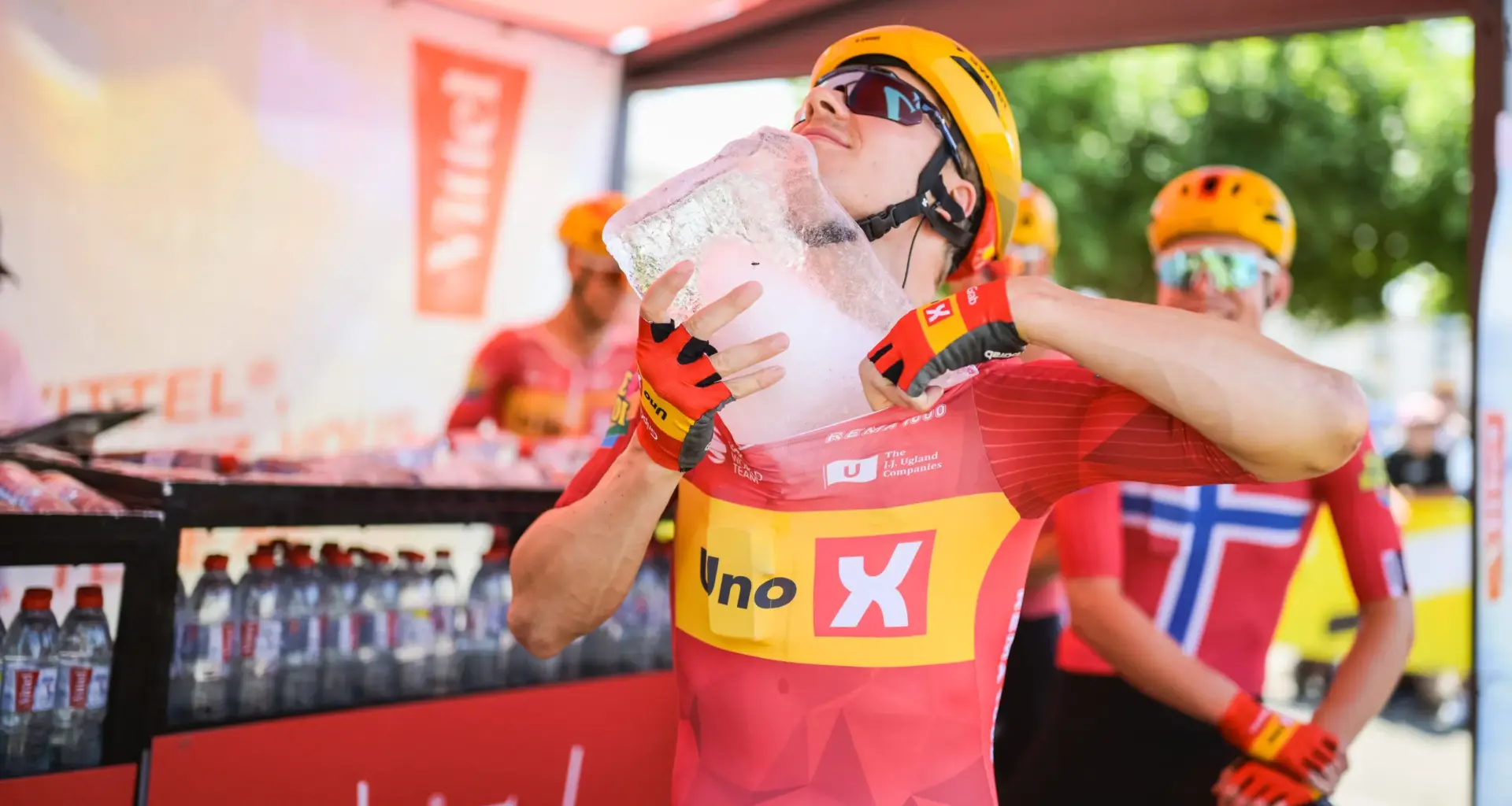
From intense cooling strategies to banning spectators and rerouting stages, extreme heat took centre stage at the Tour de France and the future looks even hotter.
Europe is the fastest warming continent – it’s heating up twice as fast as the global average, according to the Copernicus climate service – and the rising temperature has become very apparent this summer.
At this year’s Tour de France, heat was a constant topic of conversation, with wildfires, shortened stages and cooling strategies all noticeable challenges for race organisers, teams and riders. The heat is also making history, with Stage 9 the first ever Tour stage reduced due to extreme heat.
It’s not just the Tour either.
Several amateur cycling races have been cancelled including L’Alsacienne and Cycling 4 Climate France, and endurance cyclist Lael Wilcox was forced to abandon her Around the World record attempt due to scorching temperatures in Europe.
UCI weather protocols
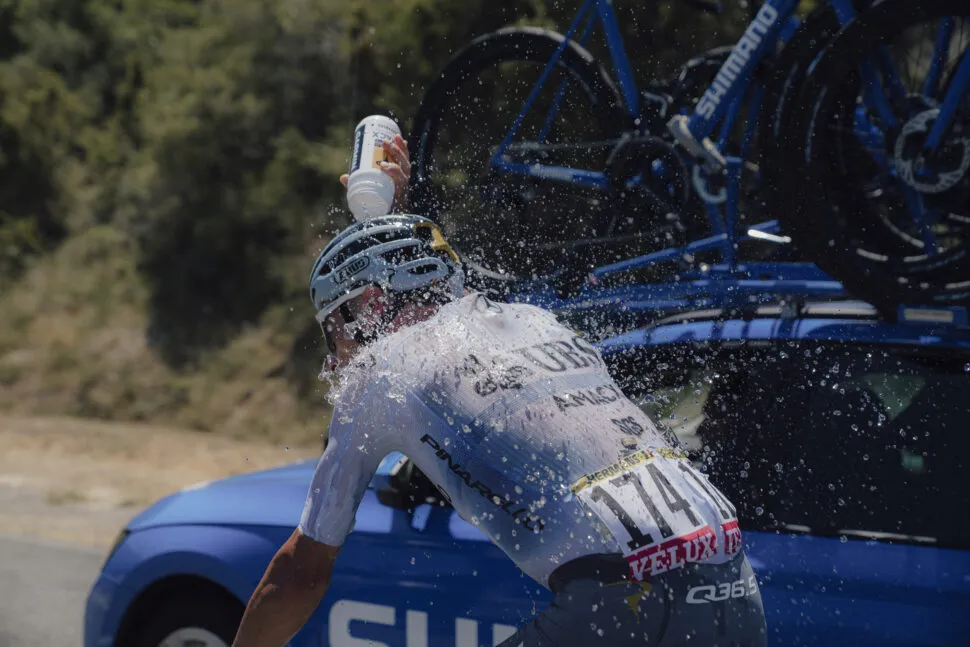 This year’s Tour de France saw far more involvement from neutral services to provide riders with water. A.S.O./Thomas Maheux
Two key protocols set the rules for UCI-sanctioned races going ahead amid extreme weather: the Extreme Weather Protocol and the High Temperature Protocol.
The Extreme Weather Protocol aims to protect riders’ wellbeing during bad weather conditions. It’s something we’ve heard more about in recent years when races, particularly the Giro d’Italia, are cold and wet.
The High Temperature Protocol, which was introduced in 2024, focuses on the potential risks for riders’ health and safety as a result of riding in high temperatures. It uses a five-tier risk assessment system based on the Wet Bulb Globe Temperature (WBGT) index. Wet bulb temperature accounts for humidity, measuring the point at which evaporation stops – important for humans because our bodies need to cool through sweat, which then has to evaporate. The WBGT also accounts for other factors such as air temperature in the shade and surrounding heat to assess total outdoor heat stress.
This year, the protocol was applied on the Stage 4 of the Tour Down Under due to extreme heat and wildfire risk. As a result the route was shortened and the stage started earlier.
It was also applied on the Stage 5 of the Tour de Suisse due to extreme heat, and feed zone arrangements were adapted.
At this year’s Tour it has also been put into use. Wildfires caused the route of Stage 3 to be changed, and Stage 9 was shortened due to a red heatwave alert in the Corrèze département of central France.
The UCI also enabled changes to feed zones to enable teams to distribute more ice and water throughout the race.
Limitations of WBGT
 Ice vests were worn at the start of every stage – whether you could see them or not. Xavier Pereyron
WGBT was originally created by the military in the US. Some critics suggest that the guidance is not specific enough to cycling races and so has limitations.
‘It’s a physical model, not necessarily a biophysical model, that applies to those cyclists on that stage at that time,’ says Dr Lindsey Hunt, a senior sports scientist at Precision Fuel & Hydration.
‘On the one hand, the threshold might be too conservative, as the riders might be way fitter and way more heat acclimated and able to tolerate conditions, and on the other it might not be safe at all.
‘It also depends on the stage, as if it’s 40° going up a 30-minute climb at 2pm that’s quite unsafe.’
The importance of adapting the WGBT to cycling specific situations is echoed by Dr Chloe Brimicombe, a postdoctoral researcher at the University of Oxford and an award-winning climate scientist focusing on the interactions between climate change and extreme heat.
‘The wind speed factor for cycling isn’t taken into account in those thresholds,’ she says. ‘There’s value in using WBGT because it is the standard across all sports and across occupational health, but it’s about adapting the thresholds to a cycling race.’
Was it a surprise?
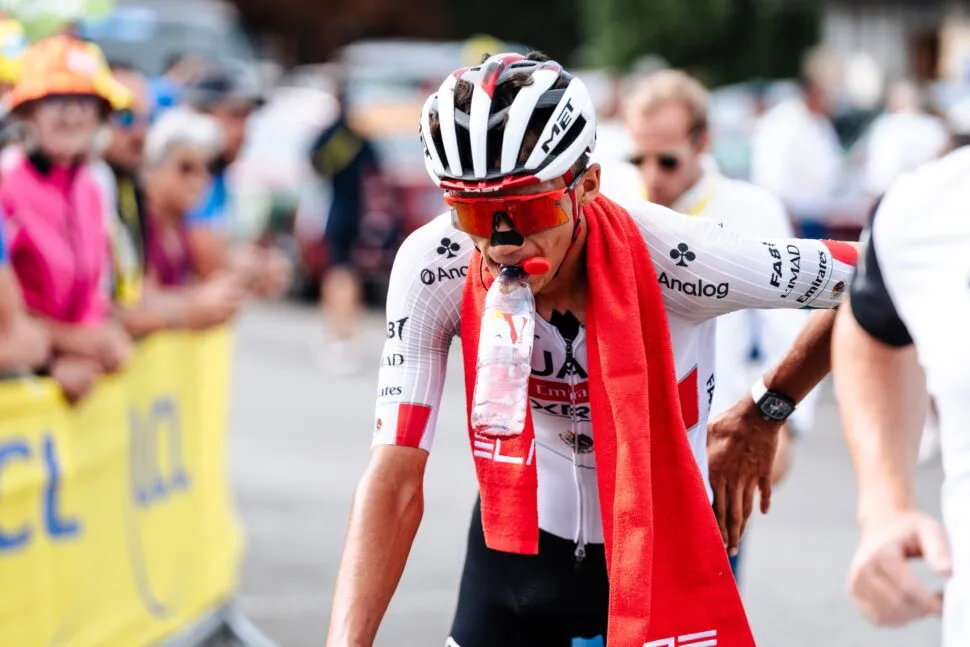 Race sponsors did appear to be well equipped for the conditions, with water company Vittel ever-present on the route. Xavier Pereyron
The impact of heat of this year’s Tour does not come as a huge surprise to Dr Brimicombe who co-authored a study called The future of European outdoor summer sports through the lens of 50 years of the Tour de France.
The study found that the Tour by and large had avoided the hottest days only through ‘chance’.
‘Our study shows that the Tour has been quite lucky when it’s on, and because of being in the mountains where there is less heat exposure,’ she says. ‘When the route moves to urban settings then it can become a potential problem.’
The study highlights Southern France as an area of risk, which we have already seen at the Tour and elsewhere – Ironman Nice was cancelled this year due to heat and organisers have now said it won’t take place next year either.
Heat is also hard for organisers to predict.
‘We can only predict heatwaves in Europe ten to seven days in advance,’ Brimicombe says. ‘If we have that forecast, it becomes about how much can we change the race so that riders start earlier in the day or you split the stage in two.’
Adapting to the heat
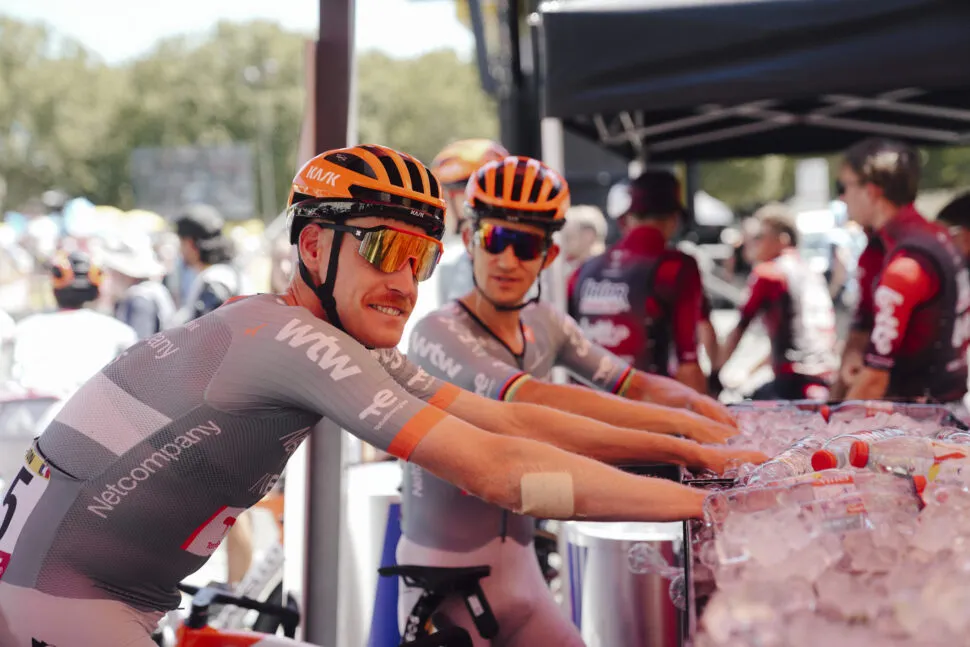 Netcompany Ineos riders were the first to be spotted submerging their wrists into boxes of icy water on the opening stage, and the riders clearly took to the method. A.S.O./Thomas Maheux
To Brimicombe’s point, races need to adapt, whether or not they are UCI-sanctioned.
‘Heat is increasingly becoming a defining issue for major sportives, not just races,’ says Lee Bibring, founder and CEO of Love Velo, a cycling travel company. ‘The Étape du Tour is a good example. In 2022 the climb up to Val Thorens saw riders dropping in huge numbers, with the roadside littered with cyclists who’d overheated or bonked.
‘Water stations struggle to cope even when riders do come prepared, you genuinely can’t carry enough for conditions like that, so stations get overrun regardless of how well-organised everyone is.’
Earlier start times and avoiding the heat of the day are also becoming paramount.
‘We build and suggest itineraries around early starts, aiming to get the bulk of climbing done before the midday heat peaks, particularly in destinations like Tenerife, Mallorca, and Calpe,’ Bibring says.
For recreational cyclists, electric bikes are proving to be a great tool in allowing people still to ride but reducing the stress of heat.
‘We’re seeing a big rise in e-road bikes, which are a real help for clients who are less experienced or less confident riding in high heat, letting them still enjoy demanding routes without the same physical toll,’ he says.
Riding in the heat
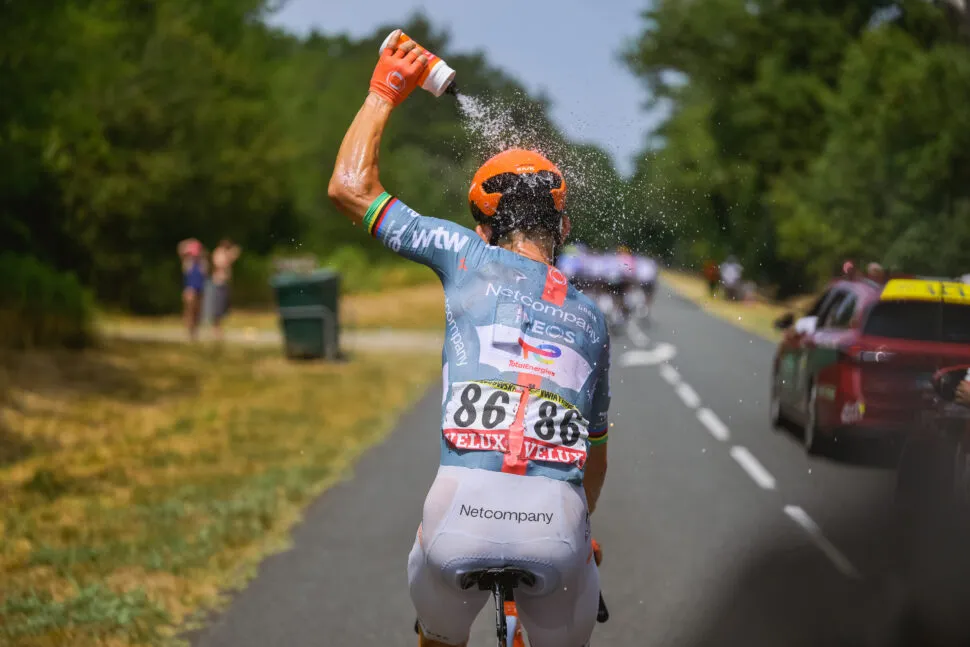 Riders pouring water over themselves during the race caused some teams to have issues with their team radios after they got wet. A.S.O./Charly Lopez
For riders, the extreme heat means adapting and evolving hydration and cooling strategies. At the Tour, we’ve seen ice vests, arms in cold water buckets, and ice socks.
‘I don’t remember having the heat wave we had the other day five years ago, and I feel like we’re not equipped for those quite yet,’ says Jess Roberts, Olympic bronze medallist on the track and former British National Road Race Champion. ‘When I’m out training I have to plan more, because we don’t have a follow car every day in our daily training so it’s really important to consider where you can top water for example.
‘For specific race training we do sessions in the sauna, and wear a paint suit, but for day-to-day training, we haven’t yet looked at what we can do at home for heat training.
‘Heat hasn’t been a big thing for us through the years, we have plans for when we’re racing in Australia or we know a velodrome is going to be hot, but not for day to day.’
Roberts thinks altitude camps are going to become more critical for riders: ‘I think the combination of heat and altitude training is going to become more important. In the last five years, the importance of fuelling, nutrition, hydration has got more important, and it’s evolving every year.’
It’s also not about adapting to heat on the road but navigating recovery in a heatwave too: ‘In the last heatwave I did a four-hour ride, and when I got home, I was straight under the fan but I couldn’t escape the heat. I was exhausted and it affected my recovery.’
Opportunities in clothing
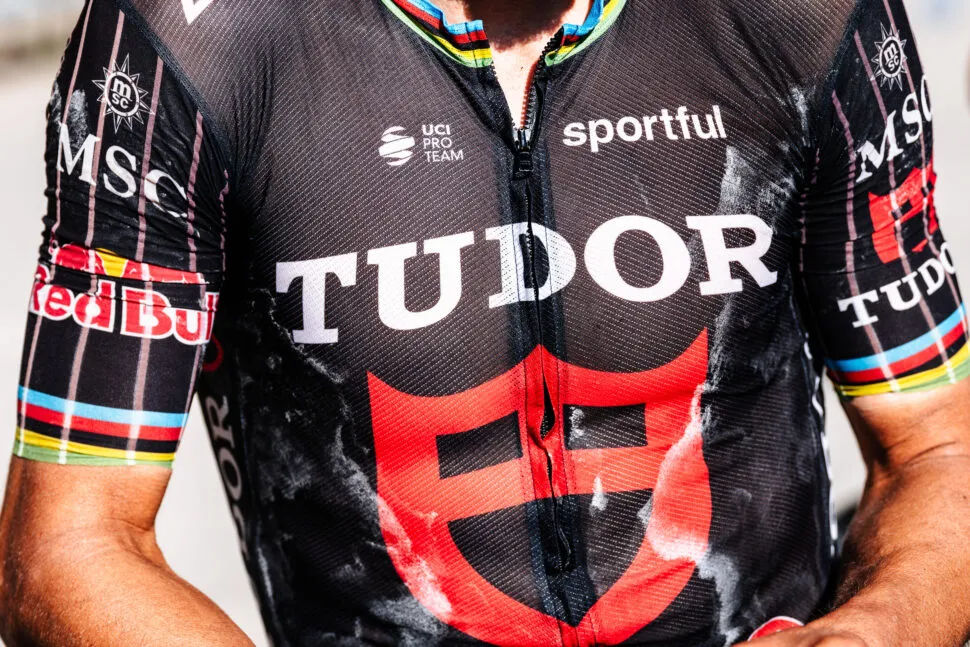 Not every clothing company were convinced lighter coloured jerseys are necessary for the Tour, but it’s safe to say Julian Alaphilippe lost a lot of salt through sweat on this stage. Xavier Pereyron
Improvements in clothing technology could help mitigate the impact of extreme heat.
Precision Fuel & Hydration’s Dr Hunt says, ‘The biggest thing is clothing as historically speaking clothing brands haven’t taken into account thermoregulation.
‘Some brands will market their clothing as good for thermoregulation but that’s all they say so I think the next big step for cycling is the clothing.
‘We’ve seen it in in running where Nike have come out with the ACG Radical Airflow jersey and I think we’ll start to see a bit more in cycling.
‘If you can get the right piece of clothing that really works with your thermoregulation system it will mean that you can race better and longer in hotter conditions.’
The ACG Radical Airflow jersey features a striking mesh hole design, which Nike says allows more air to flow directly to your skin.
Hunt also points to Visma-Lease a Bike choosing to ride the Tour in a black jersey – which typically would lead to hotter riders due to absorbing light rather than reflecting like lighter coloured fabric – and publicising why, while also highlighting the importance of the thermoregulation properties of the fabric.
Not just about the riders
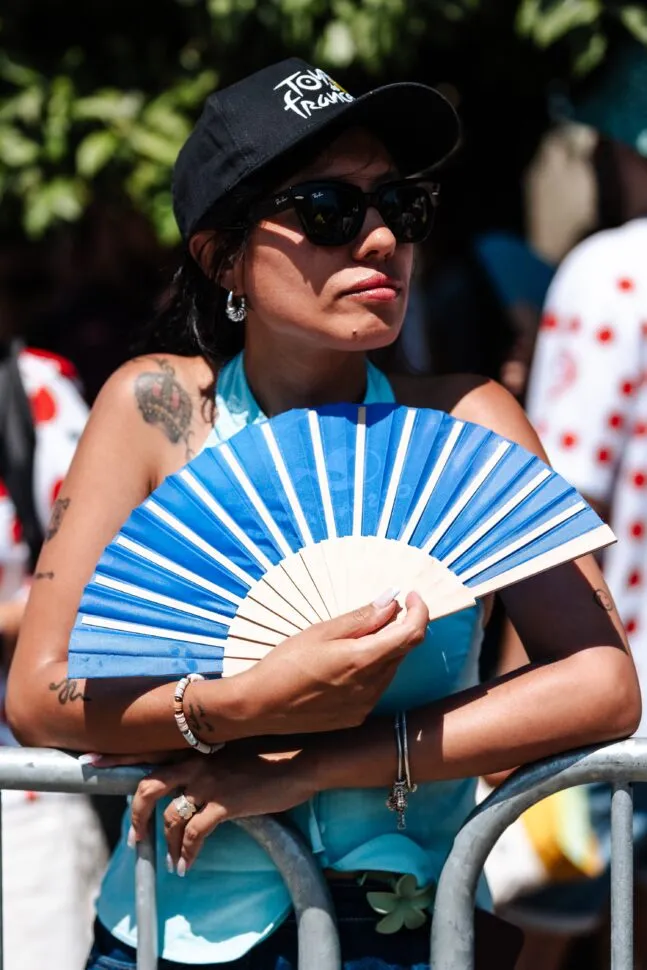 The lesser discussed issue is fans stood by the roadside in the sunshine for hours on end. Xavier Pereyron
The impact of the recent record-breaking heatwaves in Europe isn’t just felt by riders but by spectators and the local health and emergency services.
At Stage 3 of this year’s Tour, spectators were asked not to go near the route or to the finish area due to wildfires. When permitted, those wishing to catch a glimpse of a race may spend hours waiting by the side of the road.
‘Spectators are the people that are probably more at risk of health conditions due to heat as they are more likely to be exposed and to be stagnant,’ says Dr Brimicombe. ‘The heat strategies should be extended to spectators, and organisers should encourage people to bring things which help them in the heat.’
Dr Brimicombe points to the 2024 Paris Olympics, which had misting fans, shaded areas and free water available for people as a result of the heat.
What the future looks like
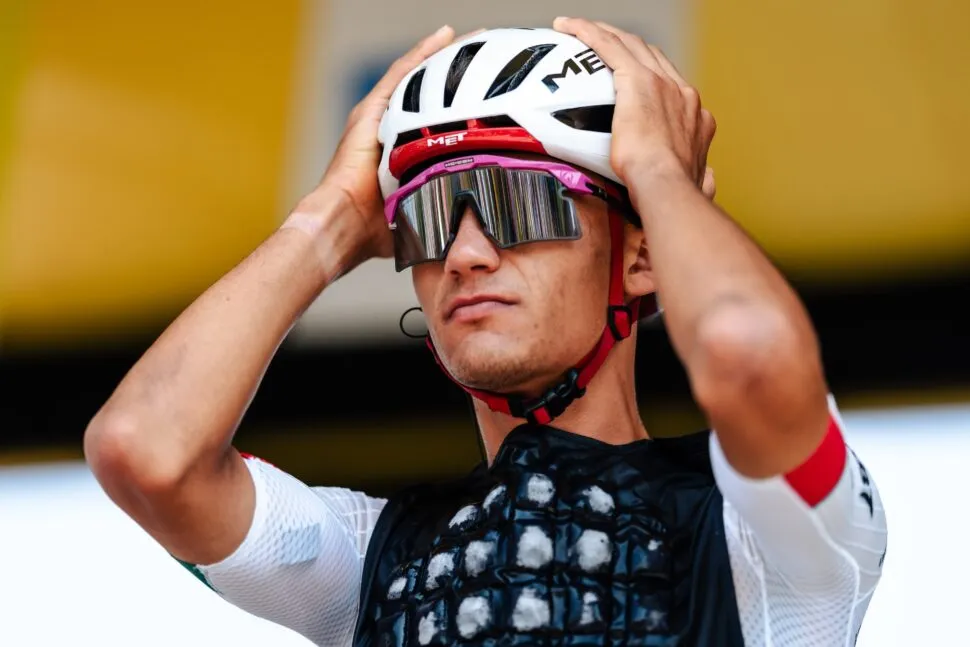 Will we see the Tour adapting its schedule to avoid hot weather? Not any time soon. Xavier Pereyron
While each sport has its own challenges in adapting to the extreme heat, bike races cannot simply add in a hydration break, close the roof or crank up the aircon.
There have been calls, including by Tadej Pogačar, to adapt the calendar to avoid racing in the hottest climates all year round, and to start races earlier in the day. However Tour de France race director Christian Prudhomme has ruled out both moving the Tour from its July slot and moving race start times to the morning. More editions like this, however, and pressure will only mount to do something different.
It’s also not just about races either, but being able to train safely.
‘I think it’s a concerning time for physical activity and sport in general,’ says Dr Brimicombe. ‘We’re going to have to look at how we change when we do physical activity and how we continue to make it safe for people to actually exercise.
‘I don’t think it is in everybody’s psyche at the moment that places in Europe could become dangerous to actually do these activities outside.’
Despite the challenges, Brimicombe points to how sport can mobilise people and the opportunities for a collaborative approach in adaptation: ‘We think that sports could be a key way that we reach people that don’t necessarily see heat as a risk to them.’
Protect Our Winters UK, which campaigns for meaningful climate action among the outdoor community, echoes the potential in sport for climate action.
‘Events have the potential to communicate the importance of the issue to spectators and racers at scale, and avoiding our increasing online communication bubbles,’ says Adam Raja, Protect Our Winters UK marketing manager.
Raja also highlights the bigger picture: racing and training could be impacted by extreme weather on a permanent basis all year round: ‘In the UK we’re already experiencing wetter winters, which are forecast to increase along with more wind and intense storms.
‘In summer we’ll get hotter heatwaves that are drier overall, causing more wildfires, then heavier deluges when it does rain. These all cause increased erosion and landslides. The scale of these both globally and in the UK hugely depends on what we do next.
‘Unless we aggressively push for systemic climate action now, these extreme conditions will lock in as our permanent reality.’