
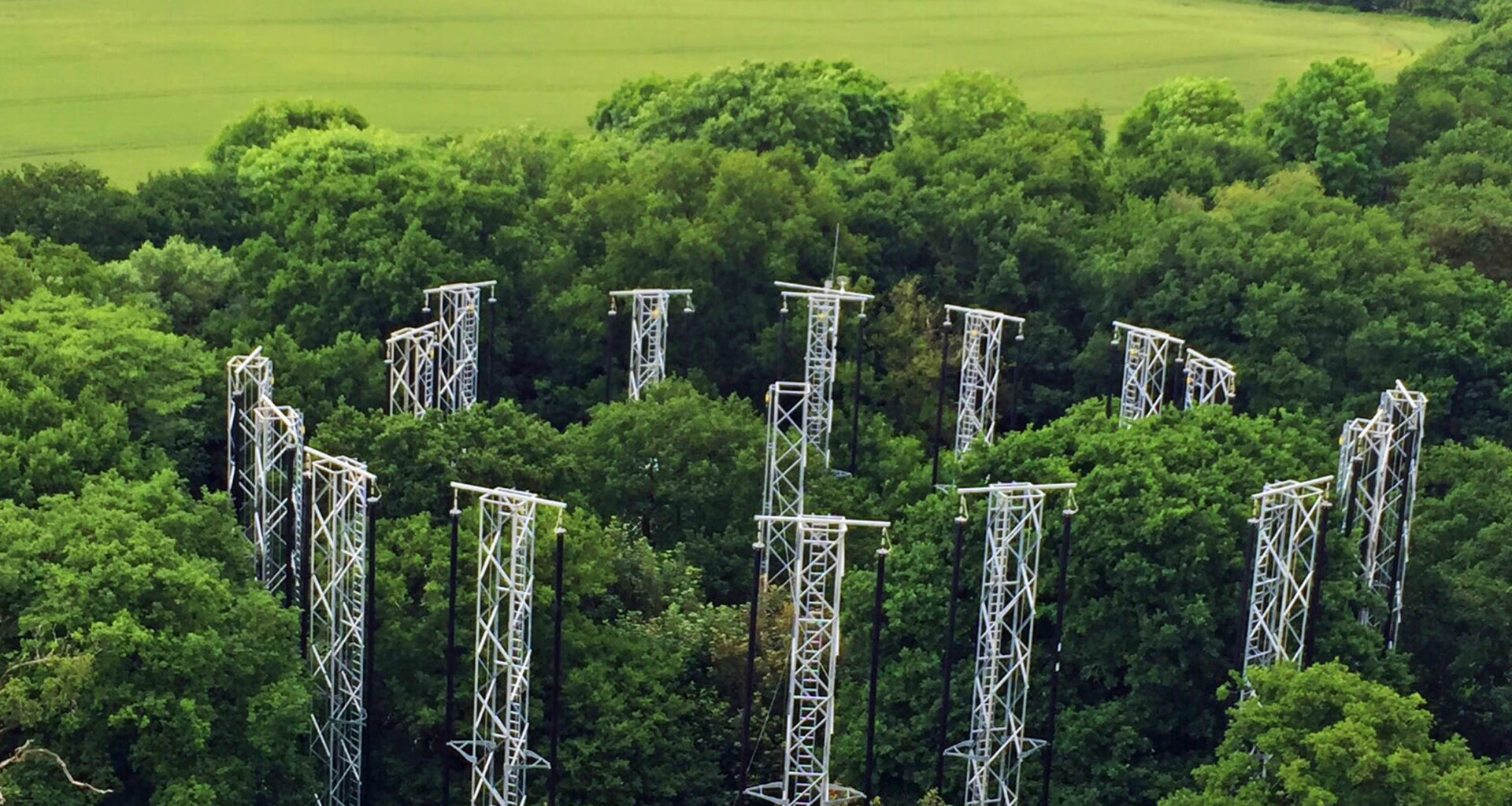
A ring of pipes has blown carbon dioxide over a stand of 180-year-old English oaks in Staffordshire, England, since 2017. The gas runs in daylight only, from budburst in April to leaf fall in November.
Oaks inside those rings breathe air at 573 parts per million of CO2, against 424 for the untreated rings. The Birmingham team running the site expects the whole atmosphere to reach that level by the 2050s.

Six years in, the fumigated trees had put on more wood than their neighbors. Trees need nitrogen to build wood, and nobody had shown where the extra nitrogen came from.
Trees cannot make nitrogen. They pull it from the soil, and most of it stays locked inside dead leaves, dead roots, and older organic matter until microbes break it apart.
That is the standing objection to the idea that a richer CO2 atmosphere will make forests grow faster and hold more carbon. Richard Norby published one version in 2010. The growth boost at an Oak Ridge sweetgum plantation faded as the soil ran short of nitrogen. Norby is a co-author on the new oak study, published Wednesday in Science Advances.
Manon Rumeau ran the study at the University of Birmingham (UoB) and has since moved to the Université de Pau et des Pays de l’Adour (UPPA). Rumeau’s team measured how much nitrogen the soil released. Every month from February to November 2022, they sieved soil, sealed a sample in a bag, buried it under the leaf litter, and dug it up 28 days later.
Across the year, soil under the CO2-fed oaks released about 29% more usable nitrogen, an extra 23 pounds an acre (26 kg per hectare). The trees took up an extra 12 pounds an acre (13 kg per hectare).
In the high-CO2 rings, the soil released almost exactly what the trees used, 112 pounds an acre (126 kg per hectare) against 113 pounds an acre (127 kg per hectare). In the ambient rings, the soil released 101 pounds while the trees took 114, drawing down a reserve the forest cannot refill indefinitely.
Roots help microbes release nitrogen
“Trees secure nitrogen from soils by releasing an easily decomposable cocktail of organic carbon through their roots,” Rumeau says. “This natural ‘energy drink,’ known as root exudates, stimulates soil microbes to break down organic matter and release nitrogen that would otherwise remain locked away.”
Soil cores from the high-CO2 rings held 39% more fine roots. They also gave off 26% more CO2 – the sign of roots and microbes at work.
Microbes freed nitrogen from organic matter about 30% faster. That figure is the least certain in the paper, because three rings per treatment leaves room for chance.
In April, at budburst, the treated soil released 75% more nitrogen than ambient soil did. Leaves were flushing and the roots were pushing out more carbon.
Then the summer of 2022 turned dry, and soil in the CO2 rings ran 10% drier. Those rings released only 9% more nitrogen from May through July, then 50% more again from August through October.
Trees keep nitrogen in the soil
Once nitrogen comes loose, some of it converts to nitrate. Nitrate washes out with rain, and microbes turn some of it into gas. A forest that breaks down more organic matter should lose more nitrogen.
“We expected a ‘faster but leakier’ nitrogen cycle, but instead we found a ‘faster but tighter’ cycle,” Rumeau told Earth.com. “The main reason seems to be that trees take up the extra nitrogen before it can be lost.”
Rumeau says the busier microbes were no surprise, given the extra carbon arriving through the roots. Nitrogen did not leak away faster as gas or in water, and that was the surprise.
Under high CO2, microbes converted nitrogen to nitrate about half as fast in spring and summer. Nitrate in the soil never rose. Rumeau suspects the roots also release compounds that block the conversion. That would keep nitrogen in a form trees can use.
Nitrous oxide, a greenhouse gas released during that conversion, showed no difference inside the cores. Instruments running at the site from 2020 to 2022 recorded 74% less of it under high CO2. That result went to a science meeting in 2024 and has not appeared in a journal.
Asked by Earth.com what this means for forests as a climate solution, Rumeau calls the findings encouraging. “They show that, through the collaboration between trees and soil microbes, trees can access the extra nitrogen they need to grow faster under an enriched CO2 atmosphere, increasing their capacity to store carbon,” Rumeau says.
Nitrogen reserves have limits
The organic matter under this forest holds about 295 pounds of nitrogen an acre (330 kg per hectare). At this pace the forest would need decades to use all of it. The share microbes can easily reach could thin out much sooner, in a soil carrying 18 times more carbon than nitrogen.
Nothing else made up the difference. Soil microbes that pull nitrogen straight out of the air supplied less than half a pound an acre, high CO2 or not. Polluted air dropped 9.5 pounds of nitrogen an acre in 2022, and that supply is shrinking.
“Declining pollutant nitrogen deposition in the UK and elsewhere—once an additional source of nutrients—may further increase the risk of future nitrogen limitation,” says senior author and Birmingham professor Sami Ullah.
Rumeau says this will not play out the same way everywhere. Few long-term experiments like this one exist, and trees and microbes may not work together this way in a forest short of some other nutrient.
A eucalypt woodland in Australia never sped up under extra CO2 because phosphorus was the scarce nutrient.
Soil carbon remains uncertain
Microbes that break organic matter down for nitrogen release its carbon as CO2 at the same time.
Roots and microbes breathed out roughly as much extra carbon as the roots delivered, within about 6%. Both are estimates, not measurements.
Asked by Earth.com what still needs testing, Rumeau names one thing above the rest.
“We now need to accurately measure all the carbon inputs and outputs in the soil to determine whether the soil is ultimately gaining or losing carbon,” Rumeau says.
The full study was published in the journal Science Advances.
Photo credit: Shomari Healy
—–
Like what you read? Subscribe to our newsletter for engaging articles, exclusive content, and the latest updates.
Check us out on EarthSnap, a free app brought to you by Eric Ralls and Earth.com.
—–