
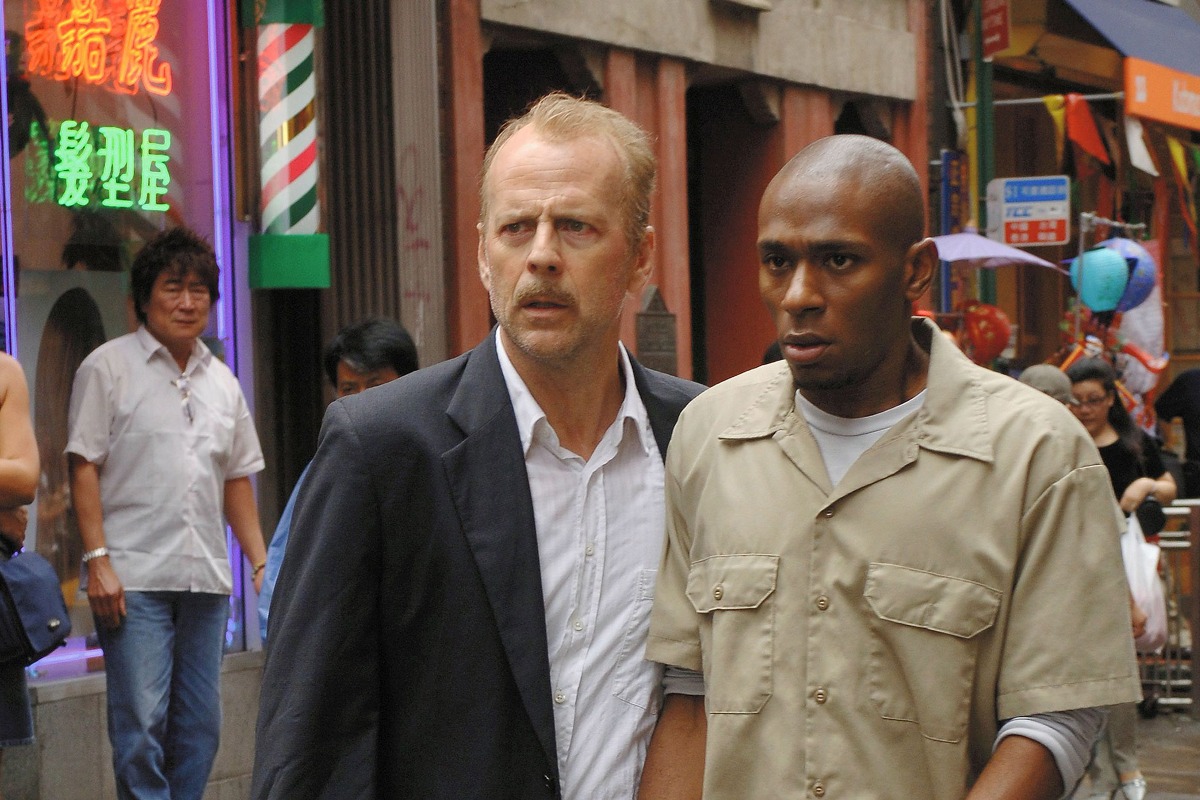
16 Blocs turns 20 this year, with Bruce Willis playing weathered cop Jack Mosley opposite Yasiin Bey and David Morse under Richard Donner’s direction. The premise stays simple, escort a witness eight blocks to a courthouse, but Donner built the film around a real-time countdown and a bus chase shot over twelve days in Toronto. Despite the pedigree, it drew mixed reviews and modest ticket sales upon release.
A mustache, a badge, and twelve days stuck in Toronto traffic: that’s the recipe Richard Donner cooked up two decades ago for one of Bruce Willis’s most slept on thrillers. Best known for turning Mel Gibson and Danny Glover into buddy cop legends, the filmmaker swapped Los Angeles chaos for a single night in Manhattan, betting everything on a cop who just needs to walk a witness sixteen blocks. Willis at his gruffest, alongside a cast that includes Yasiin Bey and David Morse, the film slipped through the cracks upon release and never got the credit it deserved.
A lesser-known gem in Bruce Willis’s filmography
Bruce Willis built his reputation on crowd-pleasers like Die Hard and The Fifth Element, films that still define the action genre. Yet one of his most restrained performances rarely comes up in conversation: 16 Blocks, released in US theaters on March 3, 2006 by Warner Bros. Pictures. The film had serious pedigree behind the camera, with direction from Richard Donner, the filmmaker responsible for Superman, The Goonies and the Lethal Weapon franchise, working from a script by screenwriter Richard Wenk. Despite those credentials, it quietly faded from memory.
A ten-minute drive that goes very wrong
Willis plays Jack Mosley, a tired, hard-drinking NYPD detective handed what looks like a routine assignment: escort a witness named Eddie Bunker, played by Yasiin Bey (then credited as Mos Def), to a courthouse 16 blocks away. Eddie’s testimony threatens to expose corruption inside the department, and the officers involved have no intention of letting him arrive. The trip should take 10 minutes. Instead, it becomes a desperate run through Manhattan, with David Morse chilling as the corrupt cop leading the hunt.
Donner leaned into a near real-time structure, which gives the 102-minute film a constant sense of countdown. According to the director, the human stakes drew him in as much as the action, since a chase means little without characters worth following.
Ride-alongs and a 12-day bus chase
Willis took his preparation seriously. He spent several nights patrolling with Brooklyn officers alongside NYPD Inspector Mike Keenan, who also advised the production on police procedure. The commitment shows in Mosley, a far cry from the wisecracking heroes Willis usually played.
The film’s centerpiece, a bus chase through city streets, demanded real logistics. The production purchased 5 buses from New York and shipped them to Toronto, where the sequence took 12 days to shoot. Two buses handled exterior and interior filming, while the other 3 were reserved for stunts, with more than 25 additional vehicles and nearly 50 stunt performers involved.
Why it deserves a second look
Critics were split on release. Some dismissed 16 Blocks as formulaic, others praised its character-driven approach, and the film earned roughly $65 million worldwide, a modest figure against a $55 million budget. It never found the audience its craftsmanship deserved.
Watched today, the film plays as one of Willis’s most grounded efforts, a story about redemption and moral gray zones rather than explosions. As Willis put it at the time, there are no heroes or monsters here, only actions that reveal who each character really is. 16 Blocks is currently streaming free with ads on Tubi and The Roku Channel, and is also available to rent or buy on major digital platforms, including Amazon Video, Apple TV, and Fandango at Home.