
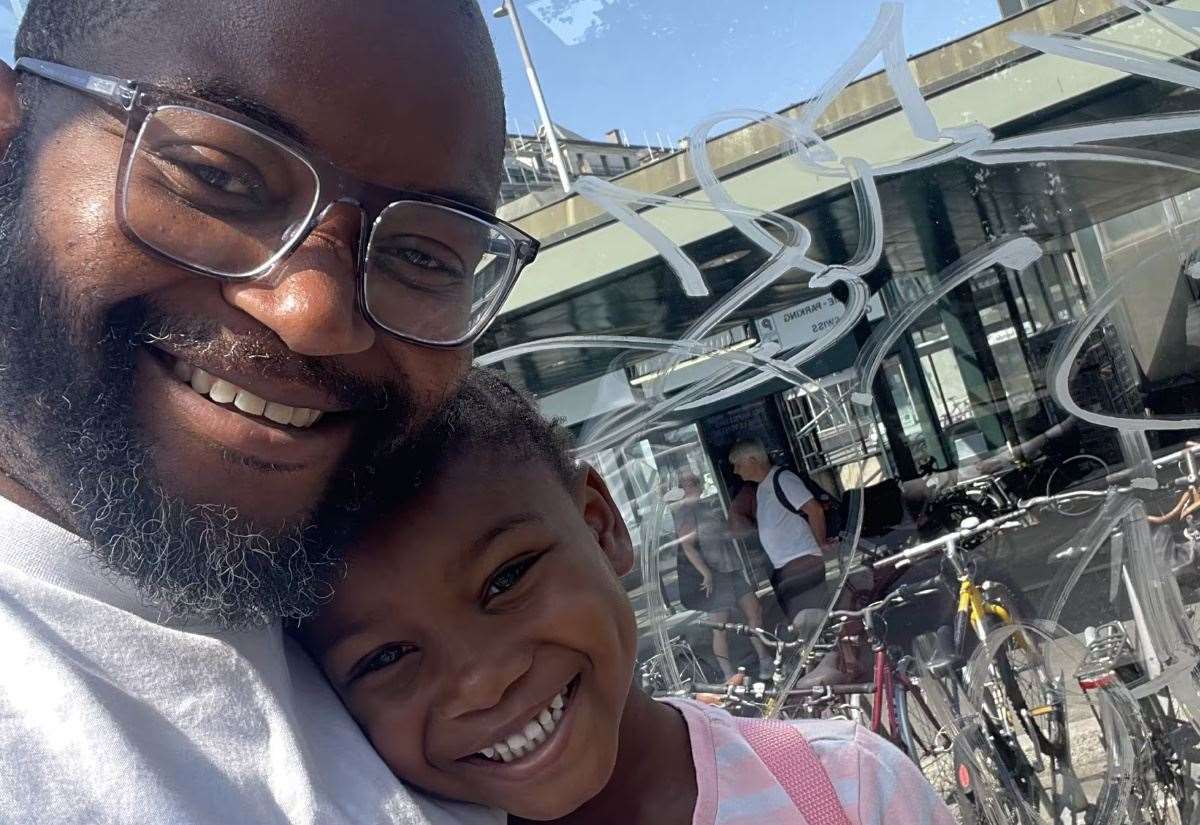
A dad-of-four has told of the terrifying moment he was left dribbling, babbling and unable to move his arms after suffering a major stroke at home in front of his children.
Anthony Ojo thought he was answering his frightened youngsters as they tried to speak to him, but no words were coming out.
 Ashford dad Anthony Ojo with one of his children. Picture: East Kent Hospitals
The 41-year-old support worker, from Ashford, said: “I will never forget it.
“My children had been asking me questions, and I thought I was answering, but no words were coming out. It was just babbling, and I was dribbling from one side of my mouth.”
Fortunately, Anthony’s wife was working from home when he suddenly collapsed and was able to dial 999.
Paramedics contacted stroke consultant Dr Saidu Abubakar by video call so he could assess Anthony before he had even reached hospital.
“Dr Abubakar was asking me to do simple tasks like raising my hands, and I just couldn’t do it,” he said.
Kent and Canterbury Hospital. Picture: Barry Goodwin.
He was then taken directly to the Kent and Canterbury (K&C) Hospital, where a CT scan revealed a blood clot was blocking an artery in his brain.
Anthony said: “I don’t really remember any of it, just waking up in hospital and my wife and the doctors telling me I had suffered a major stroke.”
An interventional radiology team carried out a mechanical thrombectomy, using suction to remove the clot and fibrous tissue.
Specialist live imaging allowed doctors to pinpoint the blockage and showed blood flow to Anthony’s brain being restored immediately after it was removed, preventing permanent damage.
Anthony spent four days in hospital and is now recovering at home with his family.
From left to right: Deputy Medical Director Nic Goodger; acting Chief Executive Dr Des Holden; National Medical Director Prof Frankie Swords; National Clinical Director for Stroke, Dr David Hargroves; Chief Medical Officer Sir Chris Whitty, Dr Robert Kaikini, lead for Stroke Thrombectomy. Picture: East Kent Hospitals
He was among the first patients treated at what East Kent Hospitals says is the country’s first standalone mechanical thrombectomy service.
The dedicated suite opened at K&C earlier this year as the final phase of the £4.5 million Kent Interventional Radiology Centre.
Mechanical thrombectomy is a time-critical procedure used to treat some of the most severe strokes, where a major artery carrying blood to the brain has been blocked.
Until the Canterbury service opened, patients from Kent and Medway who needed the treatment had to be taken by ambulance to London.
More than 1,200 people suffer strokes in east Kent each year, with hospital bosses estimating more than 100 could benefit from thrombectomy.
The William Harvey hospital. Picture: Barry Goodwin
Dr Robert Kaikini, consultant vascular and interventional radiologist, said Anthony’s recovery demonstrated the importance of providing the procedure locally.
“When he arrived at hospital he was unable to communicate, but just a few days later he was able to go home, walking and talking normally,” he said.
“Without the procedure, there would be no blood flow to part of his brain and the tissue would have died, leaving him with permanent effects.
“Thanks to the team here, he is now able to carry on life with his family.”
The new centre uses advanced imaging equipment to allow clinicians to treat not only blood clots, but severe internal bleeding, ruptured aneurysms, fibroids and cancer.
The new stroke unit will be built near the main entrance to Ashford’s William Harvey Hospital
Dr David Hargroves, the trust’s clinical lead for stroke, said bringing thrombectomy to east Kent had halved the time taken to provide the treatment.
“Improving the number of patients able to receive this innovative, life changing intervention is as important as how quickly it can be delivered,” he said.
“A local service in east Kent has been able to halve the time taken and significantly improve the outcome for local patients.”
Chief Medical Officer Professor Sir Chris Whitty and NHS England’s National Medical Director Professor Frankie Swords have since visited the Canterbury unit alongside representatives from other Kent and Medway NHS trusts.
Professor Swords described thrombectomy as one of the most significant advances in modern stroke medicine.
Protesters outside the Kent & Canterbury Hospital rally against a new planning application to close its top-performing unit and move a new hyper-acute stroke unit to the William Harvey Hospital in Ashford. Picture: Concern for Health in East Kent (CHEK)
She said it could reduce life-changing disability and give eligible patients the chance of a much faster recovery, greater independence and an improved quality of life.
But the new service has opened against an uncertain backdrop for wider stroke care at K&C.
The hospital’s existing stroke unit, which was created as a temporary arrangement during the Covid pandemic, is still due to be moved to a new 54-bed hyperacute stroke unit at the William Harvey Hospital in Ashford.
Thousands of people have backed a campaign calling for the highly rated Canterbury unit to be retained.
The Ashford unit is currently expected to open in late 2027 or early 2028.
Under the planned system, however, stroke patients who need a mechanical thrombectomy would be transferred from William Harvey back to K&C for the procedure.
Anthony, meanwhile, says his experience has completely changed his attitude towards his health.
He had previously been diagnosed with high blood pressure but admitted he did not always take his medication because he exercised and believed he was otherwise fit.
“It was a wake-up call for me,” he said.
“I had been told I had high blood pressure, but I didn’t think it was a big deal, so I didn’t always take the medication.
“When I went back to church and spoke to people, a lot of other people were the same, but now they all take it seriously.
“I’m so thankful my wife was at home because my children didn’t know what to do, so now we have given them step-by-step instructions in case anything happens in the future.
“The team were top-notch. I cannot fault them at all.”