
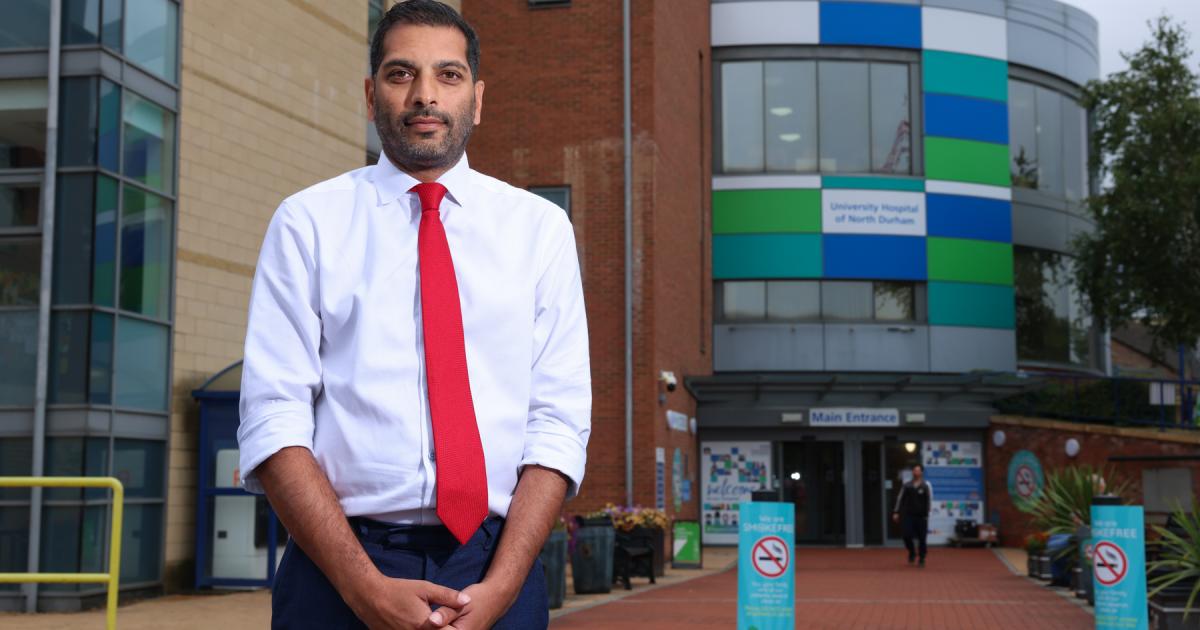
The trust is reviewing the care of 1,500 patients after a report identified a “decade of systemic failures,” but questions have been asked about how long a lookback exercise into the trust should go.
Durham Police is investigating whether criminal offences may have taken place, campaigners are calling on the government for a public inquiry, and former breast services clinical lead Amir Ahmed Bhatti remains employed by the trust on full pay but is barred from clinical work.
Here is our Q&A with Mr Russell:
Given that 1,500 women are having their cases reviewed in the lookback exercise, do you believe the Government needs to intervene with a public inquiry?
We want to support the women affected and their families, give them the answers that they want about their care, and make sure women who would benefit receive further support or treatment.
We must ensure the service women access now is very different from the service that harmed women historically.
A County Durham and Darlington NHS Trust sign (Image: NORTHERN ECHO)
I understand why women and your readers feel a public inquiry might be warranted and helpful.
Ultimately, that is a decision for the Government, not one we can take.
If a public inquiry comes forward, we will cooperate fully, as we have done. There are things a public inquiry can do and things it cannot do.
Why is Amir Bhatti still employed by the trust on full pay? Why has it taken so long, and is his continued employment insulting to the women affected?
I understand why people feel it is an injustice, given the degree of harm that women have suffered.
When I joined the trust, we extended the restrictions already in place. We did that for safety reasons and to ensure women accessing the service received different care from that provided historically.
Chief executive of the County Durham and Darlington NHS Foundation Trust, Steve Russell (Image: Chris Booth/NORTHERN ECHO)
I cannot go into loads of detail about individual employment matters, but we have acted to protect patients and followed our employment policies to undertake the necessary reviews and investigations.
They can take a long time, longer than any of us would like.
We are very serious about making sure the review is fair but robust. It has taken longer than any of us would wish, but I hope we are reaching the end of the investigation.
The trust has taken several steps, some publicly reported, in response to challenges.
Although it will feel unjust to those affected by the service’s failings, his contract requires us to continue paying him while the investigation takes place.
If this involved an ordinary employee accused of a crime, would the internal procedure be the same? Would they be suspended entirely or allowed to continue part of their role?
It is the same in the sense that these are allegations.
The employer’s first responsibility is to put in place any safeguards needed for the public, patients or staff, then undertake a thorough investigation.
Amir Bhatti, former clinical lead at the NHS Trust (Image: SUPPLIED)
While that investigation takes place, they remain allegations rather than proven facts.
During that period, any member of staff, regardless of the allegation or their role, would receive full pay.
There are additional protections for doctors, irrespective of the nature of the concerns.
What is the current situation with the investigation into Amir Bhatti and his working position within the trust?
The trust restricted Mr Bhatti from clinical practice around October or November. We extended a restriction that initially covered breast services to the rest of his clinical practice.
He can undertake non-clinical duties but is restricted from entering the area where women attending the breast service are seen and treated.
We are investigating the concerns under our policies. That remains ongoing and has taken longer than any of us would have liked for several reasons.
That is not an excuse, but I hope we are close to concluding the investigative stage. That does not mean the entire process is finished, but I hope that we’re coming to conclude the investigation.
Chief executive of the County Durham and Darlington NHS Foundation Trust, Steve Russell (Image: Chris Booth/NORTHERN ECHO)
There was also a High Court hearing which the trust had to defend.
He asked the court to direct us to remove the restriction, allowing him to return to clinical work, and to prevent us from restricting him in future.
We disagreed and defended the claim. The High Court found in our favour.
It criticised some things we had done but said the decision to impose and continue the restriction was appropriate, so it remained in place.
The trust must follow a full legal and employment process, like any organisation, before taking further action.
I appreciate that continued full payment will feel unjust to women harmed by the service and to readers more generally. However, it is contractually required, and every NHS organisation must follow a specific national policy covering concerns about doctors.
Chief executive of the County Durham and Darlington NHS Foundation Trust, Steve Russell (Image: Chris Booth/NORTHERN ECHO)
That policy requires employers to be fair and proportionate, which is right, but gives doctors additional protections and rights.
For example, a nurse cannot be legally represented during an investigation under the trust disciplinary policy, while a doctor can. That is not a trust decision; it is part of national policy.
Those additional protections can mean processes take longer than we would like.
Why was Dr Bhatti allowed to run his own clinics through subcontracted work he was carrying out alongside his NHS work?
Within the NHS, and not necessarily in Dr Bhatti’s case, there is a flaw allowing consultants to establish private clinics under their own or another name.
Because of current pressure on the NHS, patients can then be referred to those private clinics even though the same doctors also work in the NHS.
Patients may effectively be referred to a consultant who is the same person later treating them.
We have stopped using those companies and no longer operate those arrangements.
They exist in other organisations and can sometimes be appropriate, provided the correct safeguards, governance and oversight are in place.
Conflicts of interest must be properly managed so there are no perverse incentives. There must also be proper clinical oversight, as a trust should exercise over its own clinical services.
Not all those safeguards were previously in place at the trust. We have therefore terminated the arrangements and reduced the reliance on contracted companies, particularly in breast services.
Steve Russell (Image: Chris Booth/NORTHERN ECHO)
Their use indicates a capacity problem within the NHS. Normally, you would expand the NHS service or introduce new roles to manage those constraints.
For whatever reason, that did not happen. It is what we are starting to do now.
We have a partnership arrangement with Newcastle hospitals. That forms part of reassuring women that they can have confidence in a service operating very differently from before.
That they can have confidence that when they’re coming and accessing the services that they’re going to be treated in a very, very different way than they were previously.
And this in no way takes away from the poor care that many women receive historically.
How are you rebuilding trust in the trust’s breast services?
Three clinical outcomes were poor in the trust previously.
The first was the rate of breast-conserving surgery, which seeks to minimise surgery and avoid mastectomy.
The second was the reoperation rate, the number of women needing a second or third operation.
The third was whether women were offered immediate reconstruction.
The latest information shows 33 per cent of women are offered immediate reconstruction, compared with a national standard of 30 per cent.
For breast-conserving surgery, 72 per cent of women now receive it, against a national standard of 65 per cent. Previously, the trust’s figure was 53 per cent.
The proportion of women needing another operation after their first has fallen from 25 per cent to 12 per cent. The national standard is below 17 per cent.
We still need to improve women’s experience of the unit because it is not designed in the right way.
From a clinical outcomes perspective, however, it is hugely different from the previous service.
Women received substandard care, experienced poor outcomes and underwent unnecessary surgery, affecting them, their families and their wider lives.
Where is the accountability, and where should blame lie for what happened in the breast cancer service?
There is accountability for the direct care given to women. As the employer of those who delivered that care, this is partly the trust’s responsibility.
Professional regulators also have responsibility.
More broadly, governance reviews found, and we have publicly acknowledged, that the trust did not act quickly enough on information it held about concerns in the service. Harm therefore continued when it might have been avoided, which is devastating.
Mary Aubrey’s report raised concerns about board governance and leadership.
Ultimately, the board is responsible for what happens in the organisation. I am the accountable officer and have specific accountabilities. The board is unitary and takes collective responsibility.
We now have a new board. The trust no longer employs all members of the previous board, although it still employs some.
Our role concerns the fit and proper person test.
When we published our response to the Mary Aubrey report, we said we would review whether further consideration was needed under that test. That process is ongoing.
I understand accountability is one reason people want a public inquiry.
A public inquiry can compel people to attend and give evidence.
My understanding, although I am not an expert, is that an inquiry can criticise people in its report and findings but cannot sanction individuals.
It therefore partly depends on what people expect and want accountability to mean.
Chief executive of the County Durham and Darlington NHS Foundation Trust, Steve Russell with senior reporter of The Northern Echo, Patrick Gouldsbrough (Image: Chris Booth/NORTHERN ECHO)
Whether an inquiry is the right course will be decided by the Government. People are calling for one, as often happens when people have been wronged.
It is not the trust’s decision.
Our focus is supporting those affected, improving the service for current patients and being as transparent as possible.
We published all the reports in an attempt to be transparent, although I understand that may not go far enough for some people.
Is anyone else under investigation as part of the trust’s lookback exercise into breast services?
As of now, no.
However, the lookback is ongoing. We continue meeting and hearing from women who want to tell us about their experiences, and continually assess whether other concerns need further exploration.
We have not started another investigation. We are reviewing feedback from women and findings emerging as the lookback progresses.
The lookback is clinically focused on the care women received.
We have changed some imaging equipment because that felt important.
It is difficult to question historical decisions because we do not know the context in which they were made.
I understand why those decisions may appear wrong, but none of us was there at the time. We have tried to act now to improve the service, and there’s been a huge amount of learning for the organisation.
This is not something that was published and then became a flash in the pan.
It has caused considerable reflection, pain and anguish.
People remember what happened in the breast service. That is important because it will influence how the trust’s culture changes and how decisions are made in future.
I do not want to suggest we will suddenly make every decision flawlessly, because we will not.