
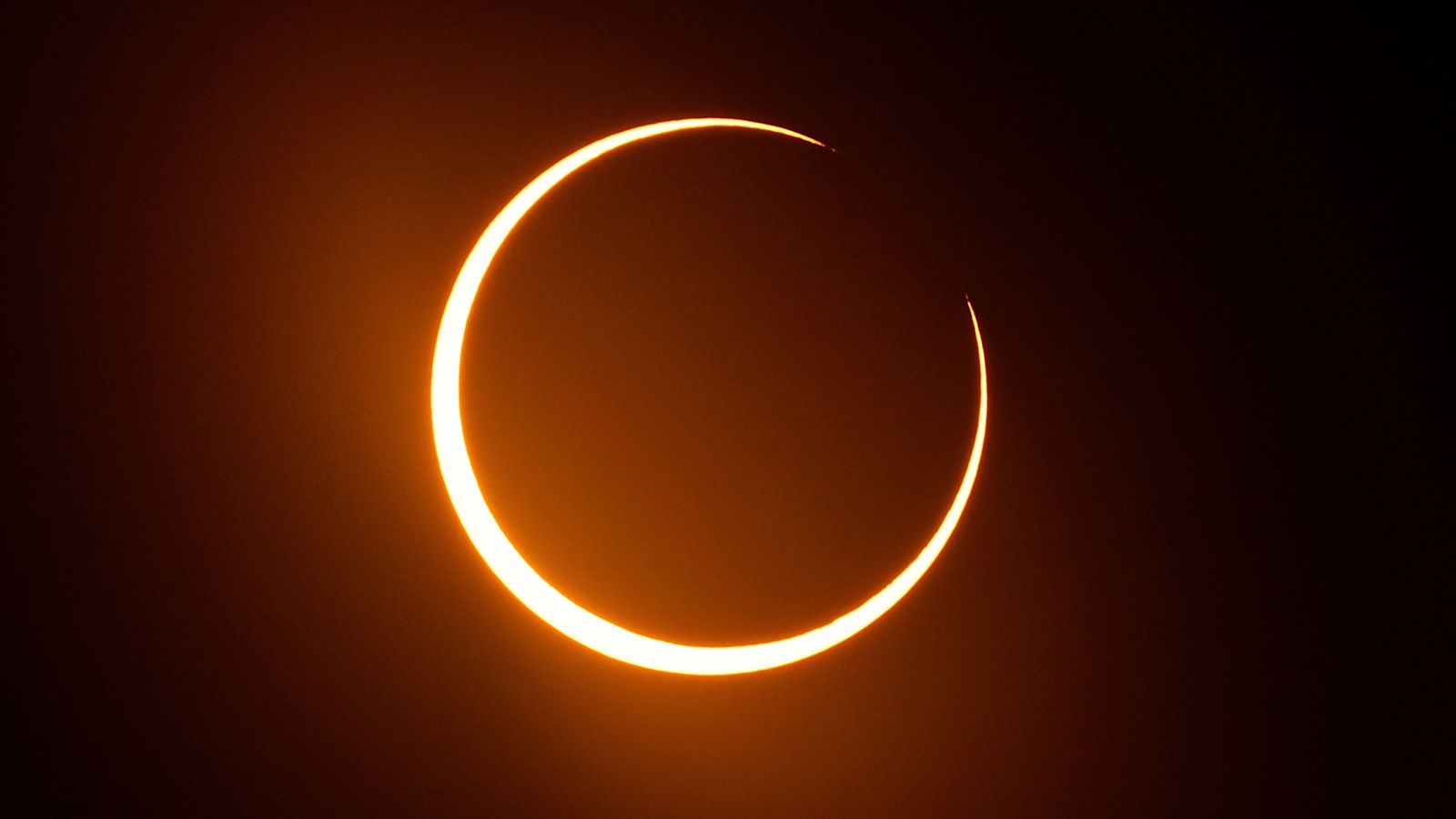
Skywatchers across the UK are in for a celestial treat on August 12, as a deep partial solar eclipse is set to unfold during the evening.
The UK will experience its most impressive solar eclipse since 1999, with up to 96% of the Sun obscured in parts of the country.
But what causes this exciting solar event and how can you watch it safely? ITV News explains.
What is a solar eclipse, and what will it look like from Earth?
A solar eclipse occurs when the Moon passes between the Sun and the Earth, meaning they all align for a period of time. The Moon appears to obscure the Sun, creating a shadow on Earth.
Hundreds of millions across the world are in for a celestial treat. Credit: Nasa’s Goddard Space Flight Center
There are four types of solar eclipse: Total, annular, hybrid, and partial.
Next week’s eclipse is what is known as “partial” in the UK, which means that only part of the Sun’s light will be blocked by the Moon.
However, astronomers say this will be the most impressive eclipse visible from British soil since 1999.
Other parts of the world, including Greenland, Iceland, Spain, Russia, and a small area of Portugal, will witness a total eclipse.
How rare is this phenomenon?
Solar eclipses in and of themselves are not unusual, happening roughly every 18 months somewhere on Earth.
However, a single place may have to wait hundreds of years to be in the eclipse shadow.
Seeing more than 90% of the Sun covered from parts of the British Isles is a rare event, making this one especially worth watching.
The next time the Moon obscures as much of the Sun will be in 2081, and the next total solar eclipse in the UK will be in 2090.
People in the UK and Ireland on Wednesday can see a partial solar eclipse. Credit: Royal Museums Greenwich
When and where will I be able to see the eclipse?
Depending on where you are in the UK, the time in which you can view the eclipse varies slightly. The celestial event will last approximately 1 hour and 50 minutes in total.
According to Royal Museums Greenwich (RMG), here is when you can witness the phenomenon:
Edinburgh and Glasgow: 6.08pm – 8pm. Eclipse maximum at 7.05pm.
Manchester and Liverpool: 6.13pm – 8.03-04pm. Eclipse maximum at 7.10pm.
Norwich and Birmingham: 6.15pm – 8.04pm. Eclipse maximum at 7.11pm.
London, Bristol and Cardiff: 6.17pm – 8.06pm. Eclipse maximum at 7.12pm.
Cornwall – 6.18pm – 8.10pm. Eclipse maximum at 7.16pm.
In the UK, generally speaking, the further southwest you are, the greater the coverage of the sun.
Cornwall and the Isles of Scilly are likely to get the best views with up to 95%.
When choosing a viewing spot, open or raised areas without buildings or trees and a clear view of the western horizon are best.
Outside of the UK, the partial eclipse will be visible in Europe, Africa, North America.
People in Cornwall may have some of the best views in the UK. Credit: iStock
How can a solar eclipse be dangerous?
Imo Bell, a planetarium astronomer at the RGO, warns that you “can’t just go out and expect to have a look” as this is dangerous for the eyes,
“During an eclipse, the Sun appears dimmer than usual”, explains the UK Health Security Agency (UKHSA).
“This makes it easier to look at directly – and that’s precisely the problem. The reduced brightness can override the body’s natural reflex to look away, allowing intense sunlight to reach and damage the retina.
“This damage happens without causing any pain, so you may not realise harm is occurring until it’s too late.”
So how can I enjoy the eclipse safely?
Experts say you must wear solar eclipse viewing glasses, which are specifically designed eye protection.
Sunglasses, or 3D glasses, will not adequately protect your eyes.
Planetarium Astronomer Dr Carys Herbert demonstrates wearing Celestron solar eclipse glasses. Credit: PA
Antonio Garcia Fernandez is part of Volunteer Astronomy Observers of Spain, a group of astronomers and professors that set up a website, Eclipse Seguro, to share safety information ahead of this year’s eclipse.
Fernandez warns that it is important to look out for fake glasses.
“Online marketplaces are currently flooded with uncertified or counterfeit glasses with fake labels, which can cause permanent blind spots in seconds.
“To ensure your eclipse glasses are legitimate, make sure that they have safety certification ‘ISO 12312-2′ or ‘ISO 12312-2:2015’ printed somewhere on the glasses”, say the RMG.
You should also not use glasses with lenses that are scratched, torn or damaged.
A safe and cheap way to witness the event is to make a pinhole projector, which can be created easily at home with minimal materials.
“You can project the image of the eclipse using a household item like a colander which has lots of holes in – point the colander towards the Sun with your back facing it, and in the shadow of the colander you’ll be able to see the eclipse in the holes, which is really cool”, says Bell.
ITV News will also be streaming the event.
Will I be able to take a photo with my smartphone?
If you’re photographing the Sun during the eclipse, the lens should be protected by a special-purpose solar filter, or you could hold solar eclipse viewing glasses up to the lens.
A digital SLR camera is your best bet for dramatic close-up photos of the Moon passing in front of the Sun, however, it is possible to take a good photo with a smartphone.
Remembers to wear suitable eye protection when photographing the event. Credit: iStock
iPhones and Android devices aren’t really designed for photographing objects in the sky. Their lenses are great for wide-angle shots but not so good for capturing close-up detail from afar.
But newer phones have sophisticated sensors, multiple lenses, and image stabilisation software that give you a better chance. Many also have exposure controls, so you can darken or lighten the image amid tricky eclipse lighting.
Zooming in, avoiding flash and lowering exposure may help capture the celestial event.
What about a selfie?
It’s tempting to make a TikTok or Instagram-friendly eclipse video using the selfie camera.
But, while you might think your vision isn’t at risk because you’re not looking at the Sun, your phone’s screen could reflect harmful ultraviolet light, eye experts have warned.
A double treat for skywatchers
As if one spectacular celestial event wasn’t enough, the Perseid meteor shower will also peak on the night of August 12 to 13.
A meteor during the Perseid meteor shower seen over Happisburgh lighthouse, Norfolk in 2020.
With the Moon in its new phase following the eclipse, skies will be beautifully dark, providing ideal conditions for spotting shooting stars.
Under clear, dark skies, observers could see 20-40 meteors per hour across much of the UK, with even higher rates possible in areas free from light pollution.
The best time to watch will be after midnight and into the early hours of Thursday morning, when the constellation of Perseus climbs higher into the sky.
Of course, the weather will have the final say. We’ll be keeping a close eye on the forecast in the lead-up to Wednesday, bringing you the latest cloud cover outlook to help you make the most of this rare day-and-night astronomical show.
Want a quick and expert briefing on the biggest news stories? Listen to our latest podcasts to find out What You Need To Know…