
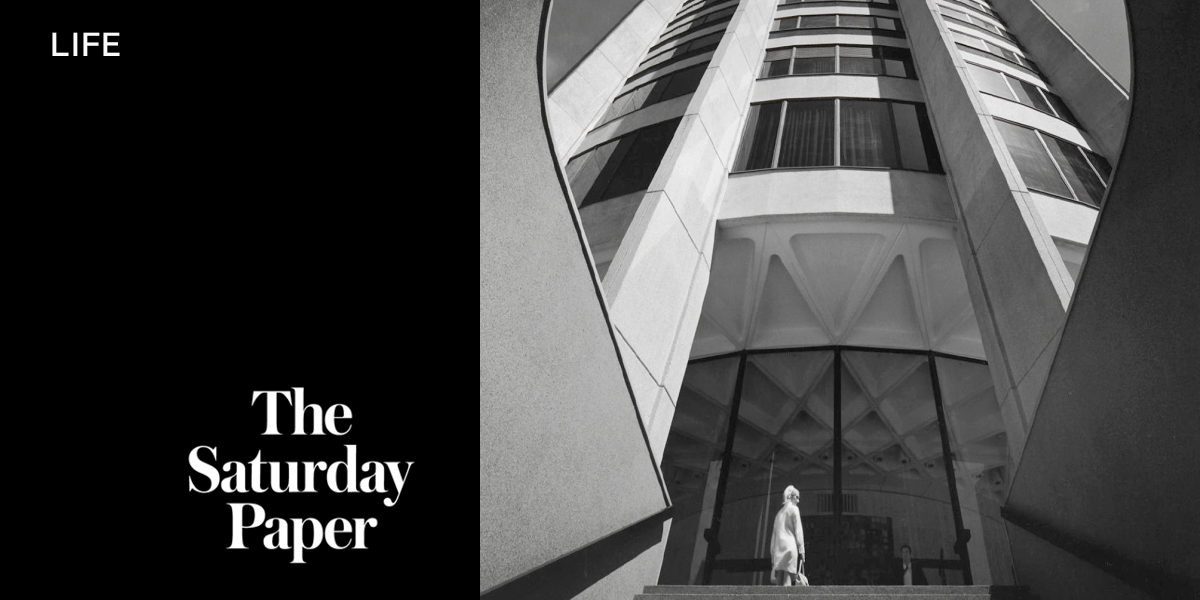
Even now, the mid-century zeitgeist flaps its long, spiked tail across our urban fabric. Had Harry Seidler chosen the United States or Canada over Australia back in 1948, our cities and conversations today would be quite different.
That conversation has turned more lately to the architect himself. Seidler the mid-century modernist is very in right now, as evidenced by an adulatory new retrospective, Migrating Modernism, at Sydney’s Chau Chak Wing Museum.
Seidler’s greatest strength and flaw is his focus on architecture at the expense of urbanism. The city is a collective creature and, although Seidler worked mostly in city centres, he had no interest in the collective.
Seidler was absolutely a man of his time. It was his oft-stated view – including to me personally – that Australia had built nothing worth keeping. This freed him to treat Australian cities as tabulae rasae, asserting his individual will in three dimensions. Unsurprisingly, this machismo found fertile soil in mid-century Australia, making Seidler one of the most prolific architects of the generation and, urbanistically, one of the more destructive.
Born in Vienna in 1923, Seidler was interned in the United Kingdom after the Anschluss of 1938. The following year, at just 17, he was deported as an “enemy alien” to Canada, where he studied architecture at the University of Manitoba. His postgrad study was under Bauhaus founder Walter Gropius at Harvard in 1945, with influence from greats such as Josef Albers and Marcel Breuer, for whom he later worked.
Seidler’s parents migrated to Sydney after the war, and it was not until his mother, Rose, commissioned him to design the family home in Turramurra (then far-flung market-garden territory) that Seidler consented to move there himself. Completed in 1950, the Rose Seidler House was so radical it had gawpers queued around the block. With its strong horizontals, its expression as a glassy box lifted from the ground by a stalwart stone plane and its evident aloofness from nature, like some newly arrived spaceship, it owed much in both plan and composition to Seidler’s former boss Breuer. Within months Seidler was hailed by People magazine as the “high priest of the 20th century”, set to dazzle us with his “shiny American ideas”.
Seidler’s greatest strength and flaw is his focus on architecture at the expense of urbanism … He had no interest in the collective.
It was this adamant adherence to precept that gave the man his signature drive and his work its charisma. It also worked against his host cities.
Seidler designed many buildings in many countries and in most Australian cities. Of them all, Australia Square (1967) is probably the most significant and pivotal, not only in his own career but in the evolution of Sydney. Indeed, it transformed Australian urbanism more broadly.
Seidler’s rhetoric at the time was all about “decongesting” Sydney, as if street bustle were the enemy. Australia Square did this in various ways. Symbolically, by rising white and celestial from an old-fashioned brown-brick city. In plan form, by obliterating a dozen or more buildings and laneways into a single, central radial sun-like diagram. Socially, by undermining the street in favour of private retail and office space. Culturally, by dragging the city’s centre of gravity north towards the harbour. And economically, by reordering the cultural geography of central Sydney towards distant views rather than proximate public streets.
This was an exercise in imperium. Overall, Australia Square’s effect was to tip the cultural balance, from the public and collective towards the private and individual. Whereas the old, masonry courtyard buildings had warmed the street with their decorated public façades, the new towers offered a sense of exclusion.
Of course, Seidler didn’t act alone. With Lendlease founder Dick Dusseldorp – another mid-century Euro immigrant with outsized ambitions – he formed a critical partnership. Together, they grasped something that now seems obvious: view is a commodity. Towering, like their buildings, over this small provincial stage, they had already drafted the country’s first Strata Titles Act (1961), enabling their high-rise apartment buildings. Now, despising council planners, they set about state-level lobbying to repeal the 1912 Height of Buildings Act and replace it with a “floor space ratio” mechanism. This changed everything.
Until then, Sydney was more like a European city: red-brick, street-hugging, introspective, its retail and economic heart uptown near Central Station. The new ratio, which allowed floor space of 12 times the site area and unlimited height, let developers replace the old, dank light well with glittering harbour views. That meant dollars.
Suddenly the game was to buy up small sites, amalgamate, demolish the buildings, obliterate the laneways and gather to the centre all allowable floor space, shoving it as close to the heavens as possible. Inflating this skyward push, it made sense to maximise ceiling heights and dedicate multiple ground floors to quasi-public retail uses (that did not count in the ratio).
The result was spectacular, elevating private amenity, profit and, literally, uplift at the expense of all things public. Even Australia Square Plaza – a pleasant enough space in itself – is privately owned, sucking vitality from the neighbouring streets, leaving them dark, undefined and windswept.
The Migrating Modernism exhibition in Sydney overlooks this important context, dwelling instead on Seidler’s spurious but oft-repeated claim to be an exponent of the baroque.
That’s a stretch. The baroque is generally understood as the decadent, intricate and mannerist end of the Renaissance: Seidler, despite his abiding and inventive obsession with quadrant-and-arc geometry, vocally despised both style and decoration and his aesthetic was unrelentingly minimalist. From professional curators we might expect a little more critical distance.
Seidler went on to build many more towers in Sydney, Brisbane, Melbourne and Perth. And yes, as objects, they’re more handsome than most. It’s also true that towers would have come to our cities anyway. That was the zeitgeist. But good cities are made primarily not of buildings but of streets, the lacework of our shared lives. Undermining and devaluing those streets has that same effect on our civic life.
Even now the debate continues. Sixty years on in Melbourne, another Lendlease tower, Town Hall Place (directly opposite Flinders Street Station), proposes to roughly double the allowable height. The controversy centres on the fact this is the last intact portion of the historic Hoddle grid. Naturally, the council is sidelined. Yet the building’s effect, as both former city architect Rob Adams and critic Norman Day pointedly note, would be to end 40-year-old protections and threaten the laneways that have made Melbourne one of the world’s most admired city centres.
It’s old now, this long-shadow zeitgeist. Well past its use-by date. What’s long overdue is not fashionable homage but a deep rethink: a geist to fit the zeit.