
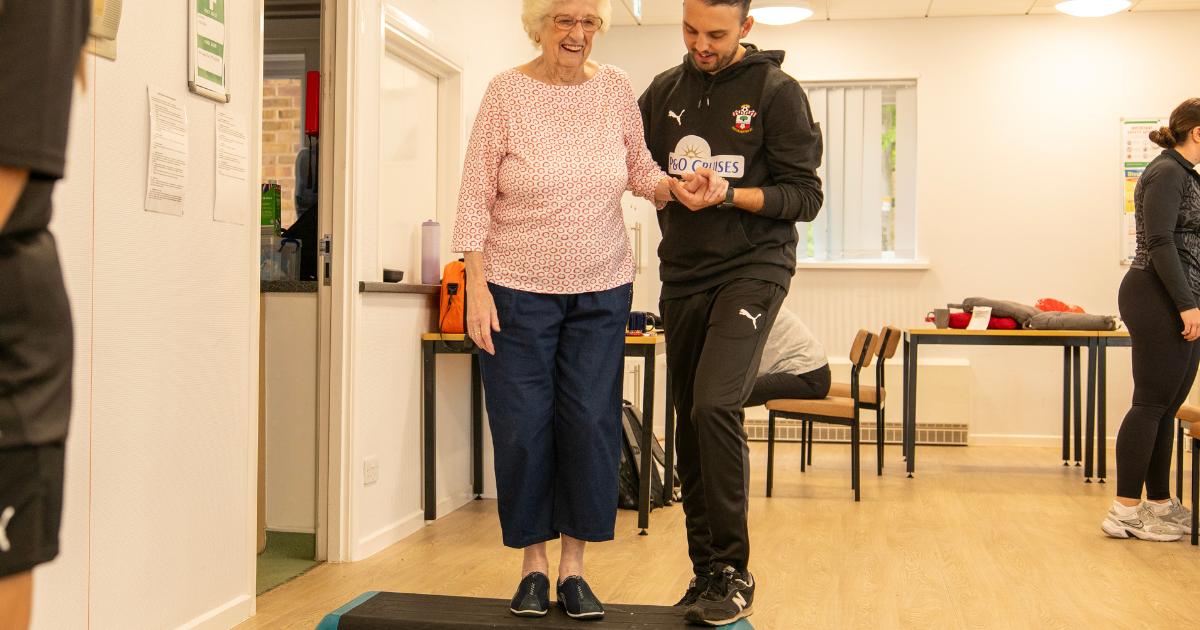
Patients are spending an average of 2.1 fewer days in hospital thanks to the scheme, which is funded by Southampton Hospitals Charity and delivered by Saints Foundation.
The programme employs Jake Batchelor, a specialist exercise practitioner from Saints Foundation, who works directly with older patients in the Medicine for Older People Gym at University Hospital Southampton (UHS).
Ellis Banfield, chief executive of Southampton Hospitals Charity, said: “These results are a powerful demonstration of what the funds we raise can achieve.
“When we first funded this role, we believed that keeping older patients active and engaged during their hospital stay would make a real difference to their recovery – and the evidence now shows just how significant that difference can be.”
READ MORE: World-first trial of fridge-free vaccine developed in Southampton
The programme employs Jake Batchelor, a specialist exercise practitioner from Saints Foundation (Image: Southampton Hospitals Charity)
The programme aims to prevent physical and mental decline caused by long periods of inactivity in hospital, a condition known as deconditioning.
By combining chair-based exercises, adapted exercise bikes, group mobility sessions and VR reflex games, the sessions help patients regain the strength, balance and confidence they need to return home safely.
Harnish Patel, associate professor and consultant physician for medicine for older people at UHS, said: “What really stands out is the impact Jake has as an individual.
“He is universally loved by patients and staff alike, and the trust and warmth he brings to every session is a huge part of why the programme works.
“For many of our patients, coming into the gym is about much more than exercise.
“It gives them confidence, lifts their mood and helps them feel more like themselves again.”
READ MORE: Southampton to share in £156m boost for new mental health emergency department
Mr Batchelor said: “Every day I see patients come into the gym feeling uncertain about what they can still do, and leave feeling stronger, more confident and more like themselves.
“Whether it’s getting back on a bike, trying VR for the first time or just moving and laughing with other patients, those moments matter enormously.”
The results position the programme as a model for how targeted investment in patient wellbeing can deliver substantial returns for both individuals and the healthcare system.