
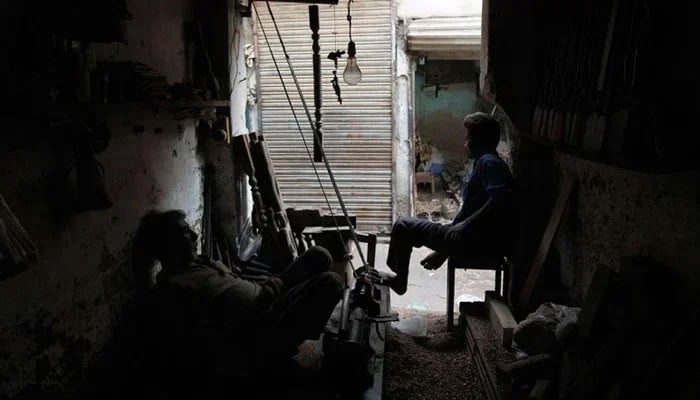
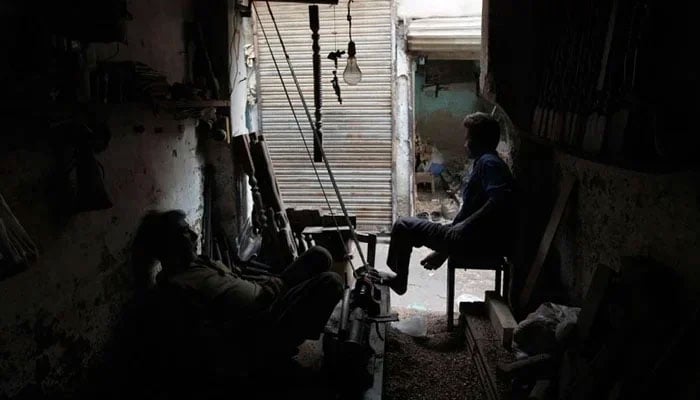
Carpenters at a workshop pause during a power outage in Karachi, on June 15, 2013. — Reuters
Pakistan’s energy transition has long been constrained by an uncomfortable reality: the country needs reliable electricity around the clock, yet its dependence on imported fossil fuels exposes the economy to volatile global markets.
While solar and wind have become increasingly competitive, their intermittent nature requires complementary technologies that can deliver stable power. The collaboration between OGDCL and SLB to undertake geothermal exploration in Sindh therefore represents far more than a geological survey. It is a strategic opportunity to redefine Pakistan’s energy future by combining indigenous geothermal resources with the emerging potential of lithium extraction. Together, these two resources could establish the foundations of a resilient clean energy ecosystem; one that provides continuous baseload electricity while enabling battery manufacturing and energy storage solutions essential for a modern power system.
The significance of geothermal exploration in Pakistan lies in its ability to address multiple national priorities simultaneously. Pakistan has historically focused on exploiting hydrocarbons beneath its sedimentary basins. Today, however, those same geological formations may offer an entirely different value proposition. Geothermal reservoirs contain naturally occurring heat that can generate electricity 24 hours a day with minimal greenhouse gas emissions.
In some geological settings, these geothermal fluids also contain commercially valuable concentrations of lithium and other dissolved critical minerals. This dual-resource opportunity transforms geothermal projects from single-purpose power plants into integrated energy and minerals developments capable of generating multiple revenue streams while strengthening national energy security, and that is where I am interested (as should you).
This partnership also reflects an important institutional shift. Pakistan’s largest exploration company is leveraging decades of subsurface expertise to investigate resources that align with the global energy transition rather than the traditional fossil fuel economy. Through collaboration with SLB, OGDCL gains access to advanced reservoir characterisation, geothermal drilling technologies, digital subsurface modelling and internationally recognised engineering practices.
The immediate objectives include comprehensive geothermal resource mapping across prospective regions of Sindh, drilling pilot wells to validate commercial viability, and evaluating geothermal brines for Pakistan lithium extraction potential. These activities will establish the scientific foundation required for future investment while reducing geological uncertainty for both public and private stakeholders.
Direct lithium extraction technologies now allow lithium to be recovered from geothermal brines while reinjecting the remaining fluids back into the reservoir, maintaining environmental sustainability and reservoir pressure. Rather than treating electricity generation and mineral production as separate industries, Pakistan has an opportunity to develop integrated projects where clean energy and critical mineral production reinforce one another economically.
The implications extend well beyond mining. Lithium is the cornerstone of modern Battery Energy Storage Systems (BESS), which have become indispensable for integrating renewable energy into contemporary electricity grids. Pakistan has witnessed remarkable growth in utility-scale and distributed solar generation, yet this expansion increasingly exposes operational challenges related to intermittency, grid balancing and evening peak demand.
Battery storage addresses these issues by storing excess renewable electricity during periods of high generation and releasing it when demand exceeds renewable output. If Pakistan can successfully develop domestic lithium resources, it can begin establishing local battery value chains that reduce dependence on imported storage technologies while supporting industrial development.
The combination of geothermal generation and BESS creates a particularly compelling energy strategy. Geothermal plants already provide stable baseload electricity with capacity factors often exceeding those of most renewable technologies. Unlike solar and wind, geothermal energy does not fluctuate with daylight or weather conditions. Battery storage then complements this stable generation by providing frequency regulation, peak shaving, reserve capacity, and rapid response services that improve overall grid reliability.
Rather than viewing geothermal and BESS as competing technologies, policymakers should recognise them as complementary pillars of a resilient electricity system. Geothermal delivers continuous power, while batteries provide operational flexibility that enables even greater integration of variable renewable energy.
This integrated model offers significant macroeconomic benefits. Pakistan spends billions annually importing liquefied natural gas to stabilise electricity generation during periods of high demand. Expanding indigenous geothermal capacity would gradually reduce reliance on imported LNG while insulating the economy from international fuel price volatility. Simultaneously, domestic battery manufacturing supported by Pakistan lithium extraction could reduce import dependence for energy storage technologies that will become increasingly essential as renewable deployment accelerates. The resulting improvements in the balance of payments, energy security and industrial competitiveness would extend well beyond the power sector.
The environmental implications are equally important. Pakistan’s NDCs require substantial reductions in greenhouse gas emissions while maintaining economic growth. Geothermal electricity offers one of the lowest lifecycle carbon footprints among commercial energy technologies and provides continuous renewable generation without requiring fossil fuel backup. The integrated approach accelerates decarbonisation across electricity generation and industrial sectors, helping Pakistan meet international climate commitments without compromising energy reliability.
Realising this vision, however, requires carefully designed financing mechanisms. Geothermal exploration remains capital intensive, with significant geological risk during early-stage drilling. Private investors alone are unlikely to absorb these uncertainties without government participation. Public-private partnerships, sovereign risk-sharing instruments, concessional climate finance, multilateral development support and blended financing structures will therefore be essential during the exploration phase.
Once commercial reservoirs are proven, institutional investors and independent power producers are likely to view geothermal assets more favourably because of their predictable generation profiles, long operational lifespans and stable revenue streams. Similar financing support will also be necessary to stimulate domestic investment in downstream lithium processing.
Nevertheless, important risks should not be underestimated. Pakistan currently lacks a comprehensive regulatory framework governing geothermal resources and critical minerals. Licensing procedures, fiscal incentives, environmental safeguards, water management protocols and mineral ownership arrangements require greater clarity before large-scale private investment can materialise. Overdependence on imported drilling technologies, extraction systems, and battery manufacturing equipment also presents strategic vulnerabilities. Without sustained investment in domestic research, workforce development and technology transfer, Pakistan may remain dependent on external expertise despite possessing valuable indigenous resources.
Looking ahead, Pakistan possesses an opportunity that relatively few developing economies enjoy: the possibility of simultaneously becoming a producer of clean baseload renewable electricity and a participant in the global critical minerals economy. By balancing partnerships with Western technology leaders while expanding cooperation with regional manufacturing and investment partners, Pakistan can diversify technological capabilities without becoming overly dependent on any single geopolitical bloc. Success will require long-term policy consistency, institutional coordination and strategic investment, but the potential rewards extend far beyond the energy sector.
If supported by a forward-looking critical minerals strategy, sound governance and sustained public-private collaboration, Pakistan can move decisively from fossil fuel dependence towards a future defined by indigenous clean baseload power, advanced energy storage and leadership in the economy. It is a strategic economic transformation.
The writer works at the Alternate Development Services (ADS) and can be reached on LinkedIn @MashhoodUrfi