
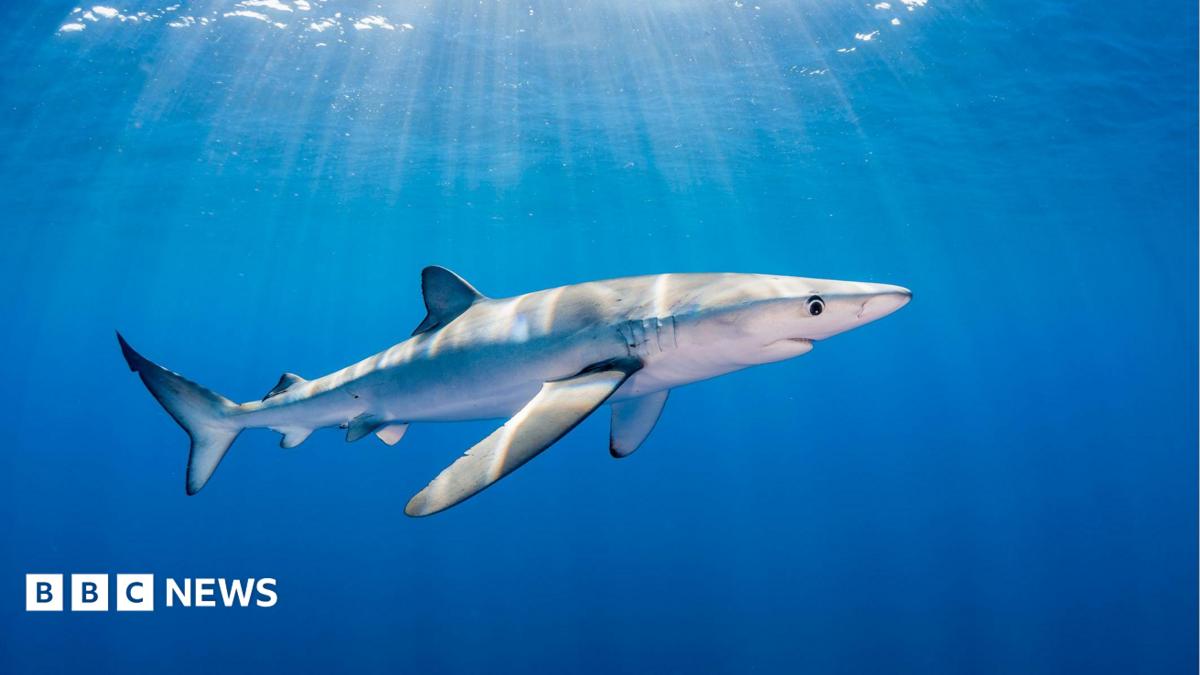
The blue shark is a long-distance migrant that is present in Irish waters usually from June to October, when it is taken by recreational anglers on a catch-and-release basis, according to Inland Fisheries Ireland, external.
It says the blue shark is one of Ireland’s largest and most valuable marine sport fishes.
Jack Kelly, a marine biologist and cinematographer in County Galway, said they are “common all around Britain and Ireland during the summer months”.
“You can definitely get them in numbers,” he told BBC Radio Ulster’s Good Morning Ulster.
Kelly said all sharks are “so curious in an amazing way”.
“If a shark approaches anything, really, it’s not like they have fingers to be able to investigate to see what it is. So they have this amazing curiosity about them where they’ll come, they’ll just kind of circle and try to check out what’s going on,” he said.
“You’ll often get them actually just really staring at you.
“For me, when I’m underwater they might give the camera a bump just to see what it is, so their curiosity for me is definitely something that stands out.”
Blue sharks can reach more than three metres in length and feed in open water on fish, squid, smaller sharks and sea birds.
The conservation status of the blue shark is listed as near threatened on the Irish Red List for cartilaginous fish and by the IUCN Red List, according to Inland Fisheries Ireland.
The Marine Sportfishing Tagging Programme, external tagged 19,309 blue sharks between 1970 and 2013 off the coast of Ireland, which accounts for 45% of all tagged fish since the beginning of the programme.
This is not the first time people have been bitten by sharks off the Irish coast.
In 2018, a Belfast man who was angling caught a blue shark and was bitten while bringing it on board a boat.
His lower arm was seriously injured in an incident where he was helped by Crosshaven RNLI in Cork.