
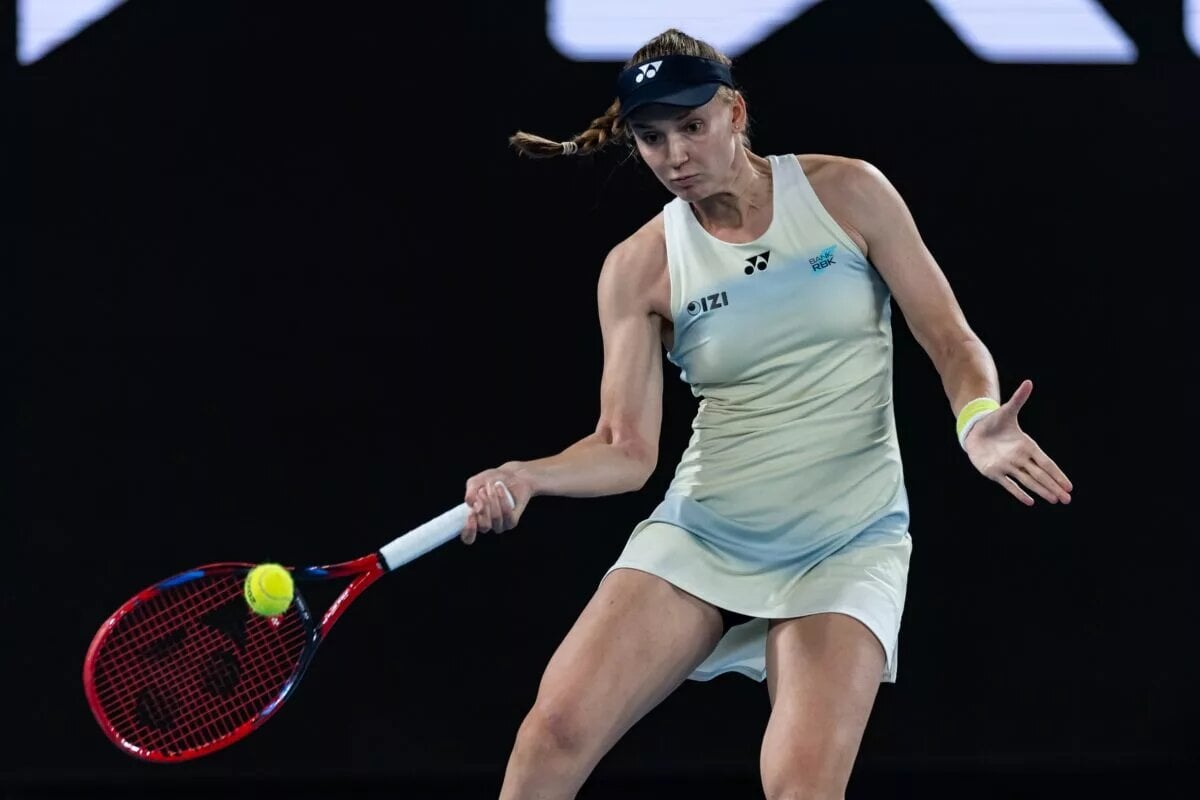
Elena Rybakina reached the Canadian Open final without a single straightforward match to get there.
She survived a 3-set battle against Daria Kasatkina, regrouping after a second-set wobble. She recovered from a double break down in the third set against Liudmila Samsonova, reeling off five consecutive games to close out a 3-hour marathon. She trailed Naomi Osaka by a set and a break, ground her way to a tiebreak, then took the deciding set in a match that lasted two hours and 33 minutes finishing with a season-high 72 unforced errors.
And in the semifinal, she came back from 5-7 down against Coco Gauff to win 6-2 6-2.
That makes her only the fourth player in the Open Era to win 4 three-set matches on the way to a Canadian Open final, joining Lina Krasnoroutskaya in 2003, Venus Williams in 2014, and Bianca Andreescu in 2019.
Rybakina’s Toronto Run is a Return of Her Missing Edge
The Part of Her Game That Has Never Been Guaranteed
Rybakina’s serve, her flat, penetrating groundstrokes, and her raw ball-striking have never been in question across her career. What has been in question, at various points, is whether she could reliably find a way through matches that stopped going according to plan.
There have been stretches, even this season, where her level lacked the continuity that a player with her ceiling should be producing consistently. She was essentially having results that made people wonder whether her win at the Australian Open earlier this year was the start of something sustained or simply a brilliant peak surrounded by inconsistency.
Toronto is answering that question in real time. The value of this run isn’t that Rybakina reached another final. It’s that she is repeatedly finding a way to win matches that don’t go to script. And that didn’t seem likely a year ago.
The Throwback That Explains Why This Matters
This isn’t the first time Rybakina has shown this level of resolve on the biggest stage.
It’s exactly what carried her to her maiden Grand Slam title at Wimbledon in 2022, when she came from a set down against Ons Jabeur in the final, with the entire crowd behind her opponent and the pressure of a maiden major final bearing down on her. That win confirmed that beneath the calm, occasionally impassive exterior she’s known for on court, there was a competitor capable of raising her level precisely when a match threatened to slip away.
What’s been less consistent in the years since is whether that same resolve would show up reliably, tournament after tournament, rather than in isolated, spectacular flashes.
What the Final Represented
Rybakina squared off against Iga Swiatek for the title on Thursday, a rematch of one of the WTA’s most familiar rivalries. Although she fell in straight sets, the story of this tournament has already been written.
A player once defined almost entirely by the cleanliness of her ball-striking has spent an entire week proving something considerably harder to manufacture: that when her first-choice game isn’t working, when the match stops being straightforward, she can still find a way through. That is the exact quality that won her Wimbledon in 2022, and for long stretches since, it’s been the piece of her game that felt least guaranteed to show up.
In Toronto, over four separate matches and nearly 12 hours of tennis, it showed up every single time.
Main Photo Credit: Mike Frey – Imagn Images