
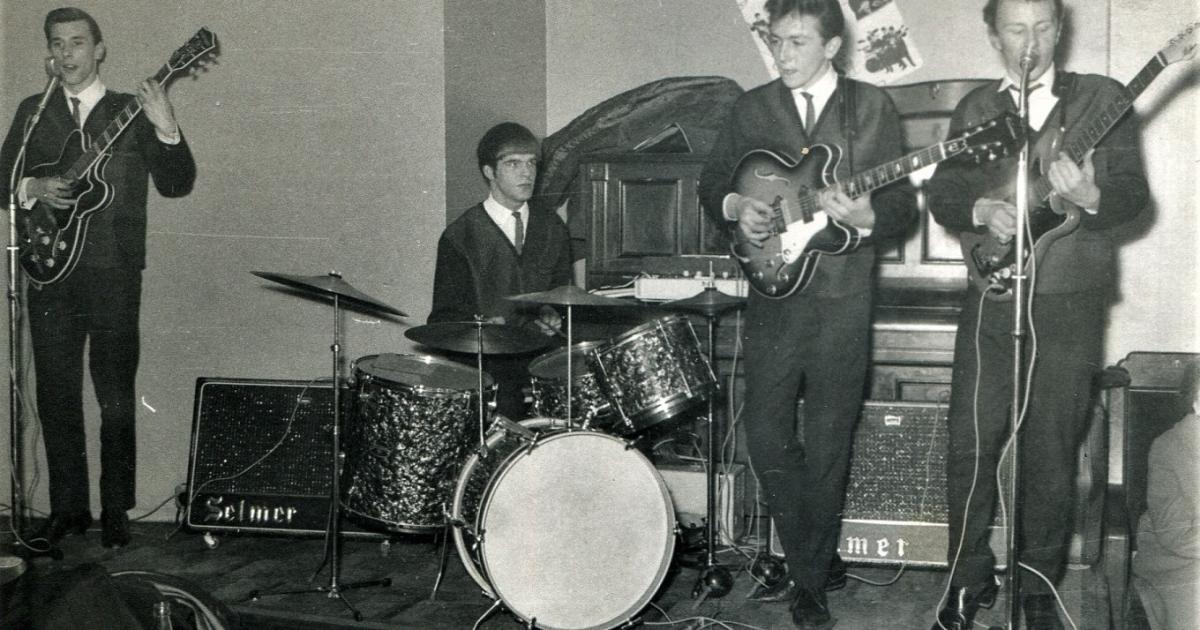
The two lads who formed the group were colleagues at the Midland Bank on Market Street – Keith Alred, lead guitar and vocals, and Paul Coleman, rhythm guitarist and backing vocals. They were joined by drummer Tony Butterworth, who was also a good rock ’n’ roll vocalist, quite an addition to any group. The bass player was Bruce Wilson, affectionately known as Stan.
They rehearsed in a hall at the Synagogue Spring Gardens and Belle Vue Hotel on Manningham Lane. Their repertoire was largely rock of the 1950s and 60s, with pop chart music added, and a few country and old time numbers for the club circuit. Favourites included Buddy Holly, Little Richard, Eddie Cochran, The Shadows, The Kinks, The Animals and Chuck Berry.
Seeds of Tyme were a popular group, playing at many local venues
By 1965 the Seeds of Tyme were well established, with a manager. Agents Harry Morris and Mark Jordan were finding them more than enough bookings – such was their demand that double bookings had to be resolved on occasion!
It was a busy time, the venues played in 1965 and 1966 ran into hundreds, on the club circuit and at dance halls including the Mecca Locarno, Lyceum Rainbow, Connaught Rooms, Fountains Hall, Excel Bowling Alley 2, the Top Twenty and almost every Bradford working men’s club, as well as sports clubs, including North Bierley, Birkenshaw, Hepworth, Lidget Green and Homewood social clubs, Windhill Cricket Club and many more in the region.
Transport was provided by a milk van driver called Ludwig and his co-pilot wife April. The cost was always 10s irrespective of mileage: 100 miles or one mile was the same! Ludwig had to get up for milk deliveries at 3.30am after driving the group home and he only broke down once in two years.
A selection of cards promoting local groups of the 1950s and 60s
In 1967, as suddenly as the Seeds of Tyme had sprung up, the lads split up due to work commitments. Another Tyme, another place, who knows? This was a group of talented lads who loved their music but didn’t quite make it. As founder member Keith Alred said: ‘It was the buzz every night of being up on stage enjoying ourselves, and hopefully everyone listening was enjoying it too’.
There was sadness when they took their last bow and the applause died down; they’d achieved as much as they’d hoped for, and more than they’d expected.
* In 1963 a rock ’n’ roll group was formed by local lads who’d seen top artists at the Gaumont and decided this was the life for them! School pals Mick Duffy and Paul Young bought guitars and practised at each others’ houses. Learning a small repertoire, they did a spot at the John Dillon Club, Little Horton Lane, accompanied by a resident pianist.
Many local groups played at Gaumont teenage shows
They had some acclaim and decided to form a group, with Paul on lead and Mick on rhythm guitar. They advertised in the Telegraph & Argus for a drummer and bass guitarist, and along came bassist John Waite and drummer Ian Greenwood.
It was Paul’s sister who came up with the name The Prosecutors. The lads gelled and soon had an assortment of numbers under their belt. John Waite sang, with Mick and Paul on backing vocals, playing venues including the Old Vic on Holme Top Street, Belle Vue, the Listers Arms, Manchester Road and Star and Garter, Kirkstall.
Geoff and the Prosecutors were at the forefront of Bradford’s rock ‘n’ roll scene (Image: Derek AJ Lister)
With a good vocalist required, they placed another ad in the T&A and talented Geoff Cowler (of Geoff and the Fairlanes) joined them. Their name was changed to Geoff and the Prosecutors. Geoff, older than the others, brought experience and they were soon gaining bigger bookings at dance halls and venues such as Bradford University, supporting Wayne Fontana, The Kinks and Long John Baldry at the Queens in Morley Street. They came to the notice of Garth Cawood’s popular Top Twenty Club in Idle, appearing there many times. Geoff and the Prosecutors were at the forefront of the rock n roll scene until they parted company in 1965.
The Evergreens has several line-ups over the years
* The Evergreens sprung into life in 1962 when Dave de Courcy, with YMCA football colleagues Tony Bentley and his brother Paul, took guitar lessons from local banjo and guitar teacher Ernie Foster. As soon as they knew a few chords they formed The Evergreens with Tony on lead guitar and vocals, Paul, rhythm guitar and vocals, Dave, bass guitar and vocals, with West Bowling lad Derek Rotheray on drums. With practice their talent shone and soon they were playing at East Bowling Unity Club, the Mecca and Majestic ballrooms, and a weekly booking at the Star and Garter at Kirkstall.
Later in 1962, playing at the famous 2i’s Coffee Bar in London (where such stars as Tommy Steele, Cliff Richard and Wee Willie Harris were discovered), an agent offered them a contract to play in Germany on the Hamburg circuit, but due to other commitments they had to decline. Derek Rotheray moved on, replaced by Alan Jones, a good drummer and vocalist, who lived at The Napoleon pub in Wakefield Road. With four vocalists, the group increaed their repertoire to include hits by Cliff Richard, The Hollies, the Searchers and the Beatles.
The original line-up of The Evergreens (Image: Derek AJ Lister)
A sudden exodus left just Alan Jones and Dave de Courcy. After an audition at The Napoleon they were joined by rhythm guitarist Dave Clegg from Frizinghall and lead guitarist Alan (Ed) Thornton from Girlington. They became The Charringtons (taken from the brewery that owned The Napoleon), and Alan’s father managed them. Their style changed to more rock ‘n’ roll and blues. Soon a new drummer was required – enter Mally Crossley, of the Del Rio Four. In 1965 the group became The Chapters, playing rock ’n’ roll and blues numbers to packed houses on the vibrant pub scene. In mid-1966 Ed Thornton emigrated to Canada and the group disbanded, saying they couldn’t replace the brilliant guitarist.