
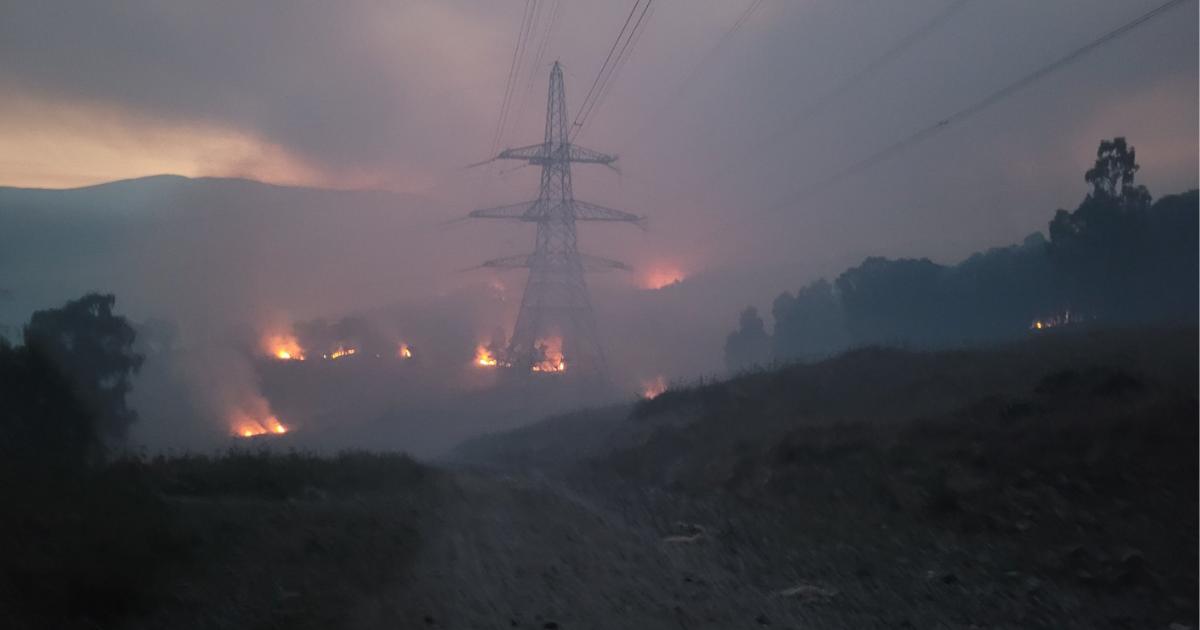
The Scottish and Southern Electricity Networks (SSEN) substation was approved by Highland Council earlier this year, but Strathglass Community Council is challenging the design adopted. The 10 hectare grid development is in an area of high wildfire risk, which only three years ago saw the massive Cannich fire spread close to the site.
“It’s hard to think of a worse site in terms of wildfire concern,” said Strathglass resident Alex Grigg, representing Strathglass Community Council. “It’s 9 km off a remote road, across moorland that has already had a wildfire in 2023, destroying six square miles of important habitat, including half the area at the Corrimony RSPB nature reserve.
“This proposed substation is 150 metres from the National Nature Reserve woodland of Glen Affric. It’s also on the very unpredictable and flammable surface of degraded peatland which is becoming drier with climate change by the year.”
The project was granted planning approval by Highland Council in February 2026 despite widespread local opposition regarding wildfire risks and peatland degradation. It is part of a £29 billion programme of grid upgrades by SSEN designed to reduce carbon emissions, mitigate climate change and increase energy security.
READ MORE:
An example of an SSEN substation at Fetteresso (Image: SSEN)
An SSEN spokesperson pointed out that “the growing prevalence of wildfires globally is one consequence of climate change” and that the substation “is a critical part of the infrastructure needed to address that challenge in this country, enabling more renewable electricity to be connected to and transported across the electricity network”.
The wrong choice of substation?
But Grigg said Strathglass Community Council has uncovered admissions by SSEN that “challenge the integrity of the entire site selection process”.
They believe that a ‘gas insulated switchgear’ (GIS) option could have been chosen, rather than the open-air option that has been approved.
It’s a view also supported by Bruce Farquharson, formerly wildfire lead at the Scottish Fire and Rescue Service, who submitted a letter to Highland Council saying that “a substation adjacent to the Glen Affric NNR introduces risk to the area”.
He “strongly recommended” that “the safer type of installation (GIS) should be the preferred option”.
Farquharson told The Herald: “The main concern for the substation is the increased risk that it introduces into the Glen Affric reserve.”
“There’s obviously another type of substation which has a reduced risk,” he said. “But, whatever substation is put in there, it’s the ongoing management of the fuel around about the substation that’s the real issue, and that’s the heart of most of the big fires that we have in the country. It’s the unmanaged vegetation or fuel that causes the risk.
“At Bingally there needs to be an ongoing regime of making sure that should a fire start for whatever reason that it hasn’t got an uninterrupted supply of fuel that will allow it to spread unchecked.”
He also highlighted that one of the reasons the recent Cairngorms fire became so large was that there was an “uninterrupted supply of fuel that allowed it to spread”.
A GIS layout, Grigg pointed out, would likely be smaller, since it reduces the physical footprint of a substation by approximately 50% compared to an open-air Air Insulated Switchgear (AIS) design.
It would also, they said, carry less fire risk. A review of CIGRE (International Council on Large Electric Systems) data revealed a far lower rate of major failure amongst GIS, of around 0.08 per hundred bay years, compared with 0.33 per hundred bay years for AIS in the most recent data set analysed – in other words, four times less failure and associated fire risk.
They pointed out that open AIS infrastructure “relies on ambient air gaps, its live conductors are exposed to pollution, moisture, and debris, making it inherently more vulnerable to catastrophic internal failure and falling canopy debris”.
(Image: PA)
Peer-reviewed research confirms that if dust and dirt accumulate on the insulator, it can “cause a flashover and the failure of the insulator”.
A spokesperson for Strathglass Community Council commented: “SSEN built their entire site selection process on a flawed premise. They filtered out viable locations because they were only looking for a massive plot of land to hold an old-fashioned, sprawling open-air substation.
“If they had modelled a modern, compact indoor design, the space needed would be cut in half. We could have completely avoided digging up thousands of tonnes of carbon-rich peat, and we wouldn’t be placing high-voltage, open-air electrical equipment right next to a major forest wildfire hazard. The mitigation hierarchy has been completely ignored.”
Was GIS ever considered?
Grigg also said that SSEN has admitted, in an email sent to them by a member of staff, that compact GIS technology was never evaluated in detail during the early site selection phase.
The email said: “As AIS is the starting point when selecting a substation site for SSEN Transmission, and there were no engineering or operational requirements which led us to require in-depth consideration of a GIS solution, there are subsequently no detailed reports relating to the consideration of GIS versus AIS.”
GIS is generally used in situations where space is limited. One of the reasons given for not using this type of substation in the past was that the gas used, SF6, has a potent greenhouse gas effect, but there is now a wave of new SF6-free designs..
Strathglass Community Council pointed out that such SF6-free substations are being built at several sites in Europe, including SSEN’s own Kintore site.
An SSEN document for instance explained its advantages at Kintore: “GIS substations have the considerable advantage of a much-reduced footprint compared to an AIS substation.”
Nearby wildfire consumed 1,500 hectares
In his letter to Highland Council, Bruce Farquharson highlighted the risks and challenges around installing “an electrical substation approximately 120m from the contiguous forestry of the Glen Affric National Nature Reserve”.
He compared the potential challenges with those of the Cannich area, where a giant blaze, caused by a campfire, consumed over 1,500 hectares in 2023.
“Glen Affric,” he wrote, “has a very similar, or perhaps even more challenging situation. While Cannich has a reasonably good A road as far as the village (single track thereafter) access to Glen Affric is via several miles of one narrow single-track road, which would make both evacuation from the area, and access for firefighting equipment very difficult, particularly as both streams of traffic would be travelling in opposite directions.”
He also noted: “The amount of contiguous forestry in Glen Affric presents a significant challenge, especially should the forest canopy become involved in fire, meaning drastic intervention to create a rapid firebreak would be required to prevent a forest fire spreading rapidly.
“The peat layers in the area mean that fire can spread below ground, often unseen for some time until it flares up again.”
The developer’s proposal to plant a screen of trees around the site, also, he said, could create more risk.
(Image: James Shooter)
“On the face of it, a screen,” he said, “seems like an aesthetically pleasing and reasonable idea. But you’re introducing more risk. Fully grown trees, are actually extremely hard to set on fire, but young trees and dead vegetation that falls off the trees is extremely easy to set on fire.
“Any screen of trees would need to be managed. There would need to be a clearing of the vegetation underneath it. There would need to be precautions taken so there is not a ladder of fuel – through which fire can go from grass to heather to bushes to saplings and onwards.”
However, SSEN point out that the area around the infrastructure will be surrounded by tarmac road, creating a gap between it and any screen.
‘Recognised as safe and proven’
An SSEN Transmission spokesperson said: “Air Insulated Switchgear (AIS) substations are used extensively across the UK and around the world and are recognised as a safe and proven technology in a wide range of environments. The consented Bingally substation has been designed to meet all relevant UK safety standards, including those relating to fire prevention and management.
“The safe construction and operation of the site was fully considered throughout the planning and consenting process, with no objections raised by either the Local Authority or the Health and Safety Executive (HSE) relating to fire risk. At the request of the community council, the HSE has further confirmed that it has no plans to further assess the fire safety of the consented Bingally substation. We have also engaged extensively with the local community to explain the safety measures incorporated within the project’s design and continue to do so.
The spokesperson pointed out that Bingally substation is “a critical part of the infrastructure needed to address” climate change in this country, “enabling more renewable electricity to be connected to and transported across the electricity network.
“By increasing the amount of clean, renewable energy that can be transmitted, the project will help reduce reliance on fossil fuels, supporting the transition to a lower-carbon energy system and contributing to efforts to tackle climate change.”
Strathglass Community Council, however, said it “understands the importance of fighting climate change” and is “resigned to some form of substation going on in the area”, but that “it needs to be done in a way that minimises collateral damage, both fire risk and peatland loss. Here we have an alternative design, GIS, that achieves all three.”
The community is now calling on Highland Council planning officers to withhold the discharge of all pre-commencement environmental conditions—specifically the Detailed Peat Management Plan (PMP).
Under National Planning Framework 4 (NPF4), developers must prove they have tried to avoid environmental damage before trying to mitigate it and the campaigners argue that failing to consider a design that halves the physical destruction means “SSEN has failed this legal test”.
Alex Grigg speaking for the Strathglass Community Council also commented “SSEN built their entire site selection process on a flawed premise. They filtered out viable locations because they were only looking for a massive plot of land to hold an old-fashioned, sprawling open-air substation.
“If they had modelled a modern, compact indoor design, the space needed would be cut in half. We could have completely avoided digging up thousands of tonnes of carbon-rich peat, and we wouldn’t be placing high-voltage, open-air electrical equipment right next to a major forest wildfire hazard. The mitigation hierarchy has been completely ignored.”
(Image: Grant Willoughby)
Fire risk not ‘a material consideration’
But they also raised the question of whether fire risk is being given sufficient consideration in grid infrastructure planning applications. Highland Council’s planning officer’s report on the proposal states “matters relating to fire risk are covered by other legislation which should not be replicated through planning”.
This is in line with the commonly adopted position by planning authorities that fire risk is not considered in planning for buildings because it is already a matter for building control rather than planning.
“It seems bizarre to me,” said Bruce Farquharson, “that the planning application process doesn’t include the risk of fire in that environment because it’s not a building. I’d be very much in favour of having fire risk considered within planning.”
A spokesperson for Highland Council said: “Applications relating to the discharge of planning conditions are currently under consideration by the Planning Authority. In assessing these submissions, the Council will take account of advice from relevant consultees, including SEPA and NatureScot.
“The planning system exists to manage the development and use of land in the long-term public interest. It does not exist to regulate all aspects of development and or land use and as a matter of principle, nor duplicate other existing legislative controls. Neither is it the regulator of last resort.
This article appears as part of the Winds of Change newsletter.
In recent days it has been widely trumpeted that renewable energy produced a record amount of electricity in Great Britain in 2025. Where, though, is the mention of where it is coming from? It seems to me time to blow our own trumpet.
According to BBC analysis of provisional figures from the National Energy System Operator (NESO), wind was the biggest single source of electricity. It generated nearly 30% of Great Britain’s electricity last year, up slightly on 2024, but there was also a significant rise in solar, which generated 6%, and gas was still responsible for 27%.
Much of that wind energy is from Scotland, which continues, as ever, a strong part in tackling climate change and bringing down UK greenhouse gas emissions. Over two thirds of the UK’s onshore wind capacity is in Scotland, and just under a fifth of current offshore wind capacity.
But before I move on to bigging-up our hard work, a quick, more-sobering note. All of this sounds like fantastic news, except that behind these figures is the fact that efforts to decarbonise the grid, effectively stalled last year.
READ MORE:
Analysis by Carbon Brief, for instance, showed that though the fleet of wind, solar and biomass power plants all set new records in 2025, but electricity from gas still went up.
There are a number of reasons for this. UK coal generation ended in late 2025 and nuclear power hit its lowest level in half a century.
“In addition,” the Carbon Brief article says, “there was a 1% rise in UK electricity demand – after years of decline – as electric vehicles (EVs), heat pumps and data centres connected to the grid in larger numbers.”
We are now at a turning point where it appears the electrification is properly coming online, and the result, overall, according to Carbon Brief is that UK electricity became “slightly more polluting in 2025” .
And this is all, by the way, occurring against a backdrop of climate change in which the Met Office predicted last month that 2025 would be the UK’s hottest year on record, in which global carbon dioxide emissions from fossil fuel combustion are projected to reach a record 38.1 billion metric tons, and increasingly experts are saying that keeping within a 1.5C goal is implausible.
It is occurring in a world in which renewables, alongside energy efficiency improvements, have been the most important drivers in reducing emissions.
But back to Scotland’s contribution. We can, of course, celebrate the efforts and progress made. The Scottish Government has not yet published renewable energy generation data for all of 2025, but we know that the third quarter saw the most renewable electricity generated in the third quarter of any year. Scotland is also exporting a great deal of it, with n 2024 21.0 TWh going south and just 1.3TWh imported.
Also, if we look at the data NESO published on monthly operational metered wind output in 2025, we see Scotland heavy lifting, producing nearly 55% of output for Britain, with only 8% of the population.
Well done. But this contribution doesn’t come without some associated negatives. There is, for instance, the question, raised increasingly frequently, of the impact of renewables infrastructure on Scotland’s landscape and environment, and of whether jobs and reduced bills are coming to areas with renewables infrastructure.
There is also the issue of curtailment due to inadequate grid development. In the first half of 2025, Scottish wind farms were paid not to produce 37 per cent of their planned output, accounting for 86 per cent of the total 4.6 terawatt hours of electricity curtailed across Britain. Not only is this costly, but a waste.
Whether you choose to celebrate Scotland’s significant contribution to grid decarbonisation, depends on your point of view on climate change and other environmental impacts, political ideology, and possibly also location.
I mostly choose to celebrate. That said, there are complexities here worth mentioning. One criticism is that Scotland already produces, through onshore wind alone, more than it needs, and enough for its forecast demand even out to 2050.
Winds of Change on offshore wind and transmission charges
When I delved into the figures earlier this year, I found that currently Scotland has an onshore wind capacity of 10GW, and a gross peak demand of 4GW – so yes we are producing far more than our needs. But, looking ahead, I also saw that NESO, in its Ten Year Statement estimates gross peak demand for Scotland in 2050 at between 8.5GW and 11GW depending on what degree of electrification takes place. We might imagine we are almost already there.
However, in a renewables centred system, where generation is intermittent, capacity needs to be significantly higher than peak demand. There is also, in any case, the rest of Britain, and NESO has also said: “Scotland will be expected to export power into the rest of Great Britain most of the time.”
What’s clear is that much of the generation being built here is not for the population of Scotland. We are gearing up for sending further electricity south of the border, and as exports elsewhere, for green hydrogen production, and, also, it seems, energy-guzzling data centres.
A growth-based paradigm lies at the heart of this. Electricity, so the story goes, will fuel growth, and also, once generation and grid infrastructure are built (delivered by a market-driven system). the demand will come. Maybe it will be data centres.
“Fire safety is not a material consideration. However, it may be relevant, in certain circumstances, for the planning system to consider the potential for fire and its likely effects. This may result in changes to the location of development within the site or the need to seek design changes that can help reduce risks to the environment and people.”
The spokesperson added: “While the Council does recognise the concerns residents have about fire and wildfires, the planning regime does not generally regulate for this.”
A nearby plan for a battery storage park at Fasnakyle, at the gateway to Glen Affric was refused by Highland Council following objections by councillors and locals that included fire risks, but was recently approved by the Scottish Government.
The Scottish Government reporter said in his decision that “it is not for the planning system to manage fire risk… there are other regulatory regimes which address this matter.”
Already this year wildfires in Europe have been estimated to cost billions. Grid infrastructure is just one of many possible cause of wildfires, and in the United Kingdom the number of wildfires caused by power generation and transmission has been negligible. In Scotland, the most common causes of wildfire are deliberate ignition, controlled or intentional burns that escape and unattended campfires or barbecues.
But in the United States, wildfire ignitions caused by power infrastructure are significant, reaching 2,500 last year, according to an article by Headwaters Economics.
With climate change resulting in more dried-out vegetation, Farquharson said, we should be doing our best to reduce all risks of fires starting. “We’re just not used to thinking about these things,” he said. “But we do need to think about them.”