
 Play Brightcove video
Seagrass meadows play an important role in tackling both climate change and biodiversity loss, as ITV News’ Rhys Williams reports
Scientists trying to restore Britain’s disappearing seagrass meadows say rising sea temperatures could make the task increasingly difficult, after a marine heatwave devastated a planting site in north Wales.
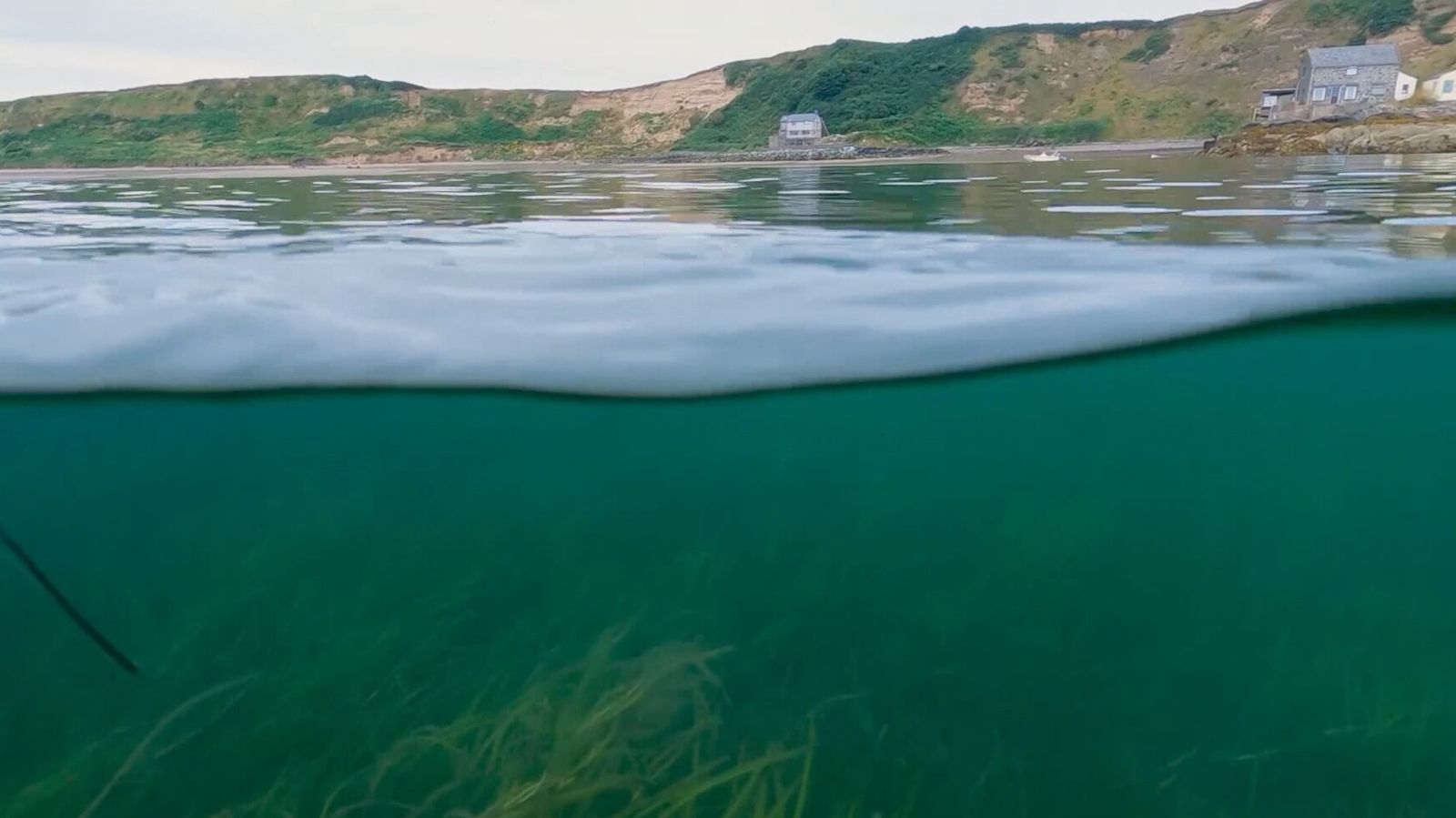
Seagrass meadows play an important role in tackling both climate change and biodiversity loss, but the UK has lost around 90% of its seagrass meadows over the last century.
Seagrass can capture carbon up to 35 times faster than tropical rainforests, while its meadows provide habitats for marine life and can help protect coastlines from erosion.
On the Llŷn Peninsula, scientists from Swansea University and Project Seagrass are working with local communities to try to bring some of those lost meadows back.
The work forms part of Seagrass Ocean Rescue North Wales, supported by WWF-UK with funding from the National Lottery Heritage Fund.
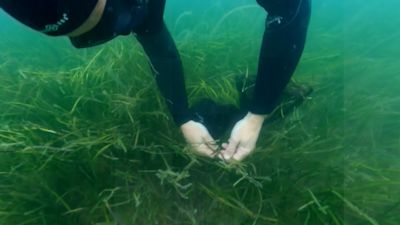
At Porthdinllaen, volunteers snorkel through an established seagrass meadow collecting seeds, which are later planted at carefully selected restoration sites.
Seagrass can capture carbon up to 35 times faster than tropical rainforests. Credit: ITV News
Laura Hughes, Marine Project Officer at Pen Llŷn a’r Sarnau Special Area of Conservation, said involving local people had become an important part of the work.
“We’ve been able to bring people out and get them hands-on with active conservation. So the seed picking, and then the seeds that we pick here in the summer, we then go out to plant them in different locations. The volunteers and communities can be a part of that as well.”
But one attempt to establish a new meadow nearby ended in disaster.
More than 500,000 seeds collected at Porthdinllaen were planted by hand at Traeth Crugan, in Bae Tremadog.
Dr Richard Unsworth, Associate Professor at Swansea University and Lead Scientist at Project Seagrass, said there had initially been every reason to believe the project would succeed.
Want a quick and expert briefing on the biggest news stories? Listen to our latest podcasts to find out What You Need To Know…
“Over 500,000 seeds were planted into this bay. The seeds were really healthy. Everything was going in a really positive direction.”
But when scientists returned to monitor the site, almost everything had disappeared.
Dr Oliver Thomas, Senior Scientist at Project Seagrass, said: “We came down to the beach and sort of planned this big monitoring program, and then we found nothing, nothing at all.
“I think, we found a single shoot, sort of just towards that buoy, and that was it. It was just bare sand.”
“It was devastating,” says Dr Unsworth.
It took several months of investigation to establish what had happened.
Researchers eventually identified a rapid marine heatwave, during which temperatures rose by around 3.5C in less than a week.
Dr Thomas said: “It was an increase of 3.5 degrees over five or six days which, in marine terms, is unprecedented. And when you’ve got a tiny little seagrass shoot, it can prove quite deleterious.”
Scientists are concerned increasingly intense marine heatwaves could pose a growing challenge to restoration projects around Britain.
Local volunteers have joined in the effort to restore lost seagrass meadows. Credit: ITV News
But the failed planting has also changed how the team works. Lessons from Traeth Crugan have helped scientists identify another site near Holyhead which is considered more resilient to extreme temperatures.
And back at Porthdinllaen, another group of volunteers is gathering the seeds that could eventually help create the next meadow.
One volunteer, Harriet, told me that “anything that feels like you can lend a hand and be a part of efforts to restore places…personally, I find that really, really rewarding.”
For fellow volunteer Hannah, helping to protect something on her doorstep is part of the appeal.
“Because we live locally, actually getting in the water and helping with it. Because I think you feel grateful to have a habitat locally, but if you don’t help, it doesn’t stay, I guess.”
With much of Britain’s seagrass already gone, scientists say restoring it remains increasingly important – even as a changing climate makes doing so more difficult.
Want a quick and expert briefing on the biggest news stories? Listen to our latest podcasts to find out What You Need To Know…