
Your support helps us to tell the story
From reproductive rights to climate change to Big Tech, The Independent is on the ground when the story is developing. Whether it’s investigating the financials of Elon Musk’s pro-Trump PAC or producing our latest documentary, ‘The A Word’, which shines a light on the American women fighting for reproductive rights, we know how important it is to parse out the facts from the messaging.
At such a critical moment in US history, we need reporters on the ground. Your donation allows us to keep sending journalists to speak to both sides of the story.
The Independent is trusted by Americans across the entire political spectrum. And unlike many other quality news outlets, we choose not to lock Americans out of our reporting and analysis with paywalls. We believe quality journalism should be available to everyone, paid for by those who can afford it.
Your support makes all the difference.Read more
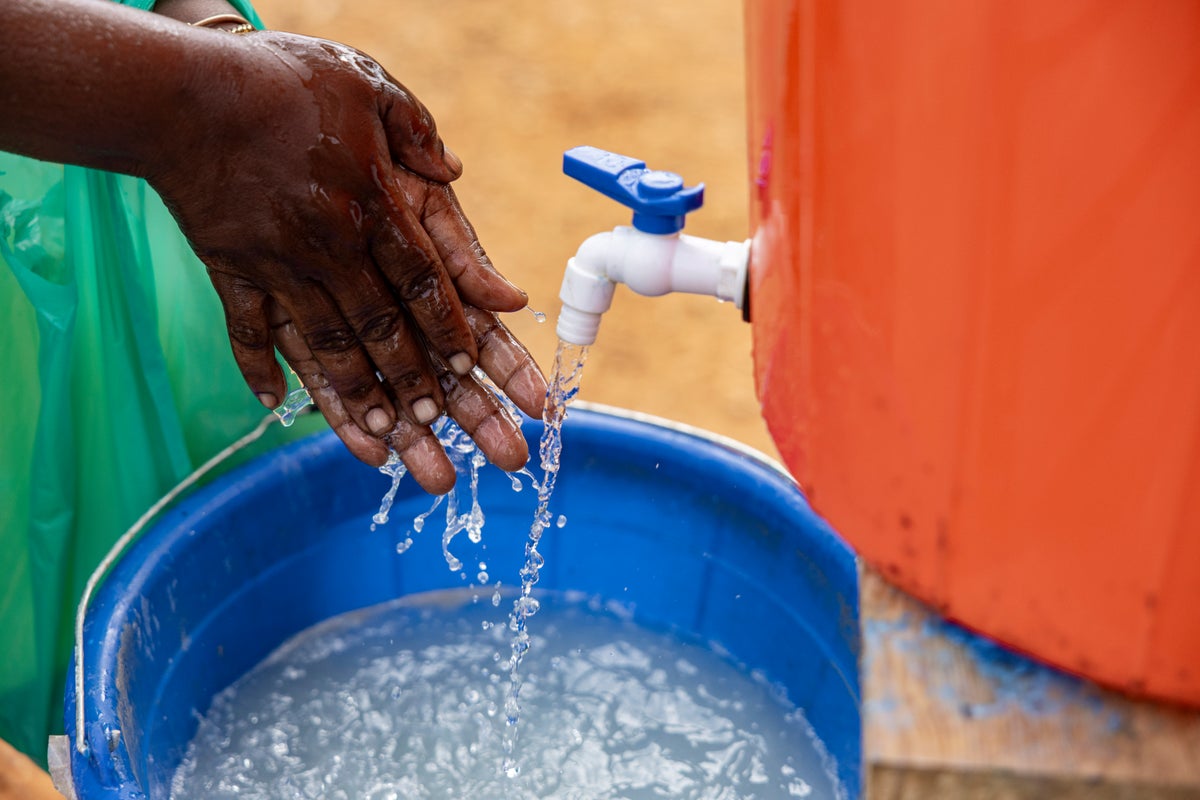
Almost one billion people around the world rely on healthcare facilities without water, leaving patients and health workers without one of the most fundamental requirements for safe care.
Some 907 million people used healthcare facilities without water in 2025, while 936 million were treated in facilities without sanitation and 652 million in places without basic hygiene services, according to new research by the World Health Organisation (WHO) and the UN Children’s Fund (UNICEF).
Overall, more healthcare facilities now have water and hygiene services than they did in 2015, but the improvements have been uneven. A significant number of countries are still struggling to provide basic conditions for patients and medical staff.
In the Democratic Republic of Congo (DRC), where an Ebola outbreak is surging, nearly one in three healthcare facilities has no water service and around 70 per cent has only a limited supply, according to the latest figures.
In rural areas, more than four in ten healthcare facilities have no toilets. In Uganda, the figure is even higher, with almost all healthcare facilities lacking adequate toilets.
The shortages have particular significance during outbreaks of diseases such as Ebola, where preventing infection inside hospitals and clinics is critical to stopping the virus spreading.

In Madagascar, 70 per cent of healthcare facilities lack basic water services, while in Nigeria, almost half do.
The gaps come as health systems in poorer countries face growing financial pressure, including from cuts to international aid. Governments and humanitarian organisations have been forced to scale back services, while the World Bank has warned that health spending in low-income countries remains far below the levels needed to provide essential services.
The problem is particularly important in maternity care. Women giving birth and newborn babies are vulnerable to infections, while midwives and other health workers need clean water and hygienic conditions to provide safe care.
“No one should have to give birth, receive treatment for an infection or undergo surgery in a healthcare facility without access to clean water,” said Helen Hamilton, head of health and hygiene at WaterAid.
“The failure to invest in clean water, sanitation and hygiene is costing lives. How can we hope to contain deadly disease outbreaks, such as Ebola in the DRC, when even the most fundamental standards of hygiene cannot be guaranteed?” she added.
Every two seconds, a woman gives birth in a health facility without clean water, a functioning toilet or basic hygiene – conditions that WaterAid’s research links to 36 deaths from sepsis a day across sub-Saharan Africa. Women who develop the condition are 144 times more likely to die than those in Britain, Europe or North America.
As part of its “Time to Deliver” campaign, WaterAid is calling on the UK government to commit investment in water, sanitation and hygiene in healthcare facilities ahead of the UN Water Conference in December. The findings come as researchers, policymakers and experts from around the world prepare to gather in Stockholm for World Water Week next week.
The WHO report also identified examples of staggering improvement. In India, a government programme boosted the number of public healthcare facilities meeting acceptable standards has risen from around 100 in 2015 to almost 52,000 last year.
To sign WaterAid’s Time to Deliver petition click here.
This article has been produced as part of The Independent’s Rethinking Global Aid project