
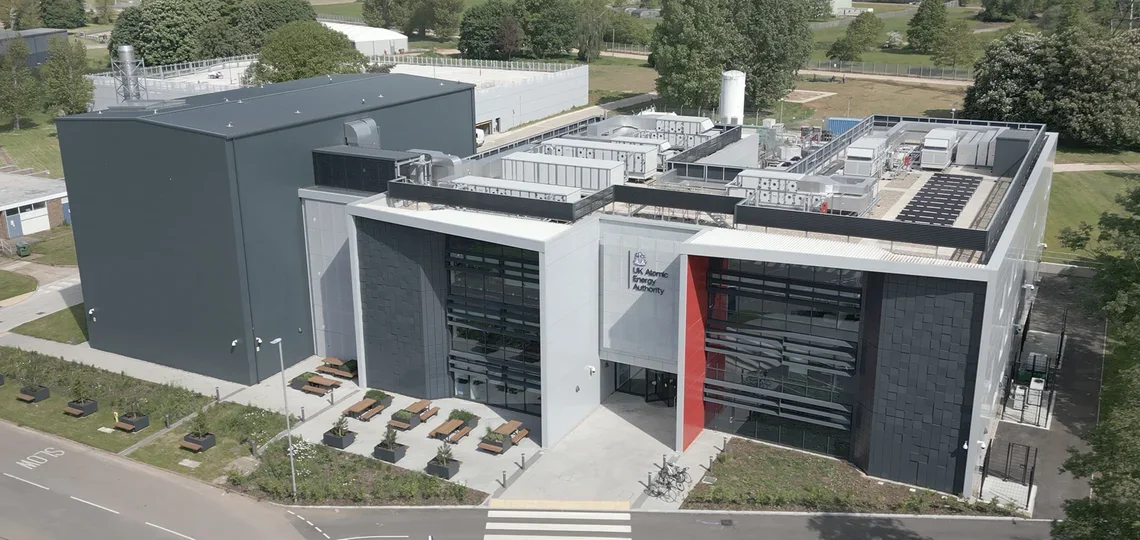
The UK Atomic Energy Authority (UKAEA) has reopened its Materials Detritiation Facility (MDF) at Culham. The facility treats components from the Joint European Torus (JET) tokamak that retained tritium during its final years of operation. Tritium permeated the materials during high-powered deuterium-tritium fusion experiments, a phenomenon the facility is now designed to reverse as part of the JET Decommissioning and Repurposing (JDR) programme.
A technology to cut waste disposal costs
By recovering tritium from materials such as tungsten, beryllium, Inconel, steel, copper and carbon-fibre composite, UKAEA’s waste teams aim to significantly reduce treatment costs. These materials, initially classified as intermediate-level waste when removed from JET, can be reclassified as low-level waste once tritium is extracted. According to UKAEA, this reclassification could cut disposal costs by up to ten times, and could even open the way to recycling in future fusion or fission machines.
Experimental trials on tiles and components removed from JET in late 2024 showed that they can be treated without prior disassembly. The trials also demonstrated that mixed material streams can be processed simultaneously, replicating conditions expected at an industrial-scale treatment facility. To remove retained tritium, the materials are heated to elevated temperatures in the MDF furnace under carefully controlled conditions designed to minimise oxidation. Limiting oxidation improves process efficiency, reduces maintenance requirements and helps keep the process safe.
Tritium capture and sample analysis
Tritium released during heating is carried out of the furnace by a process gas stream and passed through a catalyst that converts gaseous tritium species into tritiated water, enabling its efficient capture. Once the furnace has cooled, the thermally treated contents are removed and subjected to destructive sampling for further analysis. Alongside this thermal treatment, gram-scale samples from JET are being analysed to determine concentrations of other radionuclides and to quantify tritium remaining in the materials after treatment.
“Successful processing of these samples gives us access to evidence that has simply not been available before, allowing us to better understand the nature of JET materials and the challenges associated with their long-term management,” said Xavier Lefebvre, head of waste at JET Decommissioning and Repurposing. He added that the insights gained could influence the future waste strategy for the JDR programme, reducing uncertainty around waste treatment, packaging, disposal routes and decommissioning planning.
JET, a historic platform for ITER
JET was a tokamak fusion system with a doughnut-shaped vacuum chamber, in which gaseous hydrogen fuel became plasma under extreme heat and pressure. It was the only operating tokamak capable of handling tritium fuel, making it a key device in preparations for the multinational ITER project, currently under construction in southern France. The tokamak conducted its first deuterium-tritium experiments in 1997, before being operated in its final years by UKAEA and used by scientists from 28 European countries through research coordinated by the EUROfusion consortium.
JET’s final experiments using deuterium and tritium fuel ran over seven weeks, from August to October 2023, ahead of its retirement following a final pulse in December. During those experiments, JET produced the largest amount of energy ever achieved in a fusion experiment, breaking its own record set in 2021. According to UKAEA, the MDF, which processes the site’s legacy waste, is also made available to companies and organisations conducting similar research into waste and materials management.