
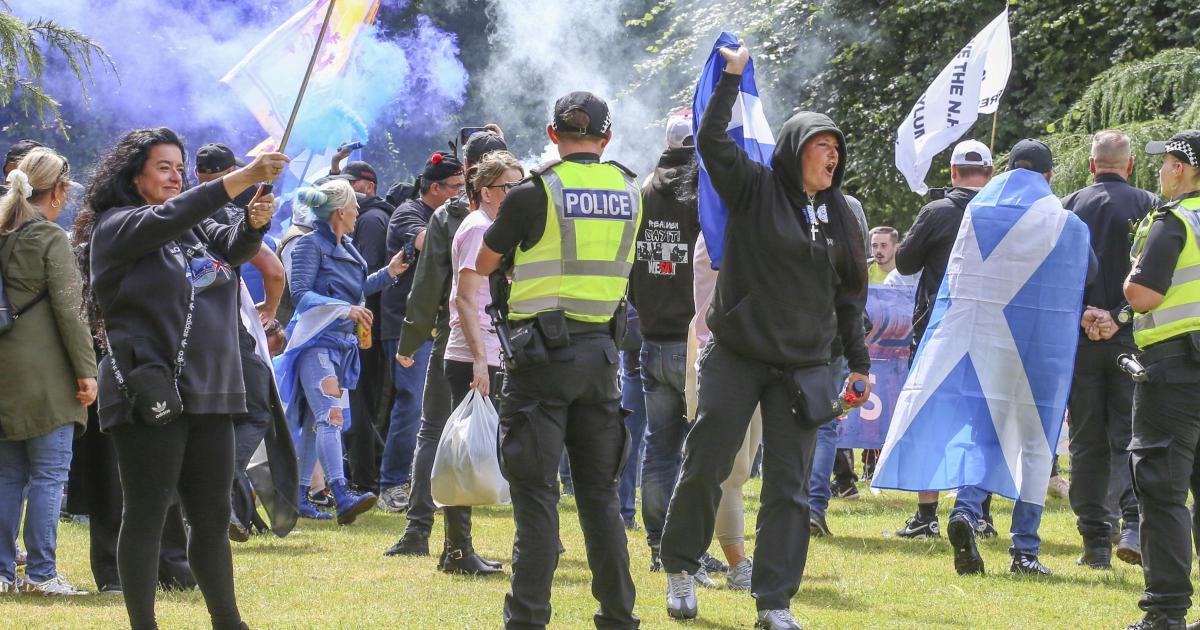
Clearly, a small number of angry, desperate, violent men call Union Street home and are determined to own, occupy and “defend” the “Four Corners” – just as territory in huge, sprawling peripheral housing schemes was fought over by rival gangs in the 1980s and 90s.
Just as clearly, the BBC film crew sort of stumbled across the mayhem – they’d arranged to cover the new Police Scotland dispersal zone in Glasgow city centre starting on a Tuesday in June.
As Disclosure reporter Myles Bonnar pointed out, the midweek start meant the first day of filming was likely to be quiet.
But this wasn’t just any Tuesday.
It was June 9th – the day after a vicious knife attack in Belfast by an asylum seeker which blinded his victim in one eye. The stabbing prompted mayhem on the streets of Belfast, with ethnic minority residents forced from homes – almost exclusively in loyalist areas. Then Elon Musk and Tommy Robinson swung in to urge widespread protests against immigration.
In the Disclosure film this sequence of events was noted, but not examined – surely, its biggest weakness.
There was a willingness to record every angry, drunken and violent incident (accompanied by the classic, slurred version of “Glasgow belongs tae me”) and interview quite a few perpetrators without seriously questioning their motives or bona fides.
READ MORE: Scottish city centre street taped off by emergency services amid incident
Darren is introduced as a member of the “self-appointed vigilante patrol group” Scots Active. He sounds credible at first, claiming there are not enough police on the streets, so he and his gang are helping them out by “walking lassies home”.
The reporter says the group links “problems on the streets” with immigration but doesn’t question this, and notes Scots Active members carry supplies for homeless people as well as drugs to reverse opioid overdoses. The impression for viewers is that these are regular Good Samaritans.
Darren’s far right politics slip into view as he talks of two cultures in Glasgow – “it’s a race war” – and claims the police can’t call it out because they would be labelled racist. “I don’t care about that label.”
Clearly not. But why was the BBC pivoting coverage around the views of one man who boasts of punching a policeman and is later found to have orchestrated a masked, threatening, angry counter-demonstration to campaigners standing up for Glasgow’s long anti-racist traditions?
Was there a point when any of the production crew wondered if they were being played? Did no-one remember the furore when BBC cameras followed the police during the Miners’ Strike – “naturally” conveying the police perspective during confrontations with strikers?
Clearly, it matters which perspective you seek out. And if that perspective is marginal, violent or racist, you should think twice about giving it centrality and should certainly seek out other points of view.
Why was there no reference to the thousands of anti-racism protesters who rallied in defence of minorities and immigrants? (Image: NQ)
But the style of filming was simply to record what happened each night on the streets – though to be fair, they did have a police spokesperson and requested an interview with Glasgow Council leader Susan Aitken which was apparently refused.
So, we were super served with Darren and his angry colleagues. Women against the Far Right staged a pro-migrant protest, so there were at least a few women on screen who could mock the idea these wee lads would provide any kind of protection. Indeed, research suggests many men claiming to “protect women” have records of domestic violence themselves. Sadly, this point was not examined.
Nor was the setting of that whole Tuesday night.
How does a violent confrontation in loyalist parts of Belfast spark violence on the streets of Glasgow (and elsewhere)? An interesting documentary would have examined the long-standing connection between right-wing extremists on both sides of the Sheuch and asked if that has also spawned the violence that spewed onto George Square. But that would take a bit of smeddum and some wider insight.
I spoke to Will Linden, deputy head of the world-renowned Glasgow Violence Reduction Unit, who, surprisingly, were not asked to contribute to the documentary. I realise a film cannot have a cast of millions, but there’s no more credible outlook on the changing patterns of urban violence and deprivation then these guys.
Anyway, Will Linden doesn’t recognise the term “no-go zone” as a description of Glasgow. “Yes, it’s a post-industrial city with challenges, but the documentary didn’t touch on the systemic factors or drivers of deprivation and violence, focusing instead on culture wars.” Will said the film’s analysis was “very surface level” and the picture of a city mired in constant violence was “not anchored in the evidence.”
Indeed, London has the highest total number and volume of knife crime offences in the UK by a wide margin, and measured proportionally per 100,000 residents, Middlesbrough exceeds any major metropolitan area, with Glasgow nowhere near top of the pile.
Of course, that’s cold comfort.
But perspective on Glasgow violence really matters. Because it’s taken Scots a long, long time to shake off No Mean City. And this film drags us right back – with a new racist twist.
There’s long been a narrative that violence is an inherent part of the Scottish personality. Wars – we just couldn’t stay away from them. And once opportunities for organised combat dried up, Scots divvied up cities and fought one another.
READ MORE: Crowds dispersed onto street as major Edinburgh Fringe venue forced to evacuate
Now it’s true. Gangs, hard men, swords and shocking everyday levels of violence made world headlines in 1968, when Frankie Vaughan arrived in Easterhouse with a weapons amnesty and hundreds of chibs, swords and blades were handed in, including kitchen knives “borrowed” by dozens of kids keen to meet the famous crooner.
But since then, there’s been big change. In 2005, when Strathclyde Police created the Violence Reduction Unit (VRU), Glasgow was the murder capital of Europe with 137 homicides.
All sorts of crackdowns had failed, so Strathclyde tried a pioneering new approach treating violence as a public health issue. The VRU’s empathetic outlook – working with deprived communities, talking to gang members and dumping old punitive, judgmental attitudes – produced results.
By 2018, Scotland’s homicide rate had more than halved and police authorities from London to the Horn of Africa were copying the VRU approach.
As London burned in 2011, Glasgow and Edinburgh did not. As copycat riots broke out in Birmingham, Bristol, Coventry, Derby, Leicester, Liverpool, Manchester, Nottingham, West Bromwich and Wolverhampton, the streets of Scottish cities stayed quiet. And eventually, the British riots were correctly renamed the English riots.
That’s not to be complacent about Scotland – the plague of domestic violence, the ruthlessness of drug syndicates or the epidemic of self-harm.
Real progress needs a reduction in poverty and inequality and a return of community workers, youth clubs and funds to stabilise communities – hard but not impossible while Westminster calls the shots.
It also needs hope of powerful social change through independence to stop the siren voice of Reform.
But importantly, Glasgow is no longer the murder capital of Europe.
That is progress, but it’s so easily undone.
We’ve been sold the idea of Scots fighting at the drop of a hat for so long, it’s got under our skin and into our collective subconscious.
There was always another story – the inventiveness, the early literacy, the legions of doctors and engineers, poets and philosophers and the generosity and hospitality of ordinary people with next to nothing.
But the negative message was more powerful. Be afraid of your ain folk. Be afraid of your warring Celtic natures. Be afraid of your selves. Be very afraid.
I’m pretty sure the filmmakers who “painted an entire city and its people through the darkest lens available”, to quote Ika Ferrer Gotic, didn’t actively set out to promote a far-right agenda.
They just didn’t try hard enough to find alternative perspectives, subject spiteful, racist tropes to rigorous analysis or ask why a city that’s lost a terrible reputation for violence deserves to be hauled back there.