
There are few foods Britain trusts more blindly than the egg. We buy them by the half-dozen, stack them in the fridge and think considerably harder about whether the yolk will be golden and runny than where the thing actually came from.
That confidence has, mostly, been earned. But the latest salmonella outbreak is more unsettling than the usual warning to wash your hands and cook your breakfast properly.
The UK Health Security Agency (UKHSA) has confirmed 207 cases of salmonella enteritidis in an outbreak dating back to August last year. Of those, 38 per cent were admitted to hospital, two developed bloodstream infections and one person has died. Whole genome sequencing suggests the cases share a common source.
 The latest outbreak has put egg safety back under scrutiny after decades of progress on salmonella (Getty/iStock)
Eggs are currently the best lead. Of 114 people interviewed by officials, 95 had eaten food prepared outside the home in the week before they became ill. Five food businesses have been linked to multiple cases and were supplied with eggs from several sources, including importers. There is no identified link to British-produced eggs or poultry.
So the box of six in your fridge is probably not the problem. The egg in your cafe lunch has the potential to be a more dubious proposition, however. A large number of the eggs we eat never appear as eggs at all: they are cracked, separated, pasteurised, dried or frozen before disappearing into sauces, pastries, dressings, cakes and other processed foods.
Some end up in ultra-processed foods, such as ready meals, factory-made sauces and some supermarket mayonnaise, while others will not.
“You or I may buy half a dozen or a dozen eggs, whereas obviously a caterer may be buying eggs by the thousand, which may be of mixed origin,” Paul Wigley, a professor in animal microbial ecosystems at Bristol Veterinary School, told BBC Radio 4’s Today programme.
Britain learned to take eggs seriously the hard way. The salmonella crisis of the Eighties saw more than 13,000 cases of Salmonella enteritidis in England and Wales, with 46 outbreaks involving more than 1,000 people thought to be linked to eggs.
“We’ve come a long way since then through the use of vaccination, through surveillance and detecting salmonella in flocks,” Wigley said. So much so, “it’s become a very rare event, if not almost zero salmonella from UK-produced Lion Mark eggs”.
Commercial laying flocks in Britain are tested under the national salmonella control programme at least every 15 weeks during the laying period.
 British supermarket eggs are considered very low risk, but the same assurances do not necessarily apply to every egg entering the food chain (Getty)
The British Lion scheme, launched in 1998, adds further safeguards. A Food Standards Agency (FSA) assessment found that recognised assurance schemes such as Lion require salmonella vaccination, additional testing and regular audits. The agency classifies Lion and equivalent assured eggs as presenting a “very low” salmonella risk – low enough that most vulnerable groups have, since 2017, been told they can eat them raw or lightly cooked.
Mark Williams, chair of the British Egg Industry Council, calls the result “the gold standard for egg production anywhere in the world”.
There is some industry chest-beating in that, naturally. The British Egg Industry Council represents British producers, but the egg on a supermarket shelf does come with a surprisingly elaborate CV.
They can turn up in pastries, sauces, dressings, sweets and pasta – and, inevitably, in some of the ultra-processed foods that now occupy so much supermarket shelf space
Williams says roughly two-thirds of eggs eaten in Britain are sold in shell at retail. Around 20 per cent go into food service – restaurants, schools, hospitals and prisons among them – while about 16 per cent are removed from their shells and made into egg products.
Once eggs leave the shell, their provenance becomes far less obvious to the people actually eating them. Liquid whole egg, egg, yolk, white, frozen egg and dried egg are bought for commercial kitchens and industrial food production rather than carried home in paper pulp boxes. The FSA says more than 60 per cent of eggs and egg products imported into the UK between 2019 and 2024 were egg products rather than whole shell eggs, predominantly destined for further processing into composite foods.
They can turn up in pastries, sauces, dressings, sweets and pasta – and, inevitably, in some of the ultra-processed foods that now occupy so much supermarket shelf space.
 More than a third of patients in the current outbreak were admitted to hospital (Getty/iStock)
The instruction to “look for the Lion mark” is useful if you’re holding an egg. But it tells you nothing about the egg component of a factory-made sauce, packaged cake or ready meal.
The irony is, processing itself can make eggs safer. Most industrial egg products are pasteurised, and adequate heat treatment kills salmonella.
Imported eggs are regulated too. They are subject to certification and border controls, with inspections carried out according to risk rather than every consignment automatically being held and laboratory-tested. Instead, the system relies on checks at several points: flock surveillance, hygiene, supplier approval, certification, inspection, processing and traceability.
For caterers, there is another familiar hazard. The FSA warns against careless “pooling” – cracking several eggs together ahead of service – because one contaminated egg can spread bacteria through the mixture. It recommends using assured eggs for raw or lightly cooked dishes served to vulnerable people, or pasteurised egg products where that assurance is unavailable.
Once people start getting ill, investigators have to trace that supply chain in reverse.
Whole genome sequencing can establish that apparently unrelated patients have been infected by extremely closely related bacteria. The UKHSA says the current strain is genetically related to another Salmonella enteritidis outbreak investigated in 2025, also associated with imported eggs.
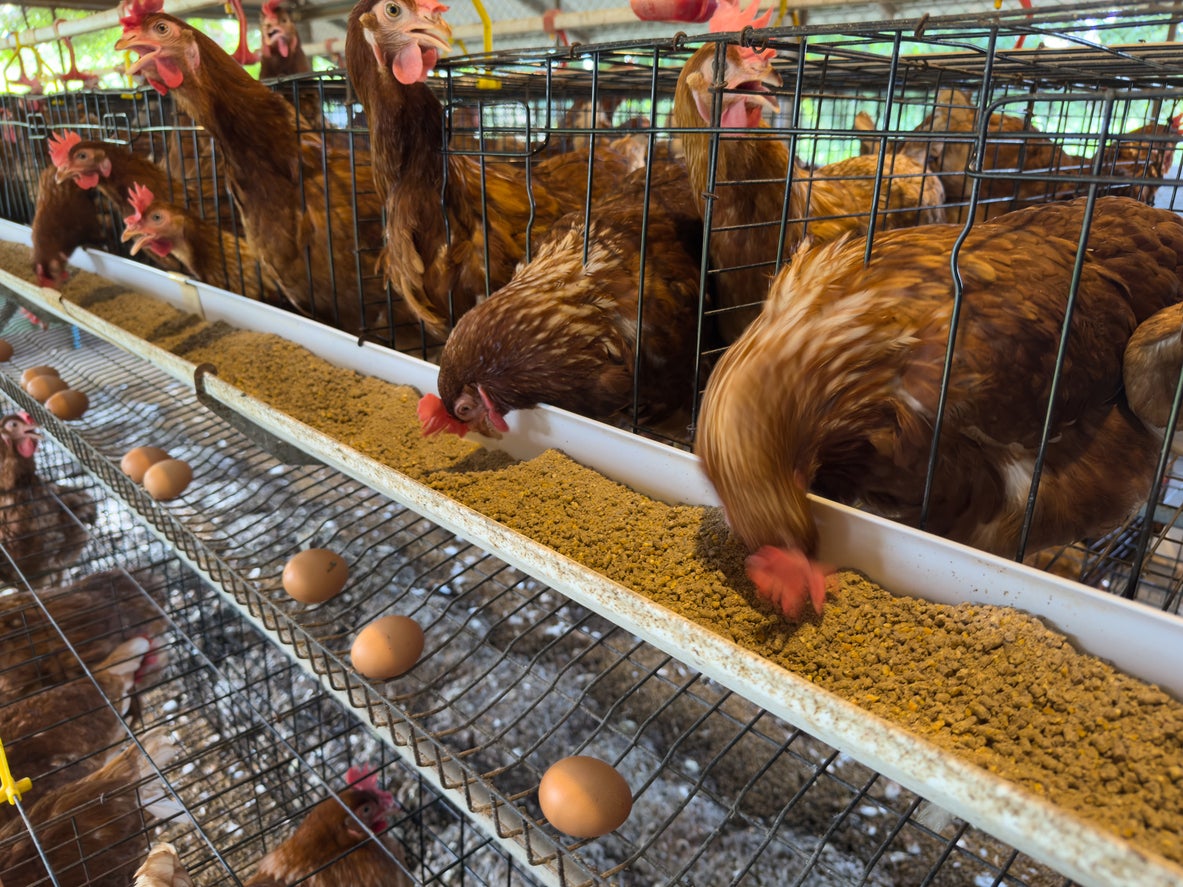 Vaccination, flock testing and tighter biosecurity transformed the safety of British eggs after the salmonella crisis of the Eighties (Getty/iStock)
“We know almost certainly through the genomic evidence that this is through imported eggs,” Wigley said. “We’ve seen very similar forms of this salmonella in recent years from imported eggs, but we haven’t yet got that absolute smoking gun of detecting the salmonella within an egg from a specific country.”
British shell eggs offer something more immediate: a producer code stamped in red ink directly onto the shell. “We can work back to which farm they’re produced in, how they’re produced,” Wigley said. For imported eggs, he said, “that level is just not there”.
The FSA also notes that trade data may record the country from which an egg product was dispatched, rather than the country where the underlying eggs originated.
Williams wants tougher border checks. “This surely highlights now that the government needs to increase those risk-based checks when eggs are imported into this country,” he said, suggesting consignments could be held until salmonella testing is complete, which typically takes a few days.
For anyone deciding what to have for breakfast, the conclusion is reassuringly dull. There is no evidence that British-produced eggs are involved. British Lion and equivalent assured eggs offer the clearest recognised safeguards if you want them soft or runny, while thorough cooking provides another defence against salmonella.
The six eggs in the fridge come stamped with a producer code and assurance mark, but the egg whisked into your omelette at the local caff tomorrow has moved further from view. By the time it has been broken into liquid and folded into a sauce, cake or ultra-processed ready meal, the person eating it may know nothing about the hen, farm or even country the chicken was pecking in.
When something goes wrong, investigators have to put that egg back together again.