
While many concerns – like cumulative energy demand and carbon emissions – have national impacts, the local contexts are also key to the debate.
In preparation for our data centre series I visited three of the communities where data centres are planned – Chapelhall, Ravenscraig and Larbert – to hear their stories.
Chapelhall – North Lanarkshire Council
The town of Chapelhall, alongside its neighbours in North Lanarkshire, is known for its industry.
It was a powerhouse in manufacturing and mining, with coal mines, iron works and quarries fuelling the local economy and providing employment.
As these industries declined, the area suffered. Chapelhall lost much of its identity, job prospects and outside investment.
READ MORE: Scottish Government intervenes in AI data centre boom
In recent decades it has benefitted from its M8 connection to Glasgow and Edinburgh and its proximity to the Eurocentral industrial estate – Scotland’s largest – which has gone some way in rebuilding the area’s employment opportunities.
In the eyes of the UK Government and the country’s AI data centre developers, this legacy of industry and its modern-day connectivity makes the area a perfect fit for new developments.
Data Centre DV1 data centre in North Lanarkshire (Image: Google Maps)
There is also the presence of the DV1 data centre – a small computing hall already in operation in Scotland.
This “co-location” data centre, provides server networks to nearby businesses, whereas the sites required to train and operate AI models are “hyperscale” locations, demanding hundreds if not thousands of megawatts to run.
DV1 has a current capacity of around 24MW, with expansion work planned to increase this to around 40MW.
In January it was announced that Scotland’s first AI Growth Zone would be in Lanarkshire, and the area could soon be home to a 500MW data centre campus.
READ MORE: Outlander star Sam Heughan speaks out against Scotland’s AI data centre boom
On a visit to Chapelhall I met with Diane and Ann of the Woodhall Faskine and Palacecraig Conservation Group, who told me that while the existing site has not caused the local area many major issues, they are concerned the community doesn’t know what could happen next, adding that DV1’s presence is already showcasing the lack of permanent employment opportunities brought by data centre development – with security being the main workforce visible on site.
They told me that the public’s attention has been drawn to the extension project at the existing data centre, causing some people to miss the emergence of plans for land just across the motorway.
DataVita, the UK Government’s chosen Growth Zone partner, and rival firm ILI Group, have submitted proposals here, slightly northeast of Chapelhall. ILI is planning a 200MW data centre.
The two sites are huge – around 100 acres between them according to campaign group Action to Protect Rural Scotland (APRS) – but recent reports have found that they won’t permanently support the thousands of jobs initially promised at the launch of the Growth Zone initiative.
The site in Newhouse/Chapelhall where one of the data centres is planned (Image: Jamie Calder/NQ)
Instead, these figures were mainly made up of construction-related temporary contractors, with full time permanent employment expected to be much lower, at most in the low hundreds. Many of these roles would be low-pay security, cleaning and administration roles.
Diane told me that she, and most of her community “are not against technology” or new developments, addressing criticism that campaigners against AI data centres are “NIMBY’s” (not in my back yard) who would oppose any new development, regardless of any benefits.
Instead, she said that they are most concerned about a perceived lack of transparency from the developers and government, and hold genuine concerns about the choice of location, environmental impacts and the numbers given on employment and economic returns.
Ravenscraig – North Lanarkshire Council
Ravenscraig, another town in North Lanarkshire – but outside the Growth Zone – is a similar contextual story.
The Ravenscraig Steelworks were among the largest in the world, with Western Europe’s largest hot strip steel mill and the full site employing up to 13,000 people at its peak production.
By the time of its closure in 1992, this had fallen to around 1200. The closure is estimated to have cut off thousands of indirect jobs with devastating effect for the surrounding towns.
Archive image of the Ravenscraig steelworks (Image: Newsquest Media Group)
On a visit to neighbouring Craigneuk, a former mining village turned suburb sandwiched between Wishaw to the east and Motherwell to the west, this loss was made clear.
Local campaigner Mary, told me that communities have felt as left at the fringes of Westminster and Holyrood decision-making processes since the area was deindustrialised.
There is hope that the clean up and redevelopment of what became Europe’s largest brownfield site could flip the script.
The most recent regeneration plan sets out the vision of a mixed-use new town – thousands of houses, space for commercial real estate, green spaces and new transport links.
But now, a hyperscale data centre is rocking the boat.
Developers Apatura and the co-owners of the land – Tata Steel, Scottish Enterprise and Wilson Bowden Developments – back the inclusion of the 550MW data centre as a way to reindustrialise the area, providing infrastructure investment and employment.
READ MORE: Scottish Duke given private meeting to lobby for £2bn data centre, leaked emails show
But campaigners have argued that it’s not clear how this project will return employment to the area – or at least more so than other commercial activity that could use the near 160-acre site – and have raised concerns over a lack of Environmental Impact Assessment, particularly owing to the potential risk of land contamination from the former works.
Further anger stems from the actual location of the data centre – not just within a redevelopment zone designed to build out a new community, but in place of 1000 homes.
The existing communities are set to be impacted as well, with Mary showing me around the eastern boundary of the site, of which a golf course, skate park and wooded walk – which she told me is popular with teenagers and community groups – neighbours.
Image showing part of the Ravenscraig steelwork estate towering over nearby residential streets (Image: Phil Rider/Newsquest Media Group)
For the communities neighbouring the former steelworks – and the community that could one day be built on its land – there remain key questions over what benefit, if any, the area would actually see from the development.
Decision makers risk placing the community at the fringe again.
Commenting, Apatura said: “We choose sites strategically, starting with brownfield and previously developed land first.
“Our Ravenscraig site, for instance, is a former steelworks that has planning approval for a regenerative masterplan including employment uses.
“This is redevelopment of industrial land which will enable wider regenerative development, rather than building on open countryside.”
Speaking more broadly on concern about job development at AI data centres across Scotland, the developer’s spokesperson said: “The economic impact of a data centre is broader than the number of people working inside the buildings once they are operational.
“There is significant employment during construction, followed by permanent roles on site and further jobs supported through the supply chain.”
Larbert – Falkirk Council
After Public Finance Minister Hannah Mary Goodlad called in two more data centre applications, putting the Scottish Government in charge of their evaluation, the Larbert proposal stands as the only active PIP application still with the local authority.
Falkirk Council is set to evaluate the application in coming weeks – with an internal target date set for September 17 – making it perhaps the campaign with the highest-stakes as approval could be just weeks away. The window for public comments closes today.
Located on undeveloped land in the Glenbervie commercial estate, Apatura’s 300MW hyperscale data centre site would neighbour a care home, dental practice, hotel and several small commercial offices and depots, while also sitting just a few hundred metres away from the major Forth Valley Royal Hospital, and close to a nursery, primary school and surrounded by hundreds of homes.
READ MORE: SNP back calls for temporary ban on AI data centre developments
A recent investigation published in The National found that the site would become one of Scotland’s top 10 polluters – ahead of Shell’s natural gas liquids plant in Mossmorran and the gas-fired Peterhead power station – due to the use of “emergency” backup generators, some of which would be run each day for 8.5 hours as part of routine testing, according to the developer’s plans.
The site’s EIA predicts at its upper range that nearby homes and facilities could be exposed to “very high” nitrogen dioxide levels of up to 8800 micrograms per cubic metre, exceeding the healthy hourly limit 44 times.
Short-term exposure can cause airway inflammation, increase sensitivity to asthma, respiratory infections and exacerbate lung and heart conditions. People with existing health conditions, children and the elderly are particularly vulnerable.
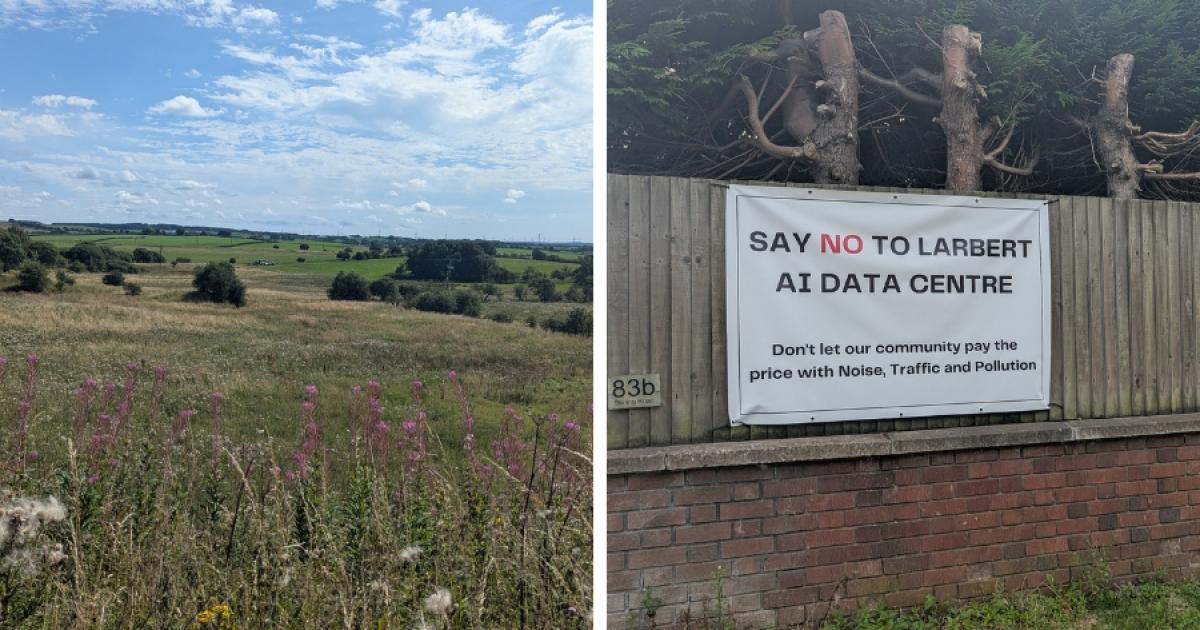
Across the roundabout from the site’s entrance there is a row of houses – many now adorning “Say No to Larbert Data Centre” banners – and on one side a new-build luxury flat development still showing “for sale” signs.
Banners placed at the entrance of the development site (Image: Jamie Calder/NQ)
For these people living directly next to the site, there are further concerns about how it will impact their day-to-day life.
Initial construction will cause additional congestion on an already busy thoroughfare, used as a key “blue light” route for emergency services connecting to nearby towns, while the operational site will generate heat, noise and light.
Emerging research – which has not yet been peer-reviewed – suggests that surrounding areas can see a “heat island” effect, with temperatures rising by an average of 2 degrees celsius.
While Apatura says the site will be designed to “be ready to supply waste heat to a local heat network if one comes forward”, there are currently no plans for a district heat network in the area – meaning large quantities of waste heat will be pushed out.
On noise, which has been a major concern for locals as hyperscale sites in America have become synonymous with a disruptive industrial humming sound, the company said: “Each of our planning applications include a noise impact assessment by an independent specialist,” they added.
Noise was included in the developer’s EIA report, indicating that without preventative measures the site would generate up to 15 decibels more sound than the current benchmark, causing a “significant adverse impact, depending on the context”.
The developer has therefore laid out plans to implement several screens and mitigation measures to bring this down to levels at or below the background threshold.
READ MORE: Pressure mounts as AI data centre anger now ‘impossible to ignore’ in Holyrood
An Apatura spokesperson defended the site’s economic benefits, citing analysis from analysis firm Glic which suggested the site would have “around 300 direct jobs on site once operational” and more than 2000 construction contractors.
However, a 212MW site in Edinburgh is expected to have 39 permanent full-time staff, and research by APRS has found hyperscale sites in the US average 20-50 employees, calling this estimate into question.
The developer also said generators will run “during outages and for limited scheduled testing. Beyond that, they run for short, scheduled tests to confirm they will work when needed, in daytime hours and kept brief.”
Lots of properties in Larbert now have banners placed on them opposing the data centre (Image: Jamie Calder/NQ)
But these comments have done little to comfort local residents, including NHS nurse Lidia Mestre, who spoke to me in the lobby of the Forth Valley Royal Hospital.
She told me she feels an “obligation” to object to the proposals for the sake of “public health”.
“I feel this very strongly as a nurse, as a mother, as a human being”, she told me.
“All they’re throwing at us is assumptions, there’s no facts”, she added, saying that not only are there concerns for the local area, but there are also fears that “the profits will go somewhere else”, particularly as it has emerged that Apatura has been in talks with an unnamed US operator for the site.
“I feel so angry, so frustrated”, she added.