
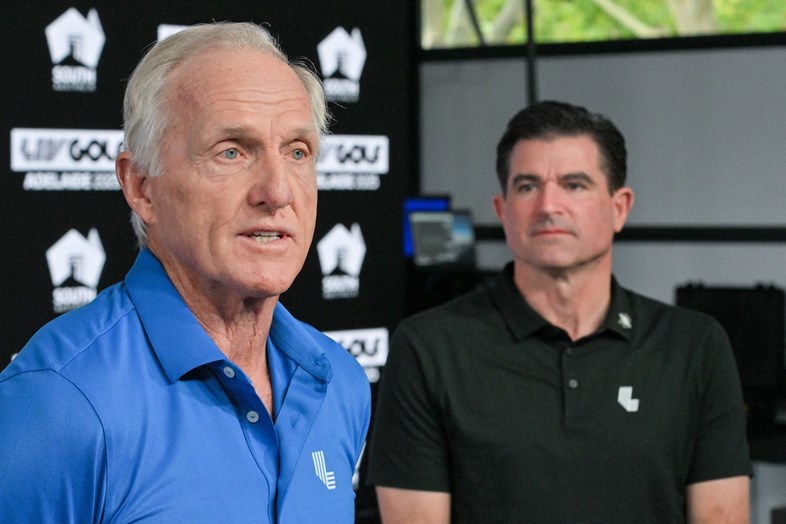
LIV Golf’s former chief executive Greg Norman has spoken out about the precarious future of the league which he helped create…
Greg Norman will forever by remembered as the aggressive, flamboyant Australian who became the best golfer in the world and let a few majors slip through his grasp along the way.
He will also be remembered as the brash, disruptive firebrand who lifted the LIV Golf League off the ground with a war chest of Saudi billions during arguably the most tense period in the sport’s history.
But after his quiet exit from LIV almost two years ago – where he was replaced as chief executive by Scott O’Neil – Norman has watched the flailing league from the sidelines.
“I’m sad, disappointed, gutted to be honest,” Norman told Skratch’s Alan Shipnuck in a wide-ranging report about the league’s future. “I hate to see it wither away. I would rather just see it end.”
The end of LIV as we know it came in Indianapolis on Sunday as the individual and team championships came to an abrupt conclusion. What happens now remains uncertain as O’Neil attempts to work through the muddied waters in an attempt to salvage ‘LIV 2.0’ – a new reimagined league without the riches that has come with backing from Saudi Arabia’s Public Investment Fund.
O’Neil is attempting to secure new investment to rebuild in a post-Saudi area, and has signed a ‘term sheet’ with a lead investor, though that is not thought to be legally binding and could hinge on his top players like Bryson DeChambeau and Jon Rahm committing their futures to the league.
It was Norman, meanwhile, that first struck a working relationship with the PIF, who announced in April that it would be withdrawing its support at the end of 2026 after plowing over $5billion into the breakaway league. The 71-year-old played key roles in poaching players like DeChambeau and Rahm from the PGA Tour during the height of the league’s disruption.
“We were a family,” Norman added in his interview with Skratch. “We were united by the feeling that we were doing something new and exciting for the game of golf. It took an unbelievable amount of effort, and there were constant headwinds, but we did it because we believed in the vision.”