
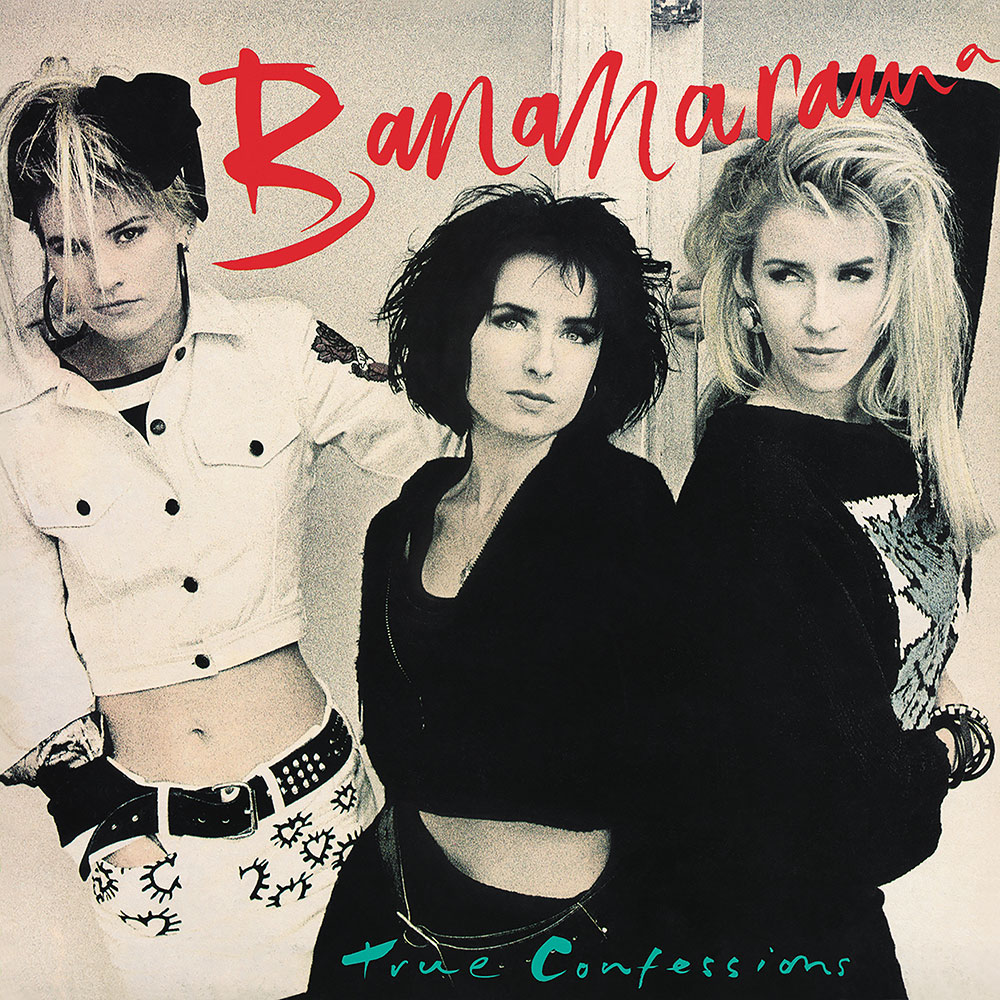
In a parallel universe, Bananarama had the most impressive backstory in pop, steeped in rock credibility and indie cool. In that world, Sarah Dallin, Siobhan Fahey and Keren Woodward were friends with half of Sex Pistols, lived in the Pistols’ Denmark Street rehearsal rooms, released as their debut single an obscure French club hit, were spotted modelling sportswear in The Face and were invited to sing with the Fun Boy Three…
In fact, as keen-eyed readers may already know, all that happened. Bananarama were friends with Steve Jones and Paul Cook, did release ‘Aie a Mwana’ (originally recorded by Black Blood), and recorded with the Fun Boy Three (‘It Ain’t What You Do (It’s The Way That You Do It)’ and ‘Really Sayin’ Something’). All they needed was a contract with Rough Trade and a John Peel session and they could have been the new Raincoats. But instead of following the new pop route of ABC, Scritti Politti and Heaven 17 – where they pretended to satirise the music industry while embracing the music industry and made great pop but in inverted commas (literally in the case of Scritti’s The ‘Sweetest Girl’) – Bananarama just became a great pop group. They released some inspired covers (the aforementioned ‘Really Sayin’ Something’, ‘Na Na Hey Hey (Kiss Him Goodbye)’ and some even better originals (‘Cruel Summer’, ‘Robert De Niro’s Waiting…’) and, uniquely, managed to make glorious shiny chart pop while appearing entirely shambolic with their untutored vocal stylings – not so much harmonising as all three singing the same words at the same time – and not entirely professional dance routines on Top Of The Pops.
In their early years, Bananarama’s work with producers Jolley and Swain, who also worked with Spandau Ballet and Imagination, was fantastic – it put the Rams in “ramshackle” – and gave the trio pop hits as well as critical approval. They may have been a huge chart act but they were also the girl next door, except there were three of them and they clearly did not give a fig about anyone else (in 1988 they blithely told NME’s Jim Shelley, “One more hit and we’ll pass The Supremes. Sad, isn’t it?”)
The Rams (as Smash Hits inevitably and irreverently called them) were successful right from the off, but by the time of their third album – this one, True Confessions – there were signs of tiredness. The chirpiness of the earlier songs was giving way to mid-fame melancholy and a distinct lack of fizz. There was the single ‘Rough Justice’, a tribute to a friend killed by the British Army. There had been the downbeat (and brilliantly named) ‘Cheers Then’, and, on True Confessions, there were songs like ‘A Trick Of The Night’ and ‘Do Not Disturb’ B-side, ‘Ghost’: the LP was not a jolly knees-up or something that would be much fun at parties. Like other bands of the post-punk, post-2 Tone era (in particular Madness and the Fun Boy Three, who had both succumbed to gloom), Bananarama were heading into a contemplative slump.
Not that this is a bad album: far from it. It’s just quite moody. From the rare solo vocal on the gorgeous ‘Ghost’ (an extra track on the reissue) to the social commentary of ‘A Trick Of The Night’, True Confessions could have been Bananarama’s Beatles for Sale – fame and fun sliding into a trough of tiredness and melancholy – but Bananarama were wise and knew something had to change. There was a record in the charts that they liked. It was by a former Goth band from Liverpool called Dead Or Alive and its title was ‘You Spin Me Round (Like A Record)’. And it was produced by Stock Aitken and Waterman, a trio of producers and writers who had had some hits with Divine and Hazell Dean but nothing like the success they were now enjoying. ‘You Spin Me Round…’ was a relentless monster of a record, whose claptraps and hooks never stopped for the entirety of singer Pete Burns’ howling tornado of a performance.
At this point in their career, Bananarama could have gone darker. They could have demanded to be taken seriously and released albums of grey mistiness. But they weren’t The Cure, they were Bananarama and, instead of going darker – they went brighter. Despite having an album’s worth of material produced by Jolley and Swain, they went to see SAW and took along the song they wanted to record with them: an old 1960s hit by Dutch band Shocking Pink called ‘Venus’ – and the rest was hysteria.
‘Venus’ in its new version, with Bananarama’s chanted lyrics and SAW’s grenade of a production job, was fantastic: urgent, daft, thrilling and catchy as anything. It went to number one all around the world, including the USA. It gave Bananarama’s career a boost, it led to the trio working with SAW full-time, and it diverted them once and for all away from the melancholy in their pop star souls (although some of that was to resurface when Siobhan left the band and formed the fantastic, none-more-melodramatic Shakespears Sister).
Bananarama without Stock Aitken and Waterman would quite possibly have run out of steam early, which would have been a massive shame. The second wind SAW gave them resulted in some great singles – ‘I Heard A Rumour’, ‘Love In the First Degree’, ‘I Can’t Help It’, ‘I Want You Back’, the arrival of Jacquie O’Sullivan, Help! with French and Saunders… and an entry in the Guinness Book of Records as the all-female group with the most UK chart entries ever. And, with just Dallin and Woodward remaining, the world’s greatest 1980s girl group is still going. Meanwhile, there’s the cornucopia of True Confessions to enjoy: extra tracks, remixes, Radio One jingles: a decent package for a decent album.
Review by David Quantick. True Confessions is reissued on Friday 28 August 2026, via London Records.
Official Bananarama Shop Highlights
SuperDeluxeEdition.com helps fans around the world discover physical music and discuss releases. To keep the site free, SDE participates in various affiliate programs, including Amazon and earns from qualifying purchases.