
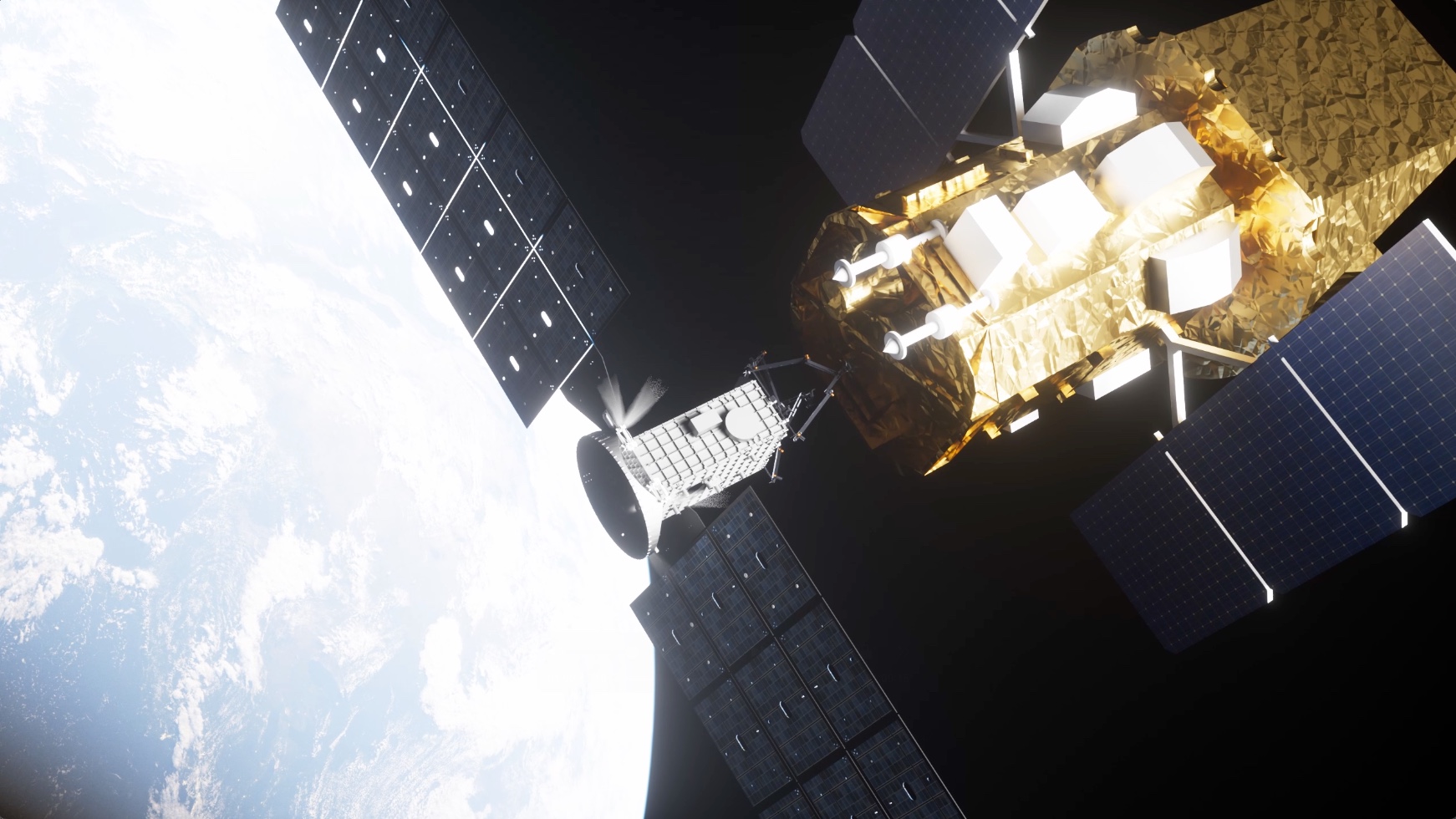
SALT LAKE CITY — Despite abandoning plans to reboost a NASA spacecraft, Katalyst Space continues to operate its spacecraft to gain experience for future satellite servicing missions.
NASA and Katalyst Space jointly announced Aug. 19 that they had called off plans to have the company’s Link spacecraft, launched in July, attach to the agency’s Swift gamma-ray observatory and raise its orbit. That decision came after Link lost two of its three reaction wheels, causing attitude control problems.
While Link will no longer boost Swift, Katalyst Space continues to operate Link, with a new goal of approaching Swift and taking images of it.
“We believe that rendezvous is still on the table, that we’ll be able to get within close proximity and be able to image Swift with our sensors,” Ghonhee Lee, chief executive of Katalyst, said in an Aug. 26 interview during the Small Satellite Conference here.
The loss of the reaction wheels has created problems with fuel usage and controllability for Link. Engineers compensated for the lost reaction wheels by using the spacecraft’s main propulsion system, a set of Hall-effect thrusters, gimballing the thrusters to provide attitude control.
However, that meant that the spacecraft could not maintain full attitude control when those thrusters were not firing. The spacecraft has reaction control system, or RCS, thrusters to compensate, but they use the same propellant as the main thrusters.
“We ended up using much more propellant than was originally allocated for this portion of the mission because of these attitude control issues,” he said. “We just didn’t have the fuel to do a meaningful boost of Swift.”
That was the main factor in the decision to call off the reboost attempt, he said. An additional issue was that the reduced control actuators did not give Link the precision needed to effectively grapple Swift.
With a reboost off the table, the company is now working to move Link to the vicinity of Swift. Controllers placed the spacecraft into a spin-stabilized mode, allowing the thrusters to fire to raise its orbit to approach Swift. Link is in an orbit at an altitude of between 319 and 329 kilometers, while Swift is at an altitude of between 341 and 343 kilometers, according to data from the Space Force’s Space-Track database.
Once Link nears Swift, it will switch back to three-axis control using its RCS thrusters and test rendezvous and proximity operations, or RPO, including taking images of Swift. “That will be a good exercise of all of the RPO sensors,” Lee said. “We’ll be able to check that against the ground testing that we did against our models.”
He said there is no firm timeline for carrying out those steps but estimated it would probably take about two weeks.
The loss of the reaction wheels was not a problem with those components themselves but with other subsystems on Link. The wheels were lost in two incidents involving what Lee called “immense thermal loading” on power electronics in the spacecraft involving interactions among systems that were not expected during ground tests.
“That caused the switches essentially to burn out,” he said. “And once those switches were burned out, we couldn’t operate the reaction wheel.”
The decision to call off the reboost attempt was not a sudden one. “This decision-making cycle was probably over the course of two weeks, so it wasn’t a rushed decision,” he said. While engineers looked at options that offered a small chance of salvaging the reboost, he said that took time as the spacecraft’s fuel levels fell.
“We would have a much better outcome by saying we can reuse that fuel for other purposes in the short term, and that is actually going to increase the probability of success of the near-term mission, rather than trying to keep this slim probability of success for the boost open,” he said.
He said NASA provided substantial support during the mission. “They just parachuted in with some of their GNC subject matter experts, their attitude control subject matter experts. They were working side by side with our engineers.”
That was part of a strong collaboration between the agency and the company during the entire mission, which NASA officials had acknowledged was a “high-risk, high-reward” effort. Lee credited NASA for putting only a few top-level requirements on the mission and not burdening the company with processes and procedures from more conventional projects.
The 60-person company was focused on trying to salvage Link. “People were working 24/7. They were literally sleeping in the parking lot in their RVs to make this happen,” he said. “This is the type of passion project that you go to aerospace engineering school for, right? To be able to launch a space robot to rescue a telescope. How cool is that?”
Katalyst Space is incorporating the experience of Link into other satellite servicing projects under development. The company has several of its Nexus servicing spacecraft in development and recently won a Space Force study contract for satellite deorbiting services.
“There’s so much learning that goes into flying a complex spacecraft like this from this mission, and that’s only going to help the future missions,” he said. “I think of myself as somebody who believes in the future of robotic servicing. I think this mission has done a lot to push that ball forward.”
Related