
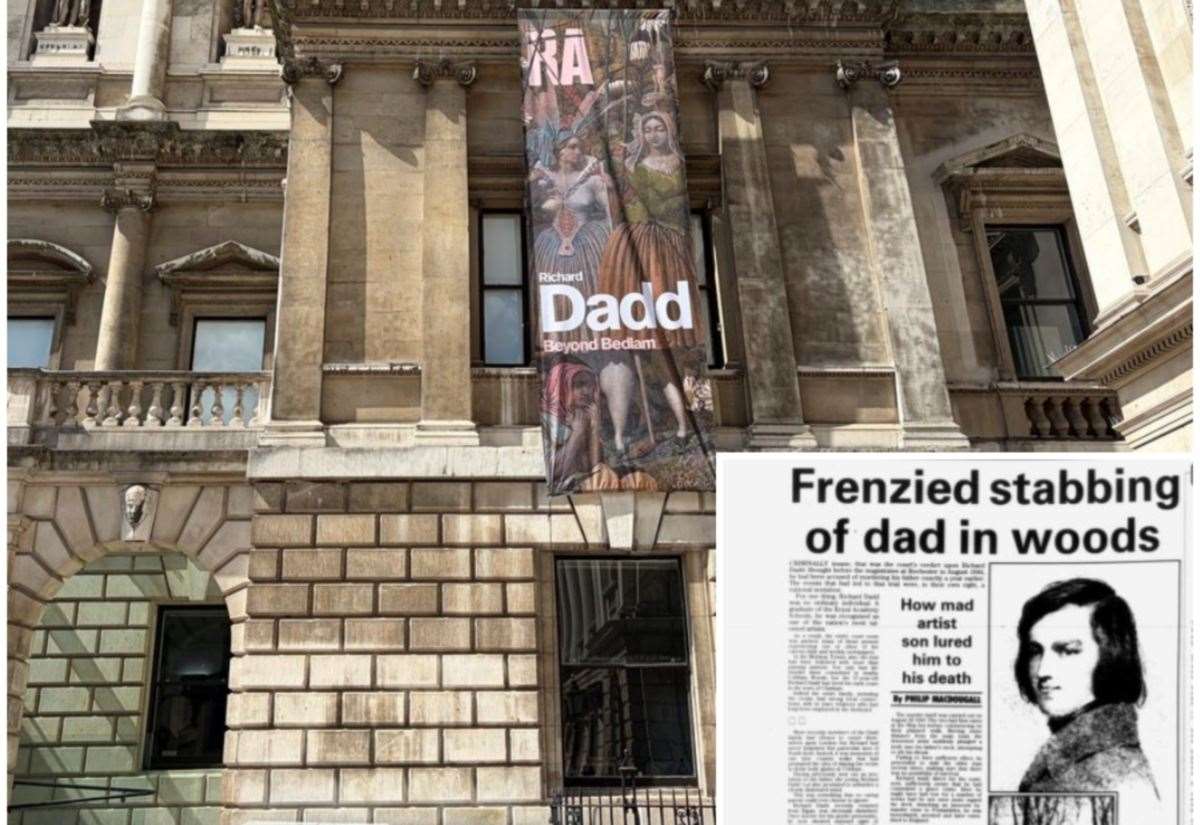
A major London exhibition is shining a new light on one of the Victorian era’s most extraordinary artists, whose life was closely tied to Kent.
On show at the Royal Academy of Arts, the exhibition has paintings and drawings spanning Richard Dadd’s career, from his early years to the intricate works he produced while confined in psychiatric hospitals.
 Paintings by Richard Dadd displayed as part of Richard Dadd: Beyond Bedlam at the Royal Academy of Arts in London.
The exhibition is arranged chronologically, showing Dadd first as an ambitious young artist before moving through the fairy paintings, travel works and later pictures created at Bedlam and Broadmoor.
It also includes his best-known work, the Fairy Feller’s Master Stroke, allowing visitors to see at close range the extraordinary detail for which he became famous.
Richard Dadd was born in Chatham, educated in Rochester and became one of the most promising young painters of his generation before severe mental illness changed the course of his life.
In August 1843, while staying in Cobham, near Gravesend, he murdered his father during a walk through Cobham Park.
Dadd fled the country, was later arrested in France and eventually returned to Kent, where he appeared before magistrates in Rochester and was held in Maidstone Gaol.
A 1974 Kent Evening Post feature looked back at the life of Richard Dadd under the headline “The ‘mad’ artist of Kent”, nearly 90 years after his death.
He would never live freely again, but went on to create some of his most famous works while confined in psychiatric hospitals.
The story of the artist, murderer and psychiatric patient is now being explored in Richard Dadd: Beyond Bedlam, a major exhibition at the Royal Academy of Arts in Piccadilly, bringing together more than 60 works from across his career.
It is also a rare chance to rediscover an artist whose connections with Kent stretch far beyond the place of his birth. Dadd was born in Chatham on August 1, 1817, the son of Robert Dadd, a well-known Medway chemist who also had a strong interest in geology and artists’ materials.
Dadd attended King’s School in Rochester, where his talent for drawing became apparent, before moving to London and entering the Royal Academy Schools aged 20.
The Ship Inn in Cobham, where Richard Dadd and his father stayed before setting out on the walk during which Robert Dadd was killed in 1843. Photo: Dee Lukasik
By 1840 he had won the academy’s medal for life drawing and was regarded as one of the most talented members of a circle of young artists known as The Clique.
His work was already attracting attention, particularly his detailed paintings inspired by literature, mythology and fairy subjects.
Two years later, Dadd joined Sir Thomas Phillips on an extended journey through Europe and the Middle East, including Egypt.
It was during this trip that his behaviour began to change noticeably.
He became increasingly suspicious and developed religious and supernatural delusions, including the belief that he was being directed by the Egyptian god Osiris.
Cobham Wood in the morning light, near the area where Richard Dadd killed his father Robert during a walk in 1843. Photo: Dee Lukasik
By the time he returned to England in 1843, his family was seriously concerned about his mental state.
Kent newspaper reports from the period said his father had sought medical advice and had been warned that his son should not be left unsupervised.
The family had longstanding connections with north Kent and had visited Cobham on several occasions, usually staying at the Ship Inn.
In August 1843, Richard returned to Cobham with his father and once again stayed at the pub. On the evening of August 28, they had their breakfast and left the pub, saying they were going for a walk.
Neither man returned to the Ship Inn that night.
A 1986 newspaper report looking back at Richard Dadd’s killing of his father in Cobham Park in 1843.
The following morning, a Rochester butcher was travelling to Wrotham with his uncle when he spotted a man lying face down in Cobham Park, around 30 yards from the road.
Thinking he might be asleep or drunk, he went over to check and found the man dead.
The body was taken to a shed beside the Ship, where a waiter thought he recognised the dead man as the gentleman who had stayed there with his son the previous evening.
After the blood was cleaned from his face, he was identified as Robert Dadd.
A bloodstained knife was found close to the body, while an open razor, also covered in blood, lay beneath it.
Visitors explore Richard Dadd: Beyond Bedlam, which brings together paintings and drawings from different stages of the Victorian artist’s career.
The killing immediately became national news.
The Globe, reporting on the case in September 1843, described Richard as a prize-winning Royal Academy artist who had previously been a particularly affectionate son.
The same report said he had been especially attached to his father.
Richard Dadd fled to France, where he later attacked a fellow passenger while travelling by coach near Montereau, slashing him with a razor.
The injured man survived and helped overpower Richard, who was arrested and later confined in an asylum at Clermont.
The Pictorial Times later reported that Dadd spoke openly about killing his father while suffering from religious delusions, claiming he had acted under divine instruction.
He spent months in the Clermont asylum before being returned to England in 1844. His return to Kent was reported in striking detail.
Some of Richard Dadd’s best known works on display at the Royal Academy, including Contradiction: Oberon and Titania, The Fairy Feller’s Master Stroke and Titania Sleeping.
The Berkshire Chronicle reported in August 1844 that Richard arrived at the police office in Rochester with his arms restrained, wearing a large military blue cloak and a long beard.
After being charged with murdering his father, he was remanded to Maidstone Gaol before being sent to the criminal department of Bethlem Royal Hospital, widely known as Bedlam.
In 1864, he was transferred to Broadmoor, where he remained until his death in 1886.
Across more than four decades in psychiatric institutions, Dadd continued to paint, supported by doctors who gave him access to materials and encouraged his work.
It was during those years that he created some of his most famous paintings, including the Fairy Feller’s Master Stroke, which he worked on between 1855 and 1864.
Close up details from Richard Dadd’s The Fairy Feller’s Master Stroke, showing the extraordinary number of figures, plants and tiny features packed into the painting.
At first glance, Dadd’s paintings can seem almost childlike, filled with fairies, tiny figures, flowers and scenes that appear to belong to a Victorian storybook.
But the longer you look, the figures become stranger, the expressions more unsettling and the natural world around them seems to close in, with oversized leaves, tangled stems and creatures appearing from places you had not noticed before.
That sense is especially strong in The Fairy Feller’s Master Stroke, where every inch of the canvas is crowded with figures, plants and tiny incidents.
The extraordinary detail is rendered with almost clockmaker-like precision, each tiny figure, leaf and blade of grass carefully placed and meticulously worked.
Richard Dadd: Beyond Bedlam is at the Royal Academy of Arts in Piccadilly, London, until Sunday, October 25.