
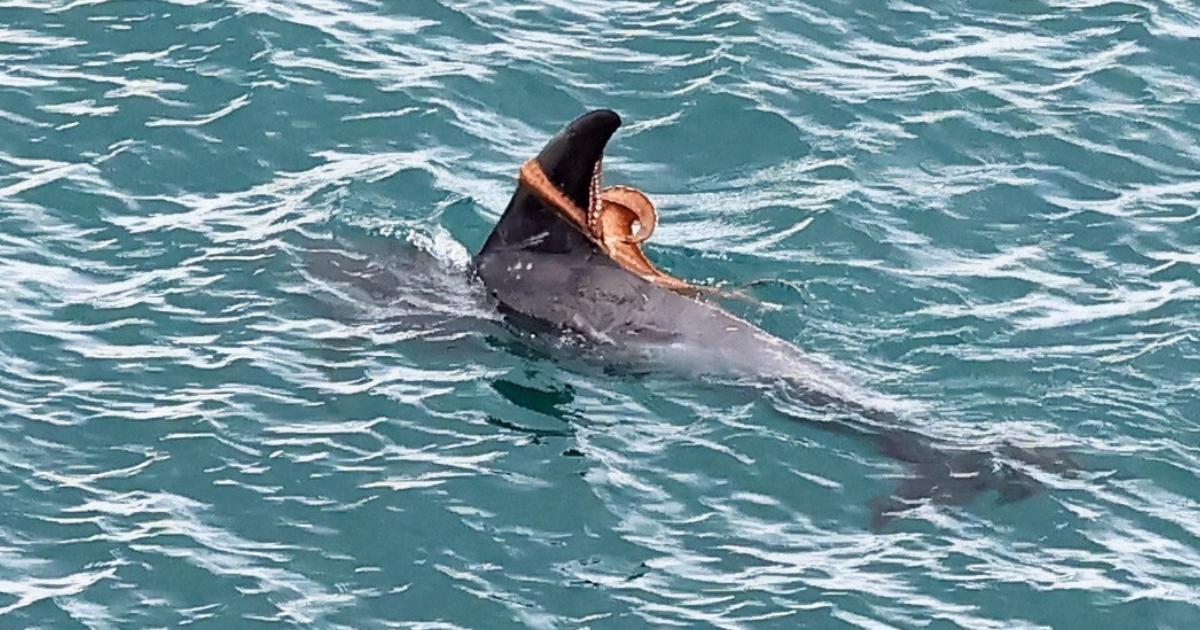
Photographs taken off Berry Head show a common octopus wrapping its arms around the dorsal fin of a Risso’s dolphin.
The sighting comes as researchers investigate unusually high numbers of common octopuses around the South-West coastline.
Photographs taken off Berry Head show a common octopus wrapping its arms around the dorsal fin of a Risso’s dolphin. (Image: Jam Press/Bill Coulson)
MSc researcher at the University of Exeter, Josh Symes, said: “These photographs offer a fascinating glimpse into the feeding ecology of Risso’s dolphins and the changing marine environment around our coasts.
“Risso’s dolphins are closely associated with cephalopods, and sightings like this help us understand how they are responding to changing prey availability.
“The images also highlight the value of citizen science, as observations from volunteers are helping us build a clearer picture of marine wildlife across the Southwest.”
While common octopuses are native to UK waters, they are typically rare. (Image: Jam Press/Bill Coulson)
Southwest coast experiencing largest Octopus bloom in 75 years
The encounter comes amid reports of the largest octopus bloom in at least 75 years along the southwest coastline.
While common octopuses are native to UK waters, they are typically rare.
The Marine Biological Association has described the 2025 bloom as exceptional in both size and spread.
Reports suggest the octopus surge may have originated from breeding grounds near the Channel Islands and northern France.
Ocean currents are believed to have carried juvenile octopuses into UK waters.
Researchers are now exploring whether the octopus boom is providing new feeding opportunities for Risso’s dolphins, who primarily feed on squid and other cephalopods.
Senior research fellow at the Marine Biological Association, Dr Bryce Stewart, said: “Observations of interactions between Risso’s dolphins and common octopus help to demonstrate how shifts in the abundance of a species can ripple through the wider ecosystem.
“It’s a powerful reminder of how interconnected our marine environment is and why we need to continue studying it.”
What has caused the large octopus bloom?
Warmer sea temperatures are thought to have played a major role in the bloom, raising concerns that similar events could become more frequent as the climate continues to change.
The South-West Marine Ecosystems State of South-West Seas in 2025 Report described the 2025 common octopus ‘outburst’ as ‘outstanding’ and noted that increased numbers had become a significant feature of the Southwest marine food web.
The report also recorded a continuing upward trend in effort-corrected Risso’s dolphin sightings, likely linked to higher numbers of cephalopods such as cuttlefish and octopus in coastal waters.
These changes are part of broader environmental shifts in the region, including warming seas, marine heatwaves, and altered distributions of marine species.
Recent research led by Nicola Hodgins, a visiting fellow at the University of Exeter and member of the marine charity Mara, found that Risso’s dolphins around the British Isles form a single genetically distinct population.
Researchers hope that continued monitoring of both species will help improve conservation efforts and provide a deeper understanding of how marine life is adapting to environmental change in UK waters.
Have you spotted any dolphins or octopuses off the Devon coast recently? Let us know in the poll above or in the comments below.