
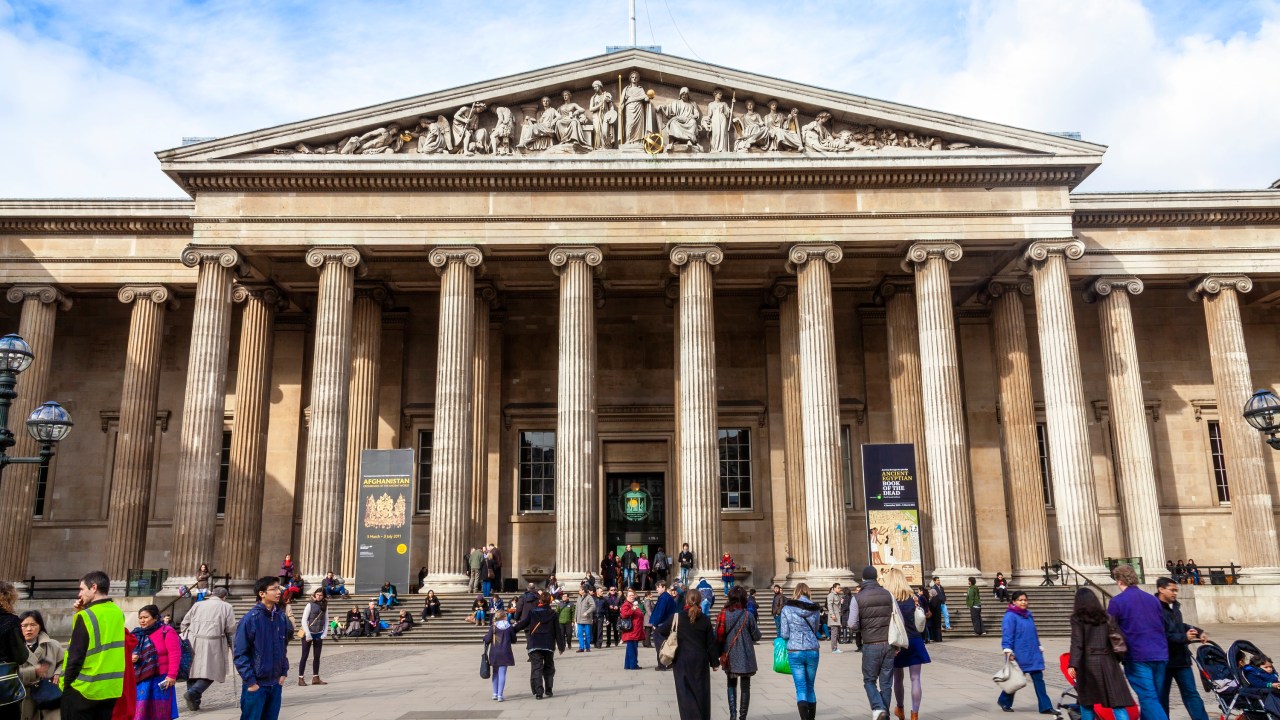
The Bayeux Tapestry has returned to England for the first time in nearly 1,000 years, triggering a phenomenal tourist boom in London.
The medieval masterpiece was also criticised as an exercise in chest-thumping machismo with references to soldiers’ dangly bits.
There were nearly $5 million worth of tickets to the show sold on the first day, with online booking queues peaking at more than 80,000.
Tickets to view the Romanesque treasure, on loan to the British Museum from France, are now sold out until the end of 2026.
However, the show continues until July 2027, with more tickets available soon.
The 70-metre-long tapestry, depicting events leading up to the Battle of Hastings and the Norman Conquest of England in 1066, is usually housed at the Musée de la Tapisserie de Bayeux in Bayeux, Normandy.
It is currently shut for renovations.
This monumental embroidery tells the dramatic story of England’s origins, beginning in 1066 with the Norman Conquest.
It was the last time England was successfully invaded.
It is also the year from which the modern monarchy dates itself.
The BBC said some historians saw it as an exercise in “chest-thumping machismo” replete with male appendages.
“A more testosterone-soaked scene is hard to find,” said Dr Christopher Monk, a cultural historian of medieval England.
This suggestive display of chest-thumping machismo reveals a medieval society made for and by men, where violence settles disputes and laddish humour scores political points, he said.
The BBC reported comments from experts noting the penis as a recurrent motif in the iconic artwork.
In his research, George Garnett, a professor at Oxford University, counted 93 specimens in the embroidery.
Eighty-eight belonged to horses, and another five to men.
Now, debate is raging in academic circles about a suggestive “pendulous scabbard” dangling from one horseman.
“The use of male genitalia, be it human or equine, is shorthand for political machismo,” Dr Monk said.
“Size matters on the Bayeux Tapestry,” observed Janina Ramirez in Femina: A New History of the Middle Ages, Through the Women Written Out of It (2022).
In the tapestry’s tale of bloody battles, virility is equated to power, and the largest and proudest appendage, she notes, “belongs to the fine stallion William is presented with on the eve of the battle”.
Second place goes to King Harold’s mount, “the implication being that he is a worthy opponent”.
Where did the tapestry come from?
No one knows for sure.
The masterpiece dates from the 11th century and was most probably commissioned by Bishop Odo of Bayeux, who wrote himself into the story and is depicted prominently on it.
The bishop was William the Conqueror’s half-brother, who helped fund the invasion, and he wanted the tapestry to decorate his cathedral at its consecration in July 1077.
The tapestry consists of 58 scenes, of which 25 scenes are in France and 33 in England.
There are 10 scenes depicting the Battle of Hastings.
Historians have suggested that the tapestry’s patrons—including Matilda, William’s wife, and Edith, the queen of the English king Edward “the Confessor”- engaged the monks of St Augustine’s monastery in Canterbury to embroider it.
They used dyed wool stitched onto a bleached linen background fabric.
The embroiderers used 10 shades of wool strings to bring depth and perspective to the work.
It shows 626 characters and 37 buildings, among them Mont Saint-Michel.
It depicts 41 ships and another 202 horses and mules.
Some of the tapestry’s imagery is almost certainly modelled on Canterbury manuscript drawings.
For example, the tapestry’s ships are similar to those in two Old English manuscripts, the Hexateuch and Junius 11, and a depiction of a man carrying a boulder is strikingly similar to one in an illustrated copy of the Latin poem Psychomachia by Prudentius.
The tapestry comprises pieces of linen fabric sewn together for a total length of 68.58m.
Whoever made it, the tapestry remains a precious visual record as well as a major work of art because it depicts England both before and after the Conquest, showing scenes ranging from warfare, castles, and ships to clothing, animals, food, and furniture.
The Bayeux Tapestry features on UNESCO’s “Memory of the World” register.
Read related topics:Travel