
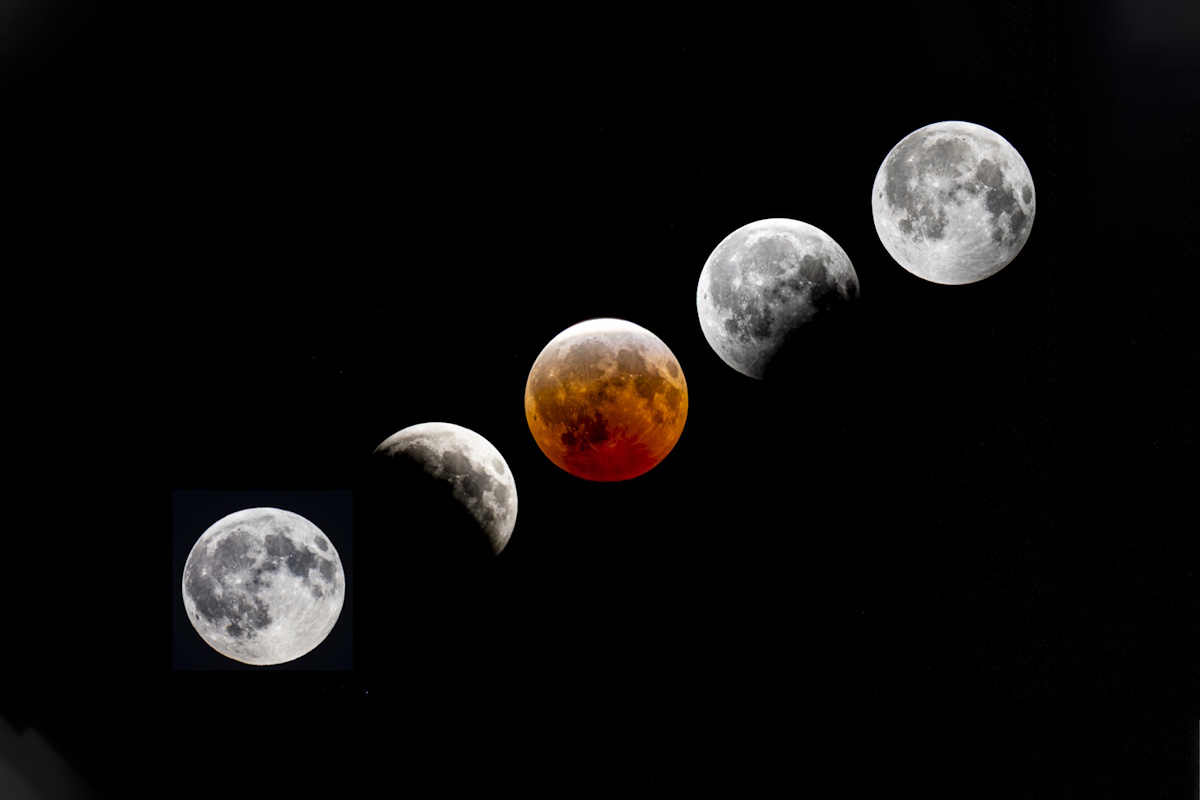
Sky conditions were nearly perfect Thursday night (August 27th) for skywatchers, amateur astronomers and photographers to capture the latest lunar eclipse to be visible over Southern Manitoba. That included Winkler’s Terrance Klassen.
“In our retirement years, my wife and I have continued to develop our passion for travel and particularly travel photography which began in early life some 55 years ago,” explained Klassen in an email to PembinaValleyOnline. “We now travel the world, and market our photography to the travel industry; for books, magazines, calendars, etc.”
A lunar eclipse is when the Moon passes into the shadow of Earth. According to NASA, as long as sky conditions allowed, the eclipse was visible in the Americas (except Alaska and northwestern Canada), western Europe and western Africa. The moment of greatest eclipse was approximately 11:13pm Central, well after sunset, meaning ample darkness to potentially capture some amazing photos.
Klassen noted they are constantly looking for opportunities to make images, “that are once in a lifetime”, and that was part of the decision to photograph the lunar eclipse.
“The opportunity to photograph the eclipse is one of those somewhat rare or unusual life occurrences that we, as photographers, take advantage of,” he said. “Even though I don’t specialize in astrophotography, I have photographed both lunar and solar eclipses previously.”
What is a lunar eclipse, and how did he photograph?
The penumbra is the part of Earth’s shadow where the Sun is only partially covered by Earth explained a description of the event on NASA’s website. The effect of the penumbra on the Moon’s appearance is subtle. But after the partial phase began, at 2:34 UTC (9:34 p.m. CDT on the night of the 27th), the umbra’s dramatic effect was easily visible as it took an increasingly large bite out of the disk of the full Moon. Less than an hour later, the part of the Moon still in sunlight was small enough for observers’ eyes to adapt to darkness and perceive the coppery color of the part of the Moon within the umbra.
Klassen noted eclipse photography is somewhat specialized, but it’s not overly difficult, pointing to the weather needing to cooperate with clear skies, minimal haze and few clouds. He said the sky conditions Thursday evening were perfect.
“Ideally you should have a high resolution camera with a long lens such as 300 mm, or larger, to capture detail on the moon’s surface during the eclipse phases and during totality,” he said. “When you use long lenses, a good sturdy tripod is necessary for the long exposures that are required to render the moon’s ‘red’ surface which is in shadow.”
Klassen stressed camera settings are also crucial in eclipse photography.
“Meaning we need to bracket our exposures in manual mode, because the intensity of illumination varies greatly from full moon to totality,” he suggested. “For this eclipse I used a 61 megapixel Sony mirrorless camera with a 600 mm lens.”
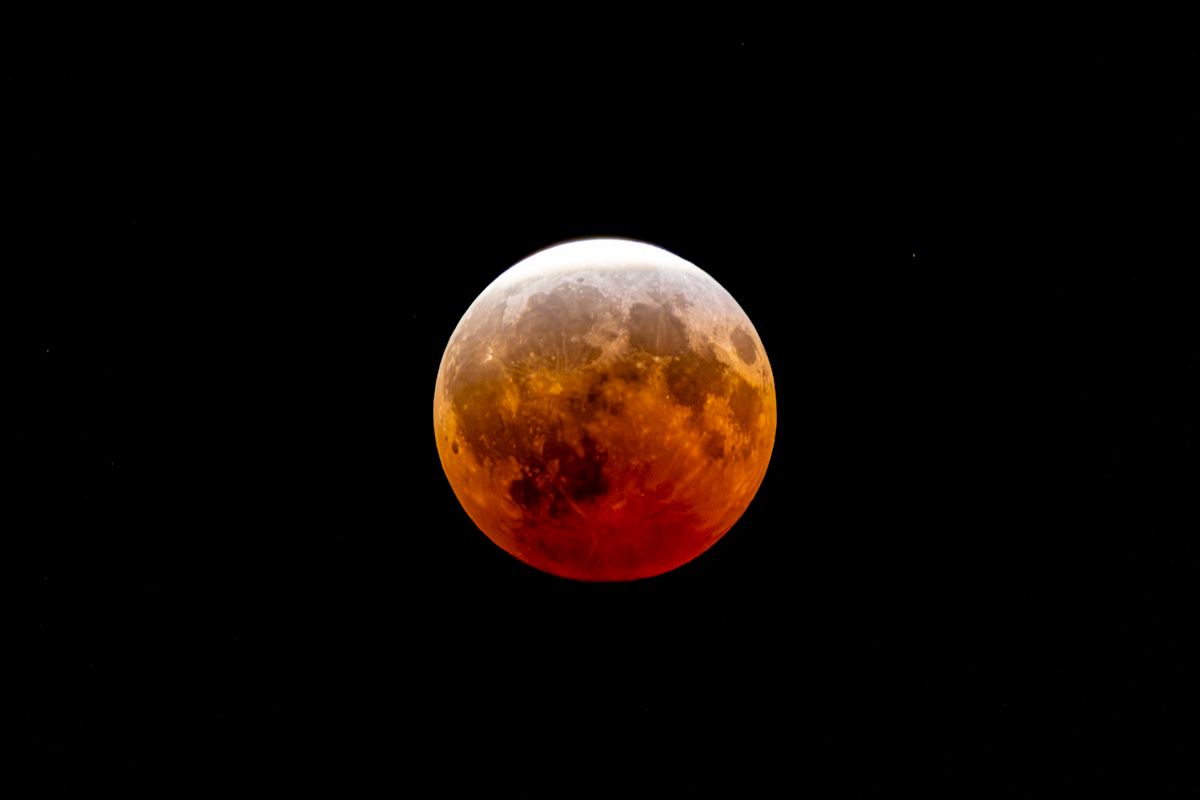 Another image of last night’s lunar eclipse; the moon 96.2% covered by the earth’s shadow.
Beauty of God’s creation
Klassen shared, in astrophotography and eclipse photography, the immensity and vastness of the universe cannot go unnoticed.
“When we look up into the sky in awe with its billions of stars, galaxies, planets and moons, we realize we are but a tiny blip in everything God has created,” he said.
These photos are just the latest in a life long photography journey for Terrance and his wife, which includes shooting in over 100 countries, some the couple has visited as many as four times.
“We still have a long list of countries or events we would like to photograph, but in the short term, we will do Fall colour photography again this Fall, and we are presently researching the exotic island of Bali sometime soon.”